Vladan Joler
Prof. dr. Vladan Joler (1977) is an academic, researcher and artist whose work blends critical and system design, data investigations, counter-cartography, data visualization, and numerous other disciplines. He explores and visualizes different technical and social aspects of algorithmic transparency, digital labour exploitation, invisible infrastructures and many other contemporary phenomena in the intersection between technology and society.
In 2023, in collaboration with Kate Crawford, he published Calculating Empires, a large-scale research visualization exploring how technical and social structures have co-evolved over five centuries. In 2018, also with Kate Crawford, he published, Anatomy of an AI System, a large-scale map and long-form essay investigating the human labor, data and planetary resources required to build and operate an Amazon Echo device.
As co-founder and director of the SHARE Foundation - one of the leading expert and activist organizations in the field of digital rights in Southeast Europe - Vladan has played an active role in organizing, researching, creating, and advocating for public policies at the national, regional, and European levels. His earlier study Facebook Algorithmic Factory included deep forensic investigations and visual mapping of the algorithmic processes and forms of exploitation behind the world’s largest social network. Other studies he authored, published in recent years by the independent research collective SHARE Lab, have examined information warfare, metadata analysis, browsing history exploitation, surveillance, and Internet architecture.
He has curated and organized numerous events and gatherings of Internet activists, artists and investigators, including SHARE events in Belgrade and Beirut. His artistic pre-history is rooted in media activism and game hacking.
He has received numerous awards, including the Silver Lion at the 2025 Venice Architettura Biennale, S+T+ARTS 2024 Grand prize of the European Commission, 2019 Design of the Year Award by the Design Museum in London.
Vladan Joler’s work is included in the permanent collections of the Museum of Modern Art (MoMA) in New York, the Victoria and Albert Museum Design Museum in London, and the Rijksmuseum in Twenthe, and also in the permanent exhibition of the Ars Electronica Center. His work has been exhibited in more than a hundred international exhibitions.

Selected Works
Reverse Contradictionary
2025
Book
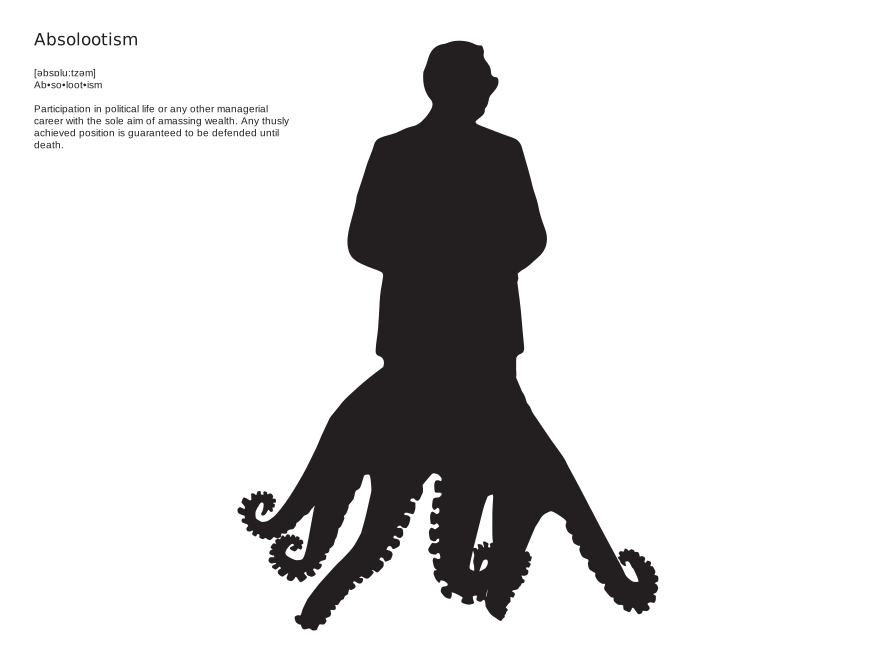
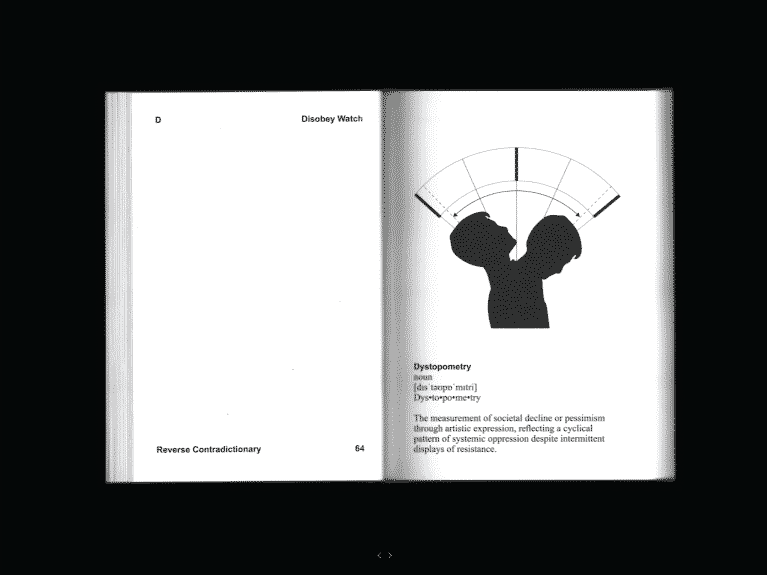
The entire cultural output of humanity is being fed into AI. Large Language Models are ingesting not only books, articles, and blogs in their entirety, but also the content of our private written and spoken conversations. LLMs are boiling lakes and burning down forests to generate texts based on statistical mediocrity, which we are supposed to worship as the beginning of a great new gilded age.
This is where Reverse Contradictionary comes into play — a collaborative effort by critical media titans Vuk Ćosić, IOCOSE and Vladan Joler. Their new “Dictionary of New Worlds” presents selected confrontational neologisms that, with acute insight and subtle provocation, challenge and overturn the predatory, algorithmic logic embedded in statistical language.
With a preface by Yes Men and a terrifying blurb by real Slavoj Žižek.
>

>
>
Testimonies of Police Brutality
2025
Data Collection Investigation Database Installation
TE
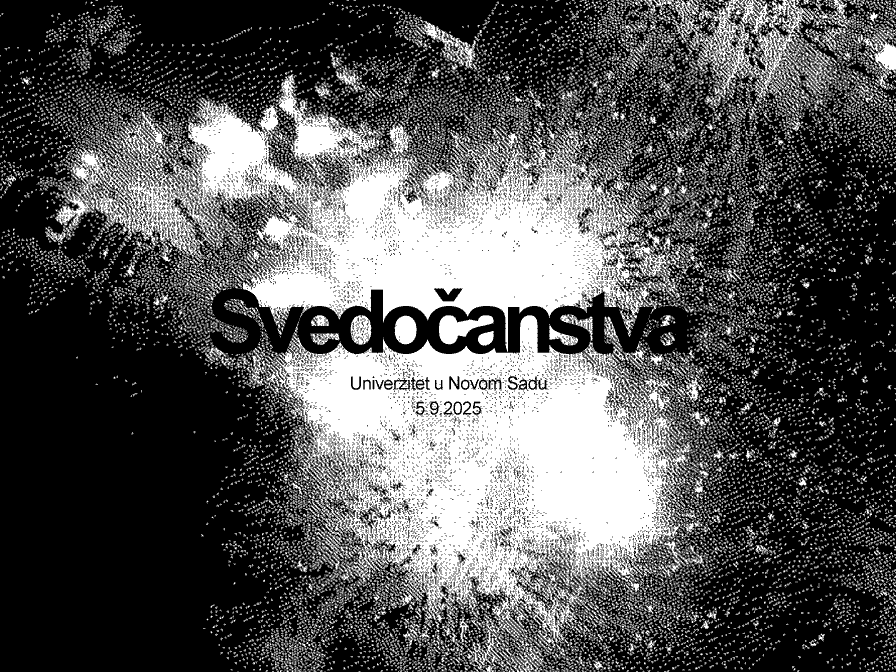
“Testimonies of Police Brutality” were created through research and an artistic installation, based on anonymous accounts of various forms of repression-physical violence, the use of pyrotechnic and chemical agents, as well as the detention of citizens against their will. These events took place during the night of September 5–6 on the campus of the University of Novi Sad, targeting students, professors, and citizens.
The peaceful student protest was a response to the gross violation of the university’s autonomy, guaranteed by the Constitution and law. Continuing the practice of art that engages in (re)interpretation and (de)construction of memory, the collected testimonies become a case study and the foundation of a unique database-an archive of accumulated information and knowledge. The artistic research thus becomes a resource for recontextualizing current events and a form of symbolic capital which, through public accessibility, gains social power and the potential to challenge dominant narratives.
>
Testimonies of the sonic weapon attack
2025
Data Collection Data Investigation Database
TE
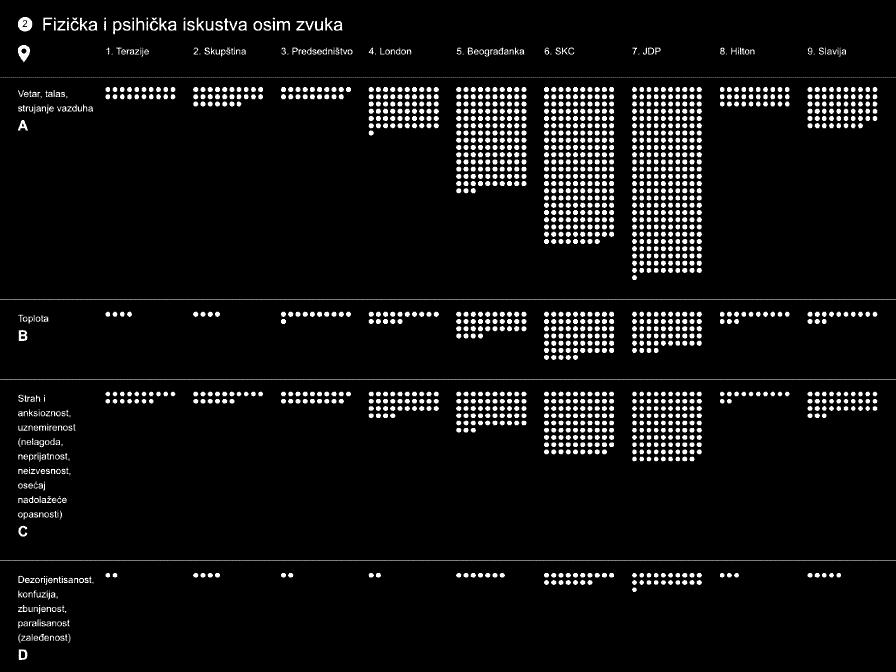
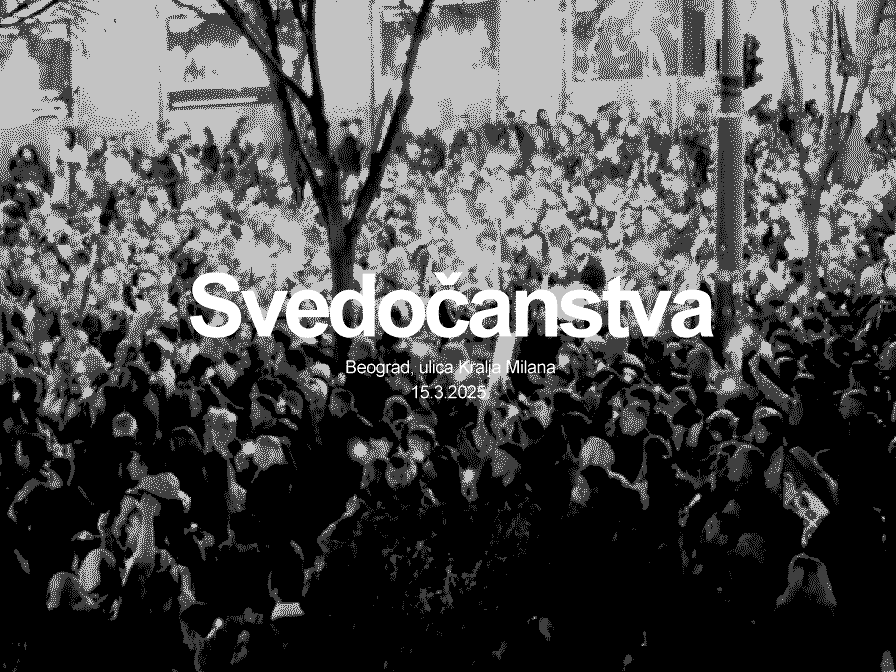
During a peaceful protest on March 15, 2025, in Belgrade, which was attended by several hundred thousand citizens, at 7:11 p.m., during a fifteen-minute moment of silence, a disturbing sound incident occurred. An unknown crowd-control device unsettled the protesters and triggered a sudden stampede, panic, and physical injuries. Most often described as a loud roar resembling that of an airplane or a train, sometimes accompanied by a wave of heat, the event provoked various reactions. Thousands citizens reported psychological and physical effects, hundreds of which have been medically documented. During the 48 hours following the incident, we collected more than 3,500 testimonies. Within two weeks, we organized, analyzed, and transformed them into a data-driven storytelling platform.
>
>
Calculating Empires
2023
Large scale map Installation
CE
*
Silver Lion La Biennale di Venezia 2025 S+T+ARTS Prize European Commission 2024 Boghossian Foundation International Prize 2025 Acquisition Rijks Museum Nederlands 2025 Commission Fondazione Prada 2023
A Genealogy of Technology and Power Since 1500
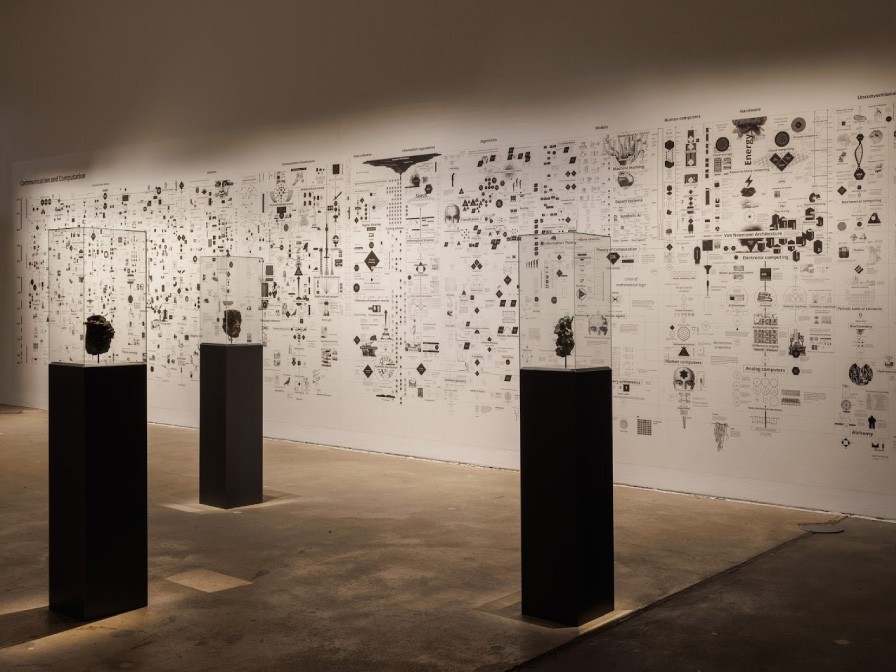
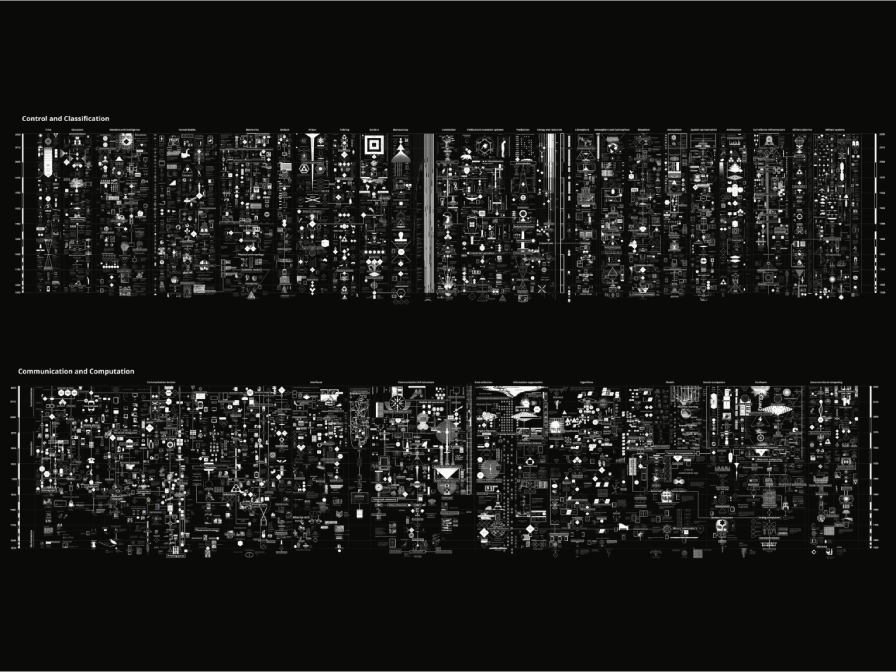
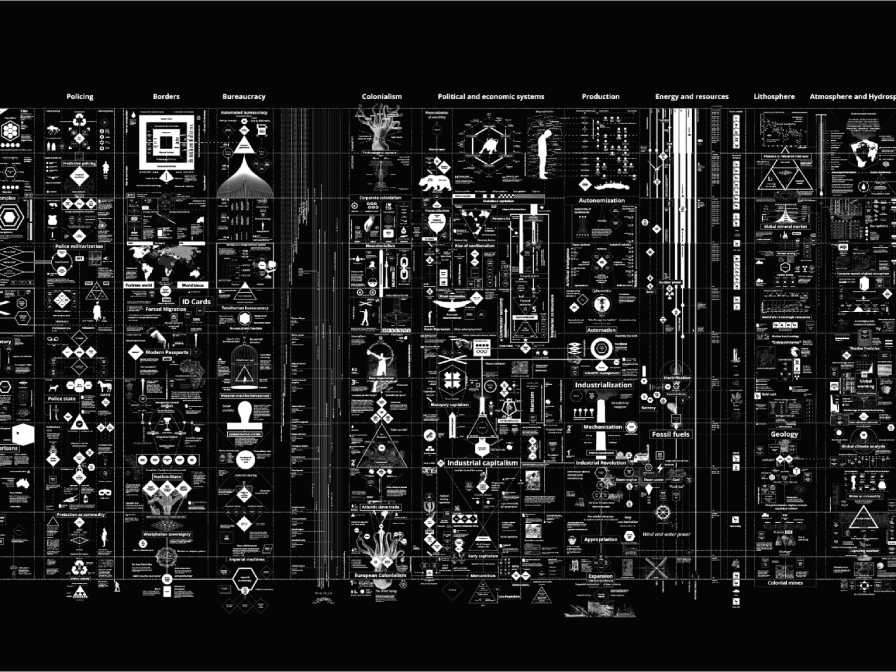
How can we understand the power of technology in the contemporary moment and its role in our lives? What are the historical precedents and patterns that explain how we got here? Calculating Empires is a large-scale evolving artwork that traces the histories, practices, and politics of technology since 1500. The work gives people a different way of seeing the current technological transformations with greater historical depth: our era is the result of long arcs of industrialization, imperialism, scientific revolutions, political revolts, and capitalist extraction. Calculating Empires contextualizes these shifts into an intricate and immersive mural that depicts the myriad ways that power and technology have been intertwined over five centuries, in order to better understand the dramatic changes currently underway.
>
>
>
Black Box Cartography
2023
Book
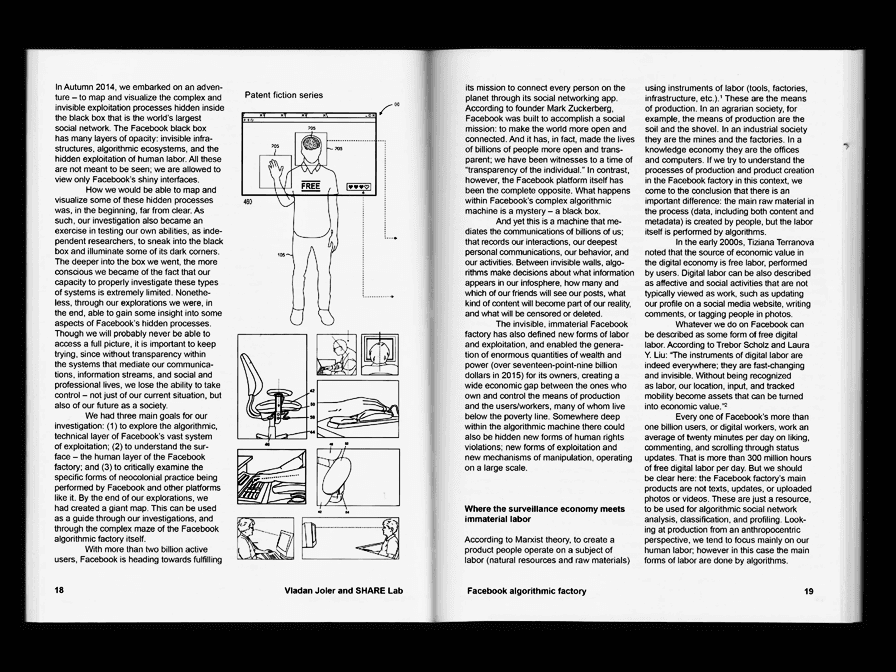
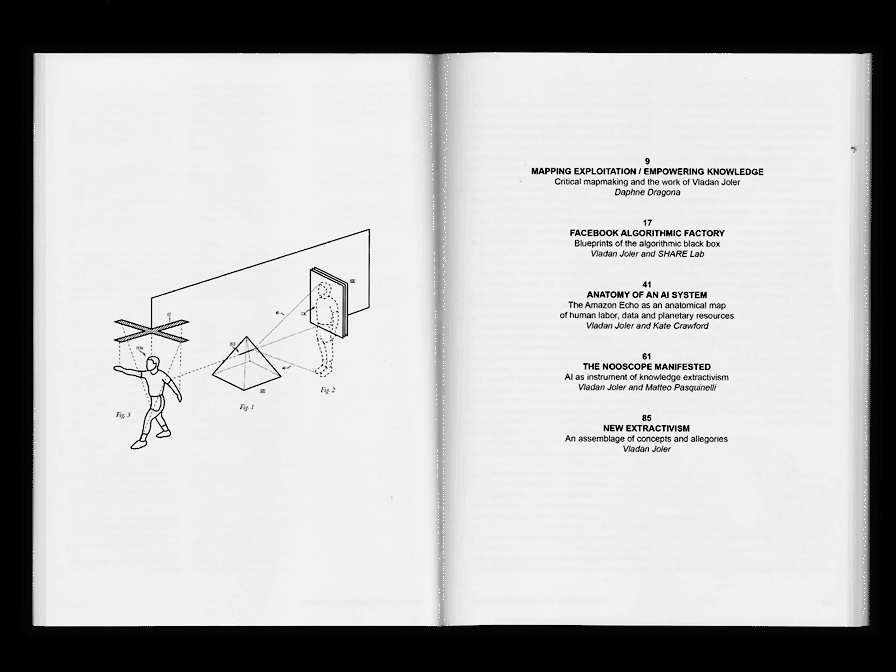
Our online environment has become increasingly populated by artificial agents of various forms. Our ability to understand and investigate such systems is becoming increasingly important as more and more processes in our lives are moderated by AI-based technologies and complex algorithms. However, our understanding of them is still extremely limited. Over the past few years, Vladan Joler has been working (with the help of a network of data analysts, media theorists and cyber forensic experts) to bring to light some of the hidden layers of these systems. Joler’s representational tactics take us into the depths of today’s technological ecosystems. Drawing on the tradition of critical cartography, his maps attempt to unfold the black box of digital infrastructures. Black Box Cartography presents, for the first time together, Vladan Joler’s most important projects.
>

>
>
Infrastructure of a Migratory Bird
2022
Research Map
MB
*
Acquistion City of Zurich, Art Collection 2023
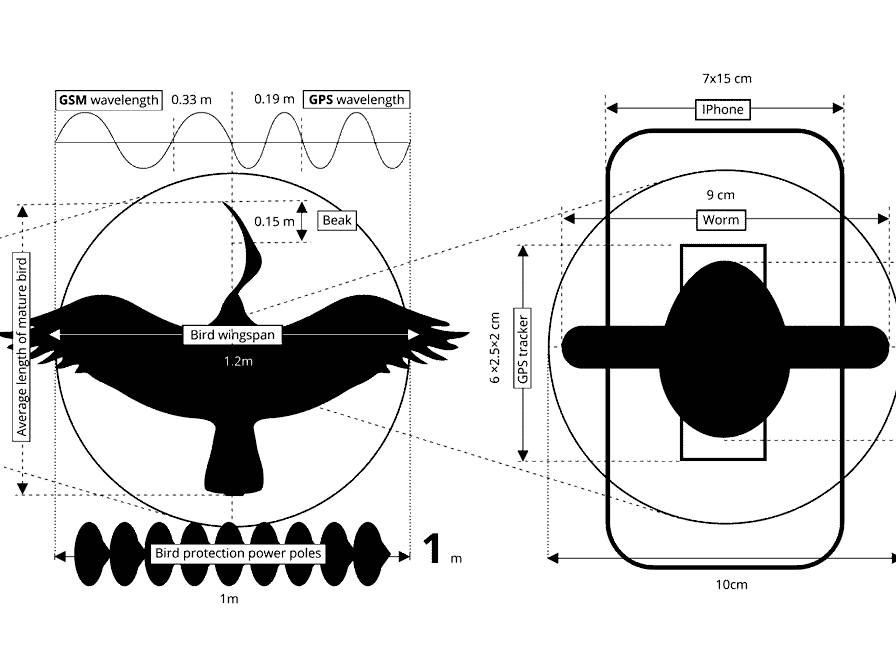
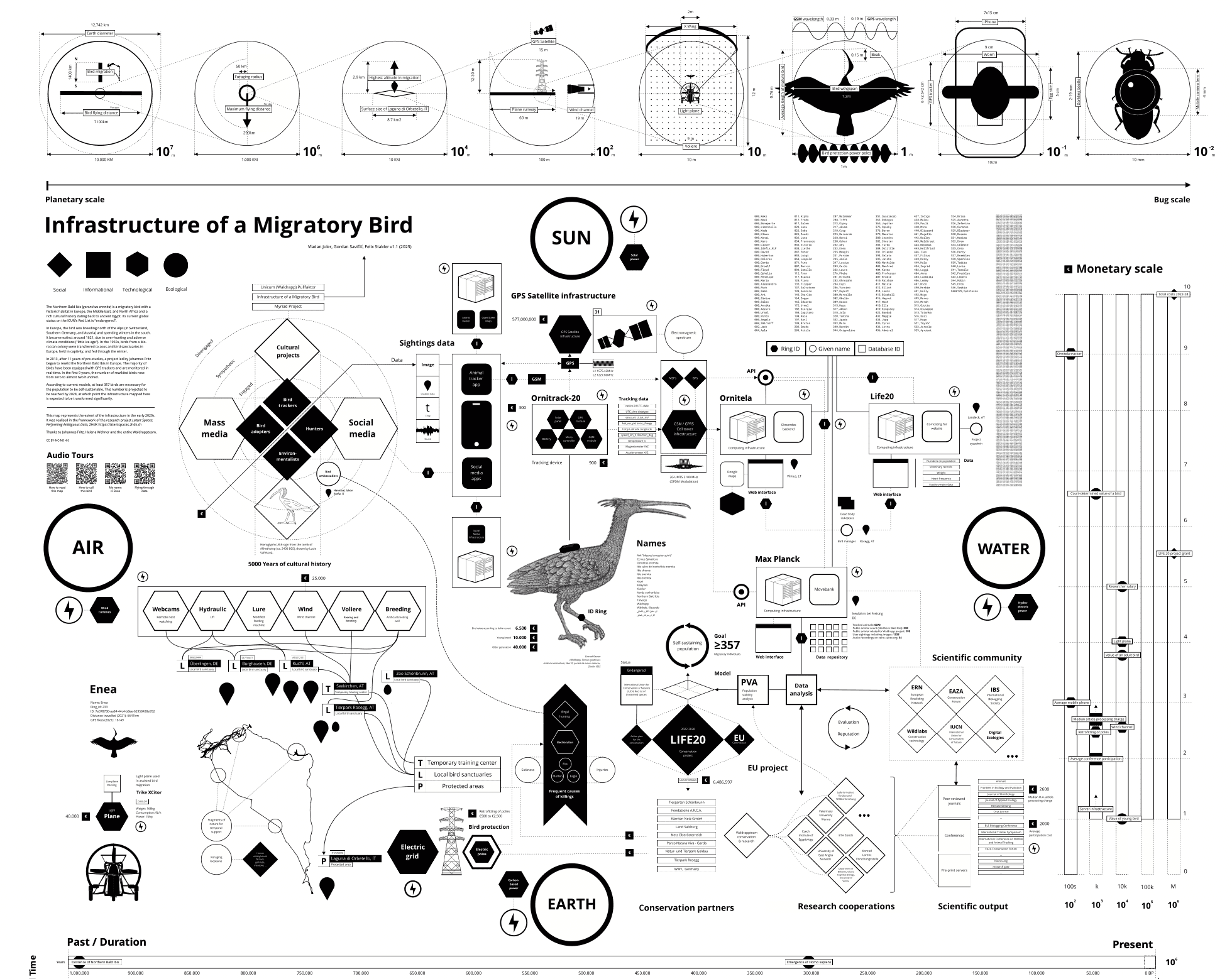
Infrastructure of a Migratory Bird map shows relationships between social, technological, informational, and ecological elements which make up the anthropogenic ecosystem in which the bird is becoming wild again. It is divided into four quadrants. Top left are elements shaping the public’s understanding of and relationship to the bird. The top right comprises elements generating real-time data flows through which the birds are monitored and the rewilding project makes sense of itself. Bottom left are discontiguous locales connected and adapted to make room for the bird. Bottom right are institutional networks that make up the project, provide funding, and negotiate scientific value. The scales show the spatial, monetary, and temporal dimensions of many of the elements that make up the relational graph. Thus, the scales provide another way of understanding these elements.
>
>
>
Knowing Machines
2020-2023
Research
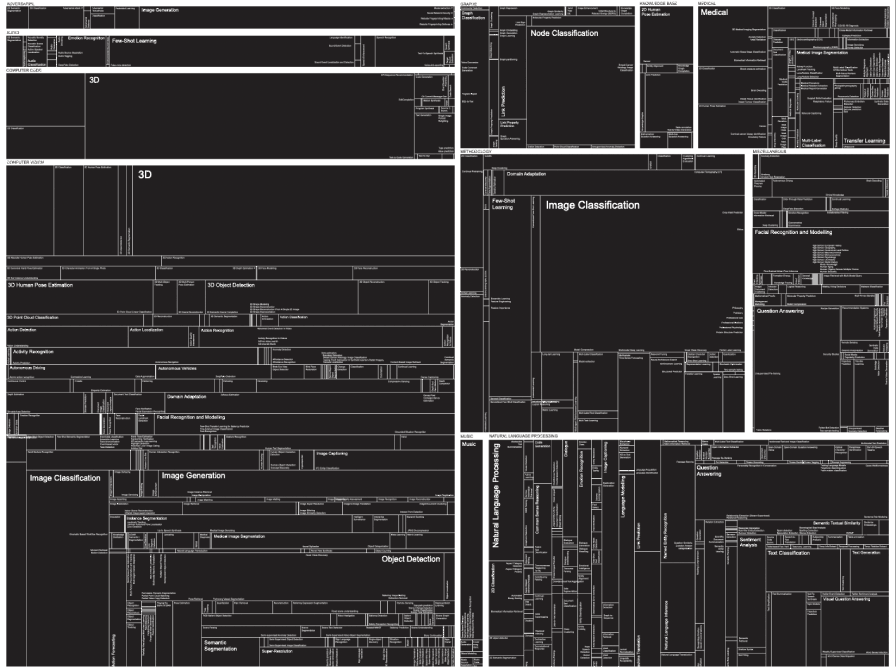
Knowing Machines is a research project tracing the histories, practices, and politics of how machine learning systems are trained to interpret the world. We are developing critical methodologies and tools for understanding, analyzing, and investigating training datasets, and studying their role in the construction of “ground truth” for machine learning. Our research addresses how datasets index the world, make predictions, and structure knowledge cultures. Working with an international team, we aim to support the emerging field of critical data studies by contributing research, reading lists, research tools, and supporting communities of inquiry that are focused on the foundational epistemologies of machine learning.
With Mike Ananny, Tamar Avishai, Cristo Buschek, Kate Crawford, Melodi Dincer, Hannah Franklin, Jake Karr, Sasha Luccioni, Will Orr, Jason Schultz, Hamsini Sridharan, Jar Thorp, Michael Weinberg, Sarah Ciston, Frances Corry, Annie Dorsen, Edward Kang, Nicola Morrow and Talya Whyte.
>
>
>
A Critical Field Guide for Working With Machine Datasets
2023
Publication
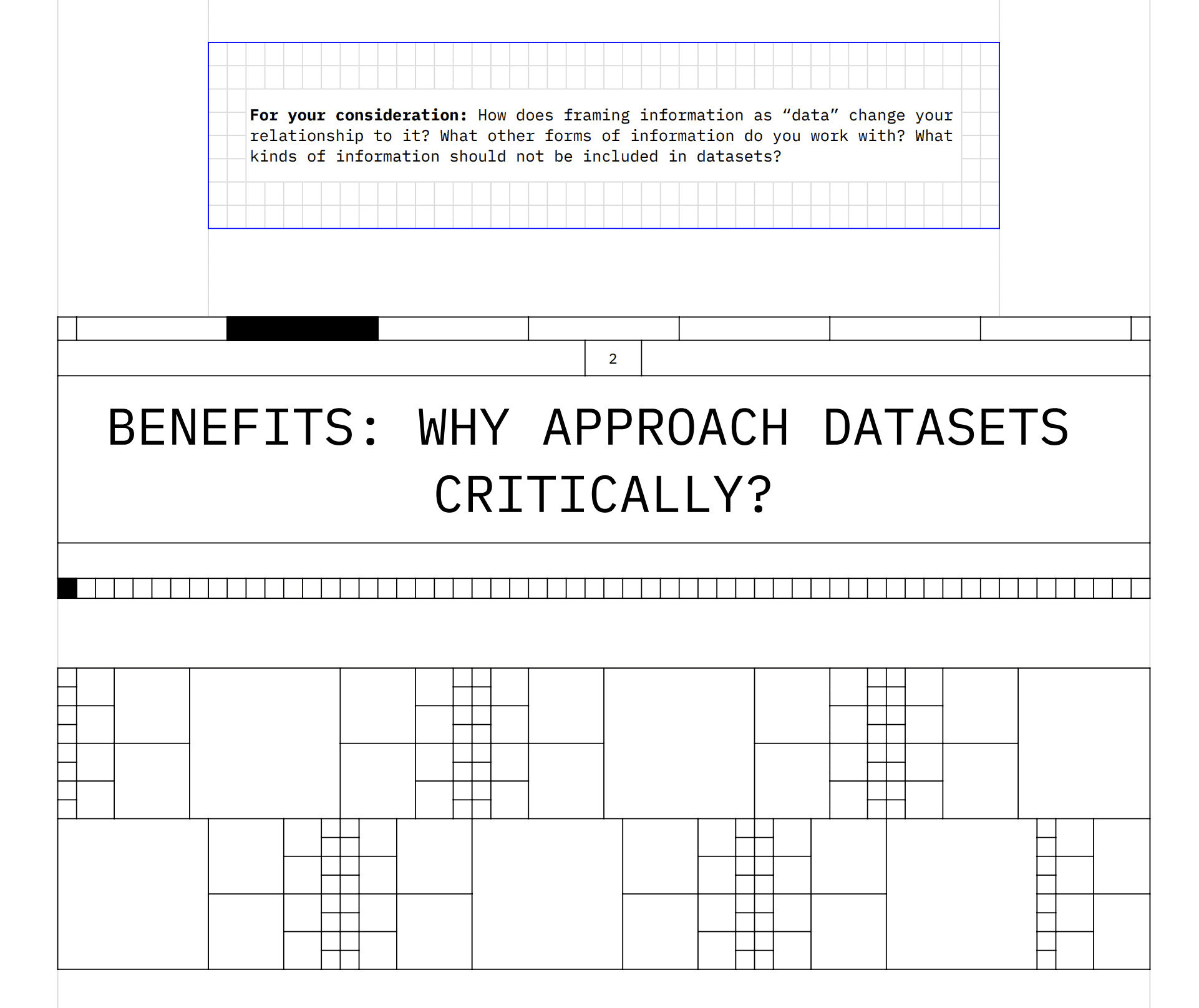
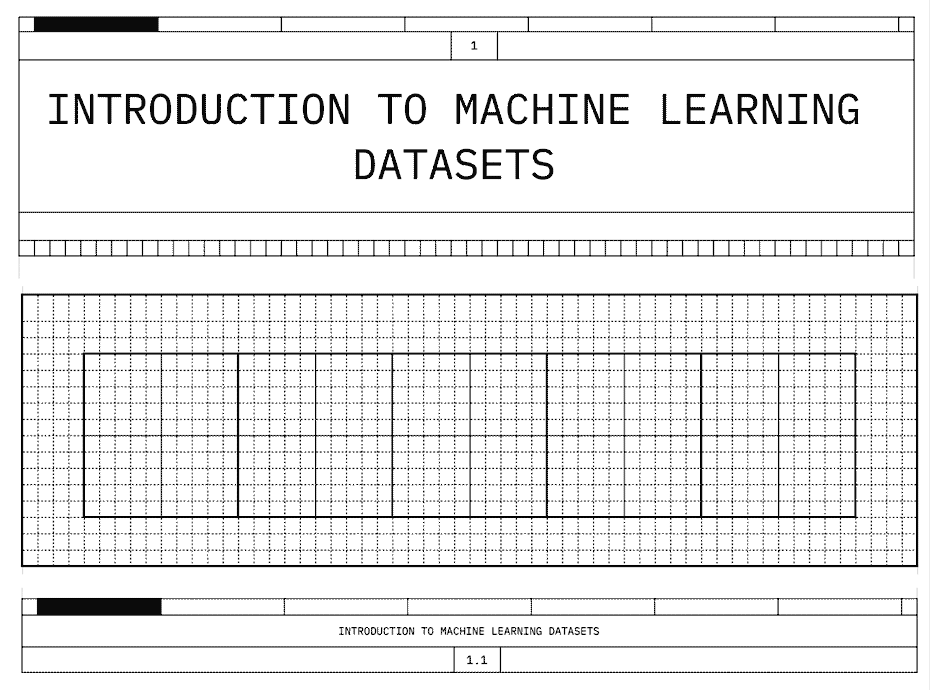
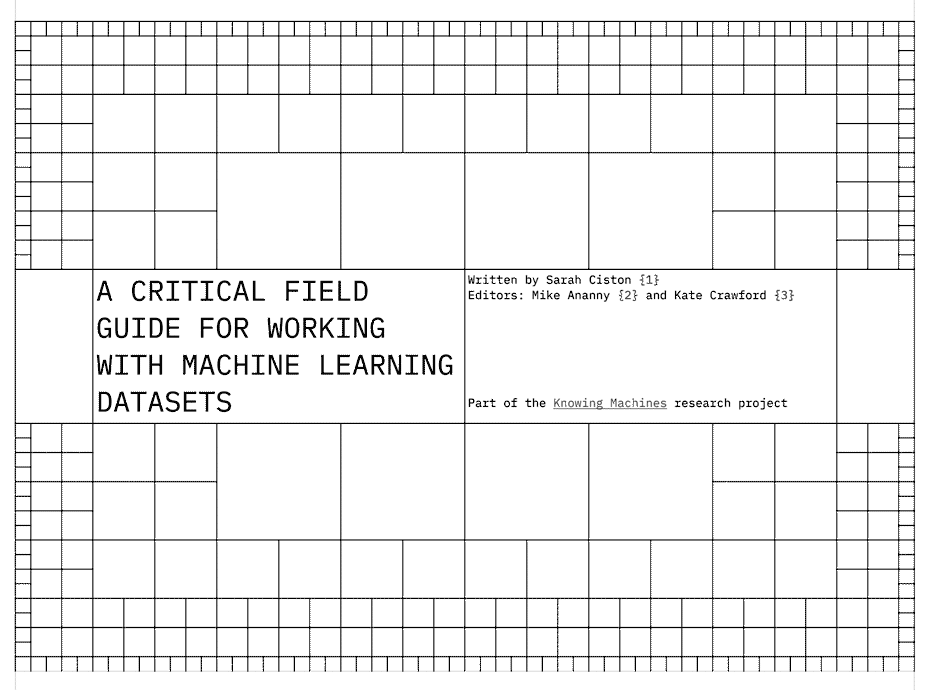
As a part of the Knowing Machines research project, we designed Sarah Ciston’s “A CRITICAL FIELD GUIDE FOR WORKING WITH MACHINE LEARNING DATASETS”. In the tradition of the early net.art experimentation, this Guide was entirely created within a spreadsheet. This experimental design concept is exploring possibilities and constraints of the spreadsheet as a medium that plays an important role in the creation of the machine learning datasets. The illustrations, inspired by early modernism and optical art, play with the idea of a "bureaucratic modernism"–style of art, fitting for an age where everyone is expected to take on the roles of both manager and bureaucrat.
>
>
>
E-Relevance
2021
Book
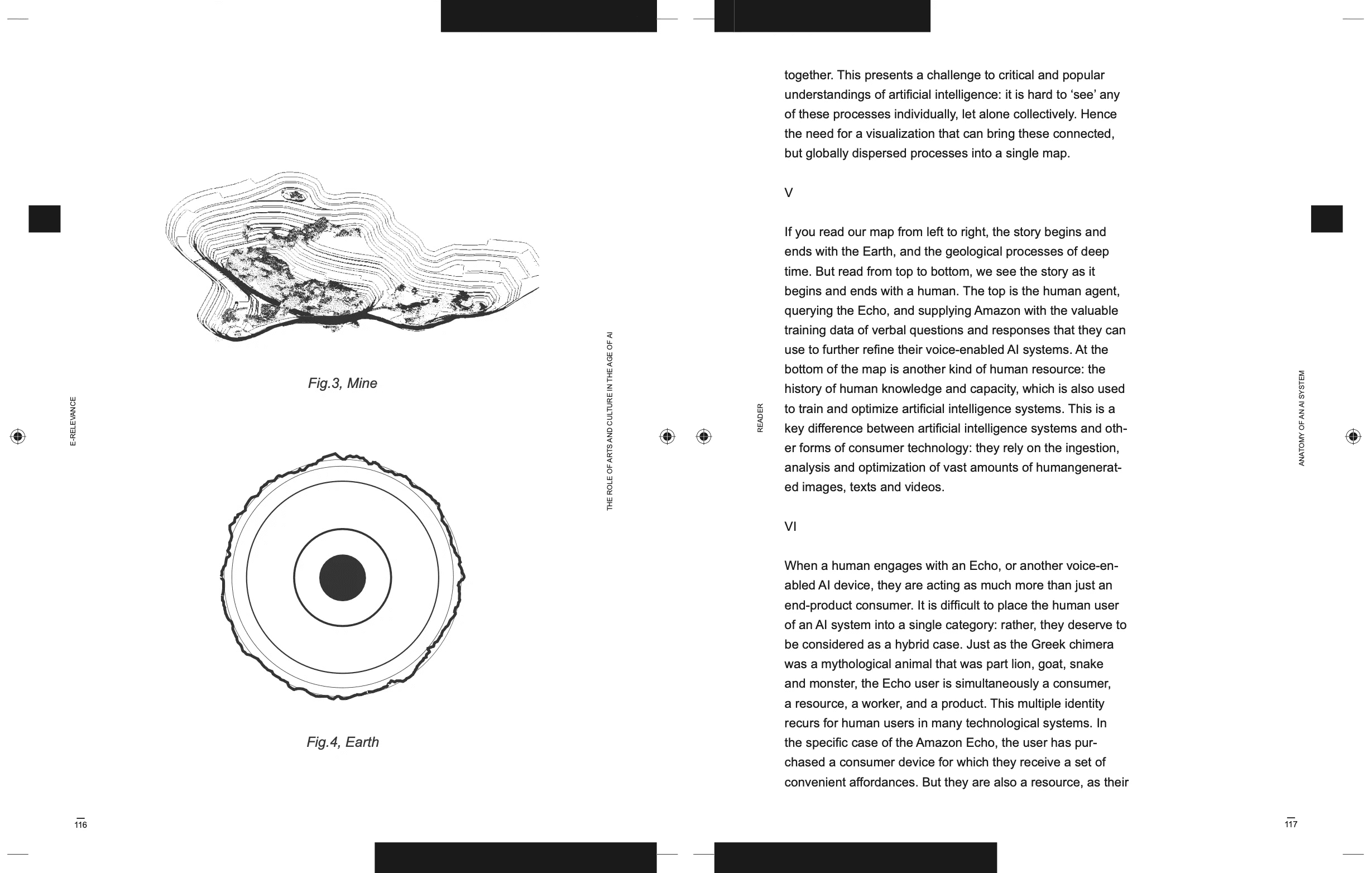
This publication is about humans and their preferably democratic future living with machines, in addition to the role that the arts and culture play in this complex environment. The renowned contributors suggest that the public dialogue concerning our shared future needs to be broadened. Just as in past periods of rapid technological progress, contemporary creators and thinkers are now tapping into the excitement of artificial intelligence (AI) and inviting us to critically reconsider the complexities of the human condition and the ambiguity of our relationship with science and technology. Both academic reflections on AI and insights into AI-powered artistic expressions will provide readers with entry points to further investigate what algorithms can and should do for society and the planet.
>
>
>
The Nooscope Manifested
2020
Research Map
NO
AI as Instrument of Knowledge Extractivism
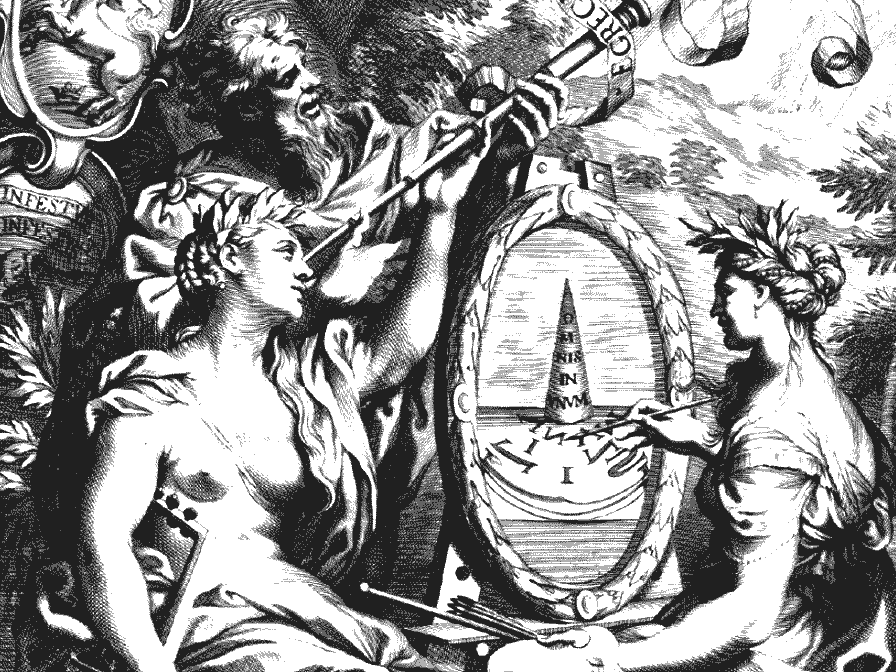
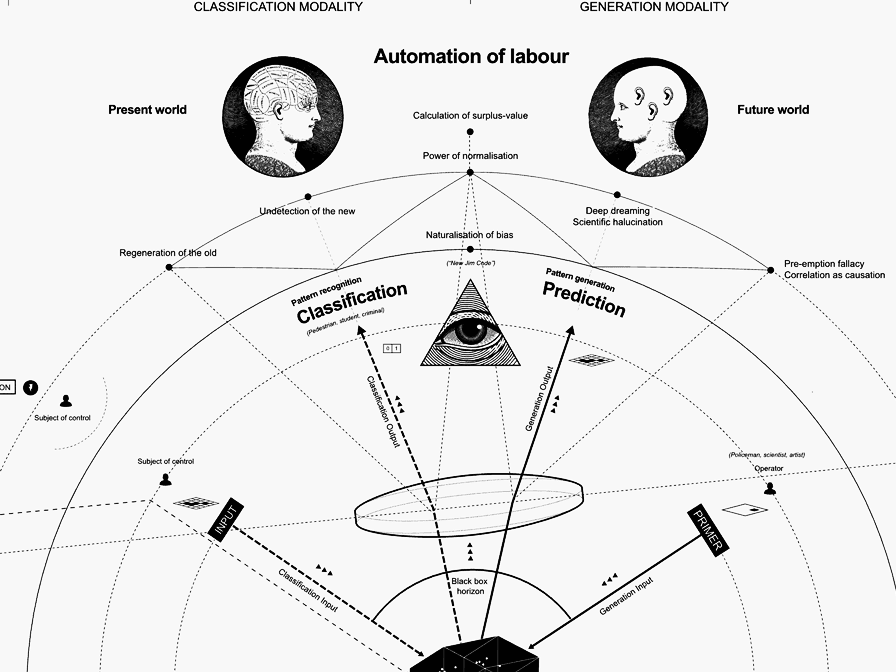
The Nooscope is a cartography of the limits of artificial intelligence, intended as a provocation to both computer science and the humanities. Any map is a partial perspective, a way to provoke debate. Similarly, this map is a manifesto — of AI dissidents. Its main purpose is to challenge the mystifications of artificial intelligence. The purpose of the Nooscope map is to secularize AI from the ideological status of ‘intelligent machine’ to one of knowledge instrument. Rather than evoking legends of alien cognition, it is more reasonable to consider machine learning as an instrument of knowledge magnification that helps to perceive features, patterns, and correlations through vast spaces of data beyond human reach. Borrowing the idea from Gottfried Wilhelm Leibniz, the Nooscope diagram applies the analogy of optical media to the structure of all machine learning apparatuses.
>
>
>
New Extractivism
2020
Map Essay Video
NX
An assemblage of concepts and allegories
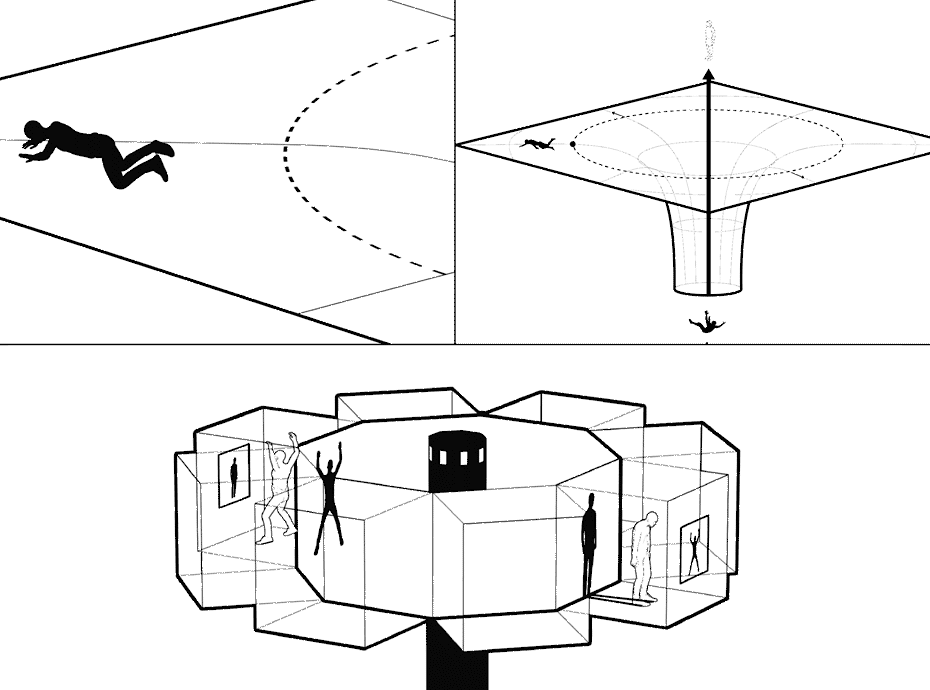
New Extractivism is a cartographic project that can be understood as a titanic effort to outline interconnections and to make sense of our contemporary reality. The project can be understood as an “assemblage of concepts and allegories”, drawn from a variety of resources: statistical research and data mining, ancient and contemporary philosophy, media theory and fiction, sociology and economics. Pierced together, these fragments take the form of a map, a manual and a video animation that guide the viewer through the traps, tunnels and slippery corridors of a world-scale infrastructure designed to extract, collect, quantify, analyse and connect all aspects of reality and turn them into capital: new accumulations of wealth and power concentrated in a very thin social layer dominated by a few global mega-corporations.
>
Architecture of the Face Recognition System
2020
Research Citizen action Advocacy Map
FR
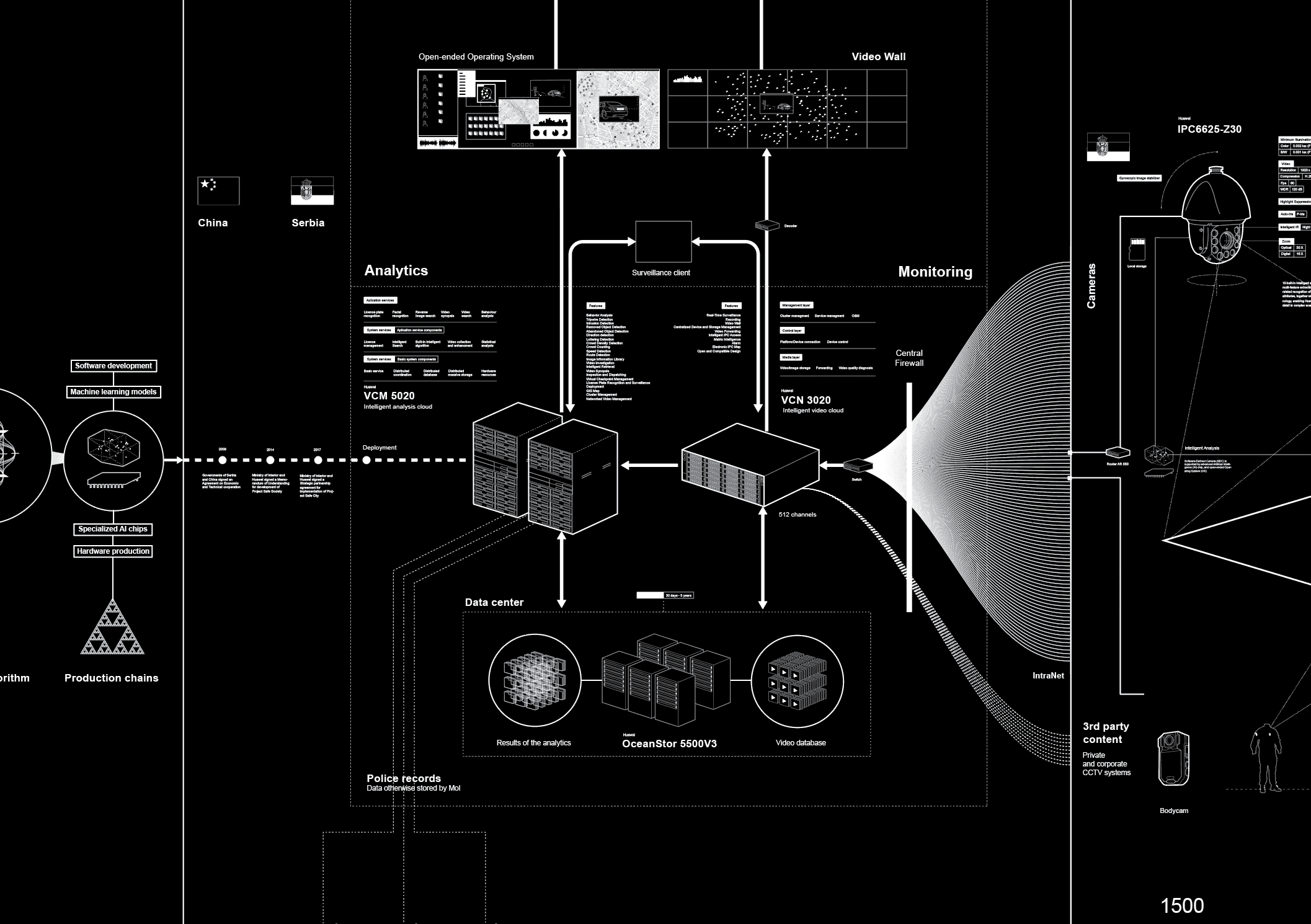
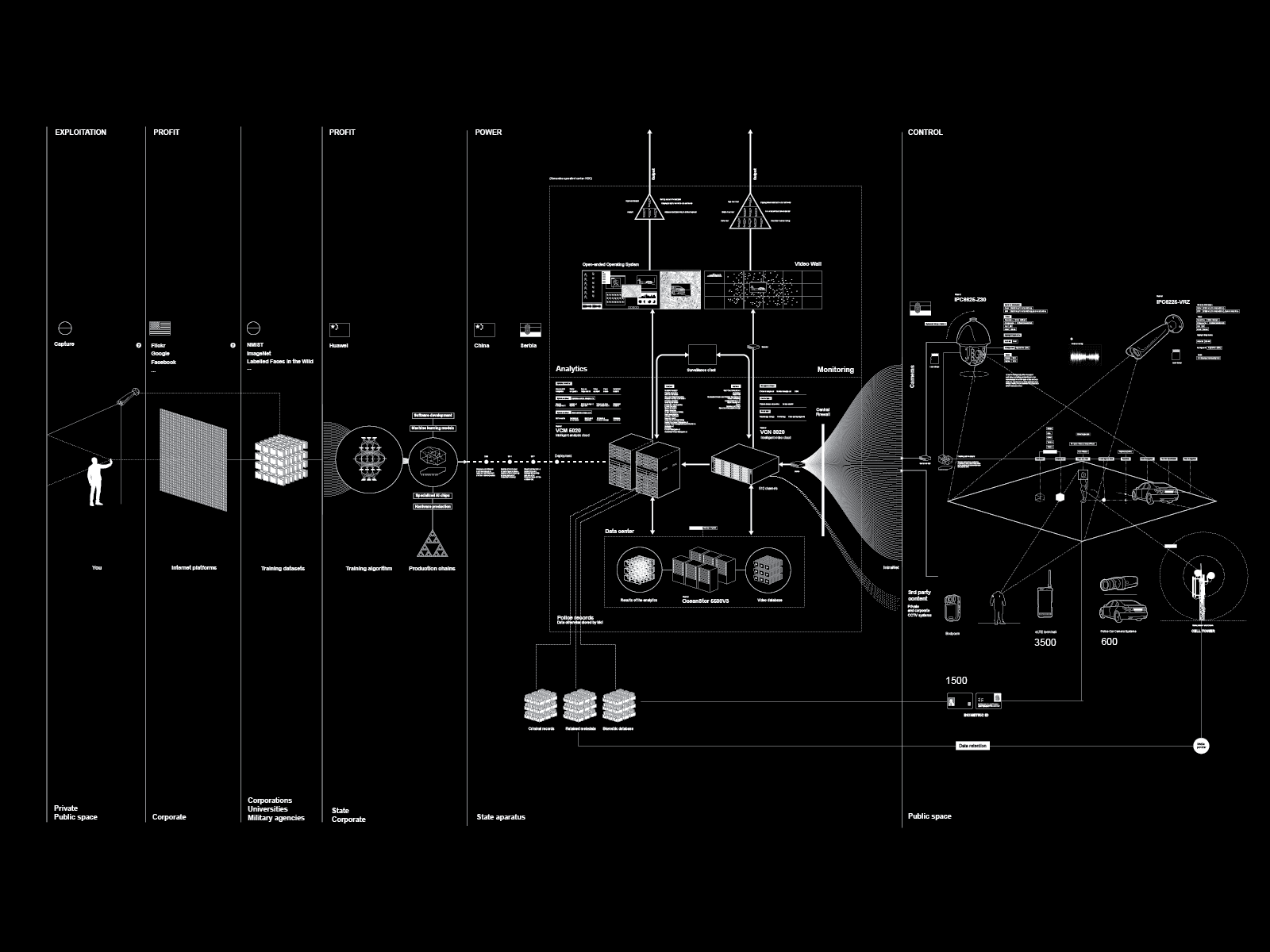
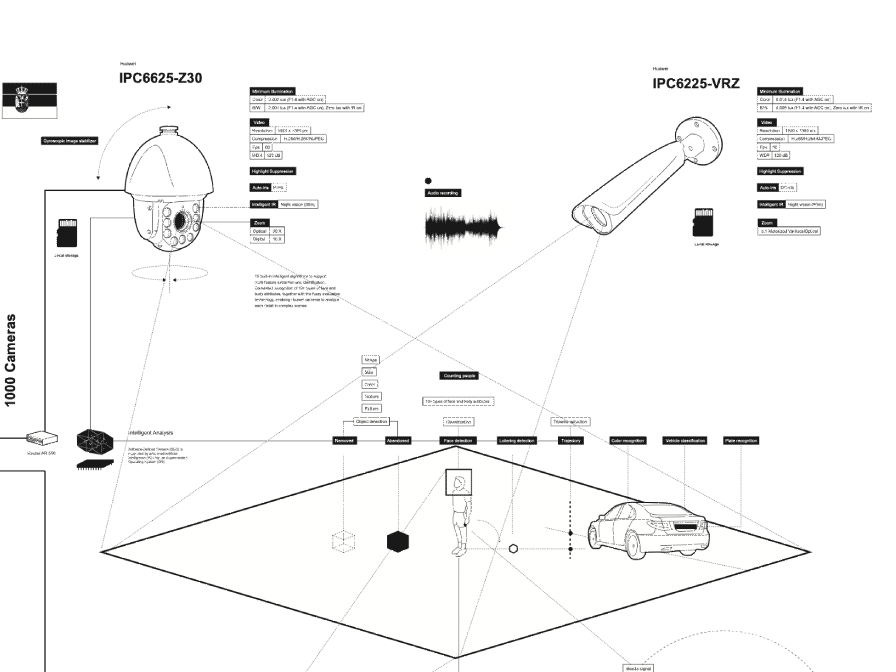
Belgrade has become the first city in Europe to implement a biometric mass surveillance system across its entire territory, following the Serbian government’s secretive purchase of a facial-recognition system from Huawei with minimal public disclosure. In response, Hiljade Kamera (“Thousands of Cameras”) emerged as a civic initiative and online platform led by activists, digital-rights organizations, and citizens to document, map, and critically examine the rapid and opaque rollout of “Safe City” surveillance technologies in Serbia. Through crowdsourced investigation and the analysis of patents, official documents, and publicly available technical data, the project has revealed far more cameras than authorities acknowledged, exposing serious gaps in transparency, legal oversight, and public debate, while highlighting the risks posed to privacy and civil liberties. The project also produced a detailed investigative map that visualizes not only the local deployment of surveillance cameras but also the broader technical, political, and corporate infrastructures connecting Serbia’s system to global networks of power and control.
>
>
>
Critical Cartography of The Internet and Beyond
2019
Book
Unauthorized Blueprints
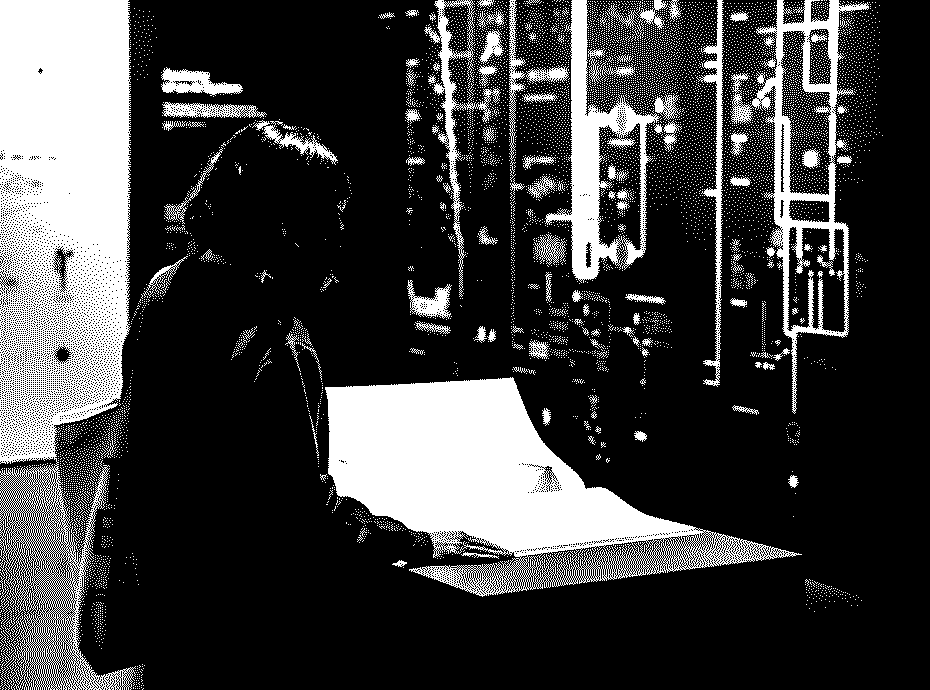
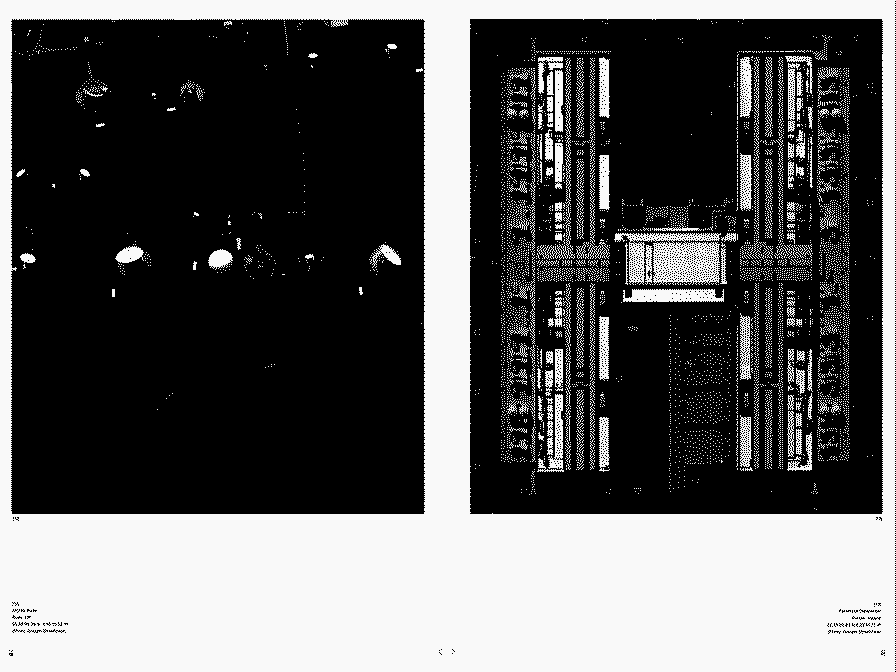
“Critical Cartography of the Internet and Beyond” is a large-scale art and research publication that covers early investigations conducted by SHARE Lab between 2014 and 2018. It offers the most comprehensive overview of this initial period of data investigation, beginning with the journey of a single internet packet and culminating in the planetary-scale systems described in Anatomy of an AI System. The book consists of hundreds of large-scale data visualizations, system maps, and diagrams that describe different layers of technological and social systems. An obsession with exploring and visualizing the invisible underpins the investigations documented in this book.
>
>
>
Anatomy of an AI System
2018
Research Essay Map
AN
*
Design of the year award Design Museum in London 2019 S+T+ARTS Prize - Honorary mention European Commission 2019 Acquisition MoMA New York 2019 Acquisition Design Museum London 2020 Acquisition Victoria and Albert Museum 2019
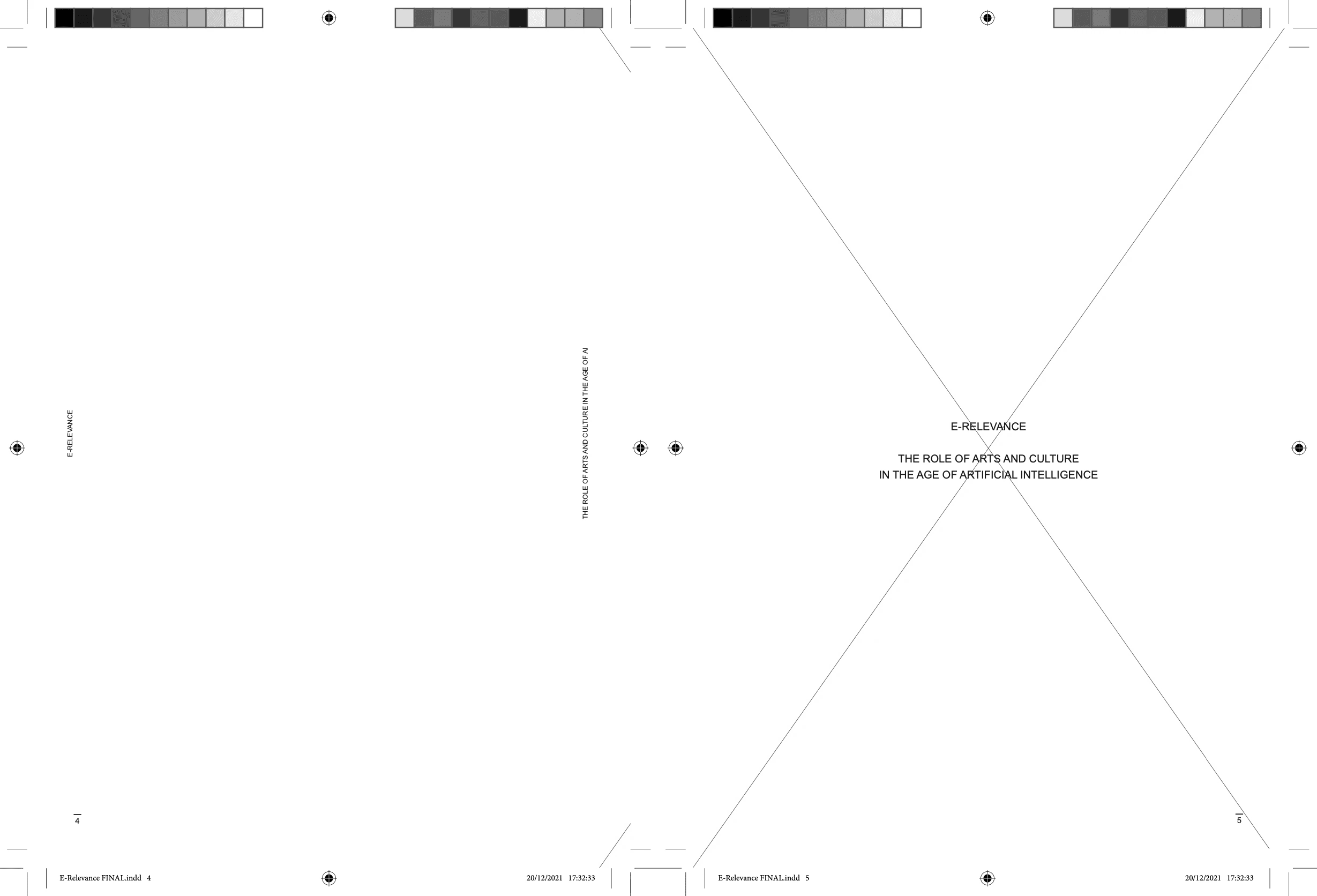
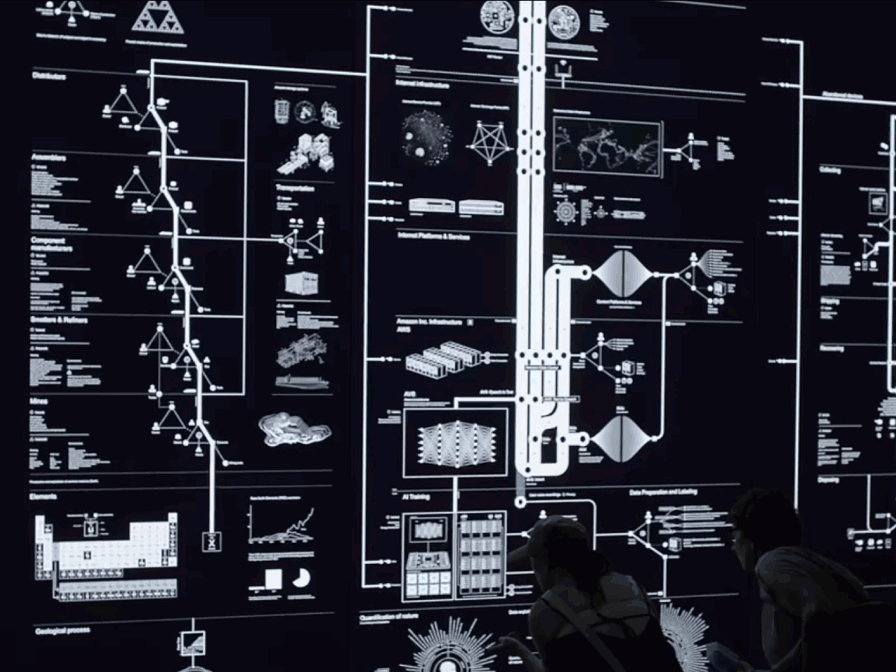
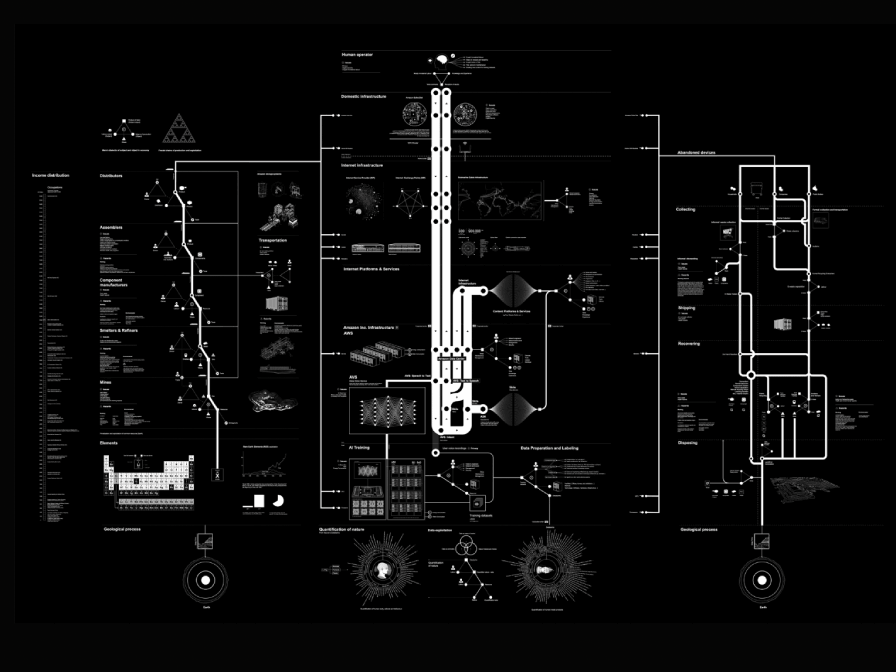
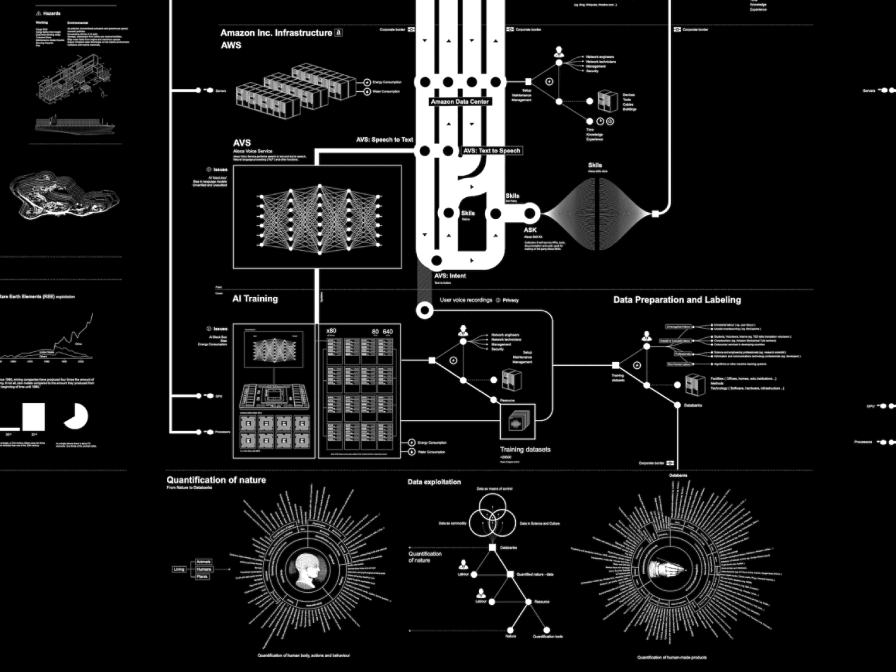
The Amazon Echo as an anatomical map of human labor, data and planetary resources
Anatomy of an AI System is a large-scale map and long-form essay investigating the human labor, data, and planetary resources required to build and operate an Amazon Echo. The exploded view diagram combines and visualizes three central, extractive processes that are required to run a large-scale artificial intelligence system: material resources, human labor, and data. The map and essay consider these three elements across time—represented as a visual description of the birth, life, and death of a single Amazon Echo unit. The stack that is required to interact with an Amazon Echo goes well beyond the multi-layered ‘technical stack’ of data modeling, hardware, servers, and networks. The full stack reaches much further into capital, labor, and nature, and demands an enormous amount of each. The true costs of these systems—social, environmental, economic, and political—remain hidden and may stay that way for some time. We offer up this map and essay as a way to begin seeing across a wider range of system extractions.
>
>
>
SHARE Monastery
2017-ongoing
Community Event
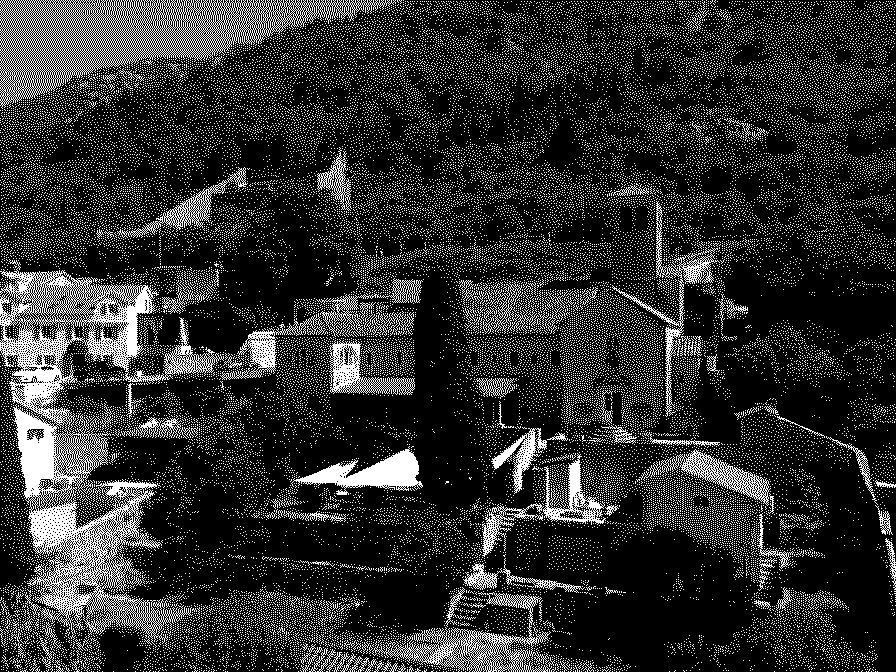
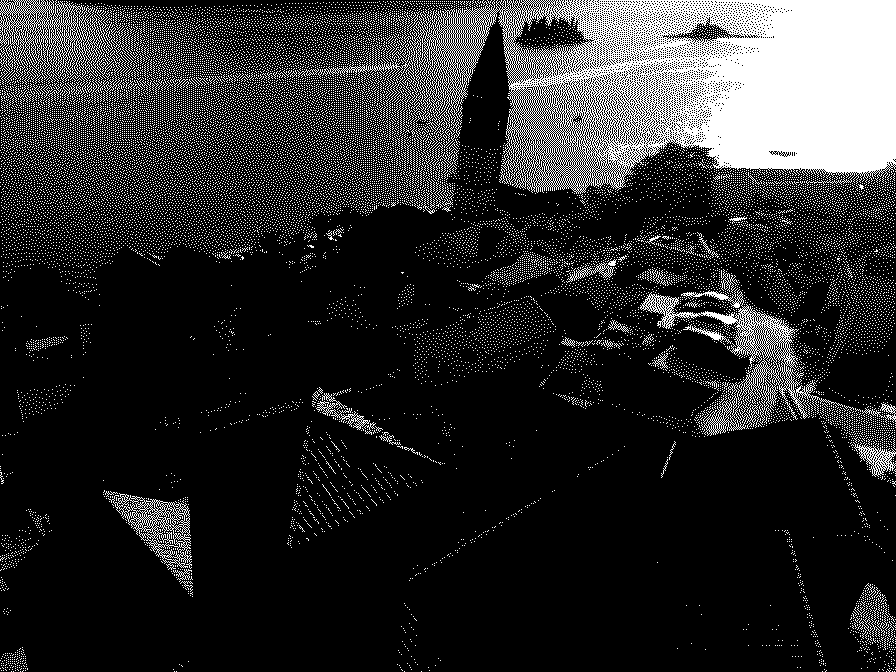
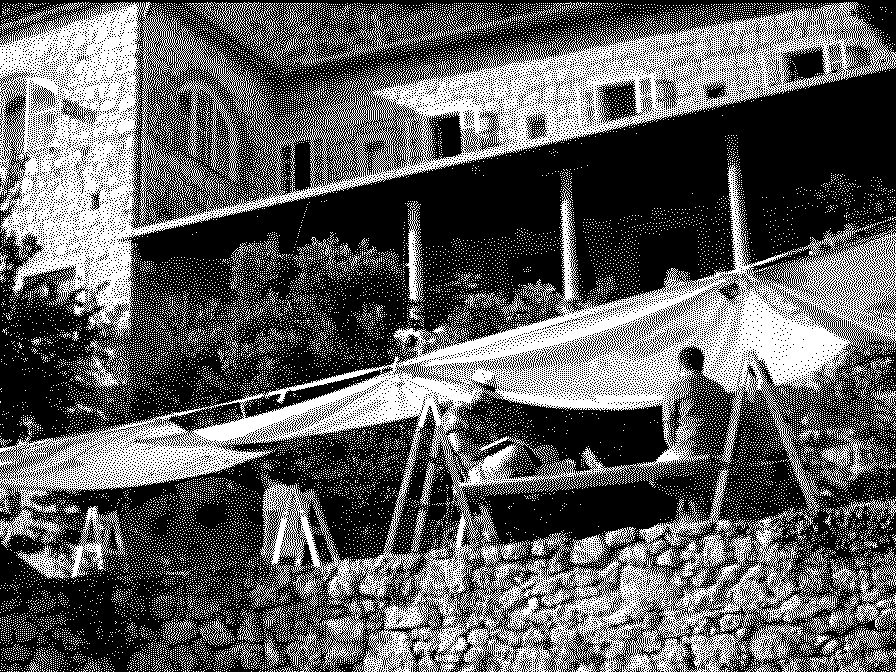
Since 2017, Share Monastery has evolved into a cornerstone for dialogue, learning, and collaboration at the intersection of technology, society, and human rights. Over the past nine years, with the tenth edition already in preparation, the initiative has built strong partnerships with leading digital policy NGOs such as Share Foundation, Tactical Tech, Digital Freedom Fund, EDRi, and universities including NYU, CEU, the University of Belgrade, and the University of Amsterdam.
Gathering more than 1,200 participants from over 60 countries, including scholars, policymakers, and global leaders, the Monastery has hosted over 30 events that have shaped the regional and international digital rights landscape. Among its most notable programs is the Digital Rights Summer School, introducing digital policy to hundreds of emerging activists, and the Data Investigation Camp in Montenegro, co-organized with Tactical Tech, an event that brought together 50 international experts, data investigators, and storytellers to explore accountability, justice, and transparency.
>
>
>
Topography of the Information Warfare
2016
Research Monitoring Map
IW
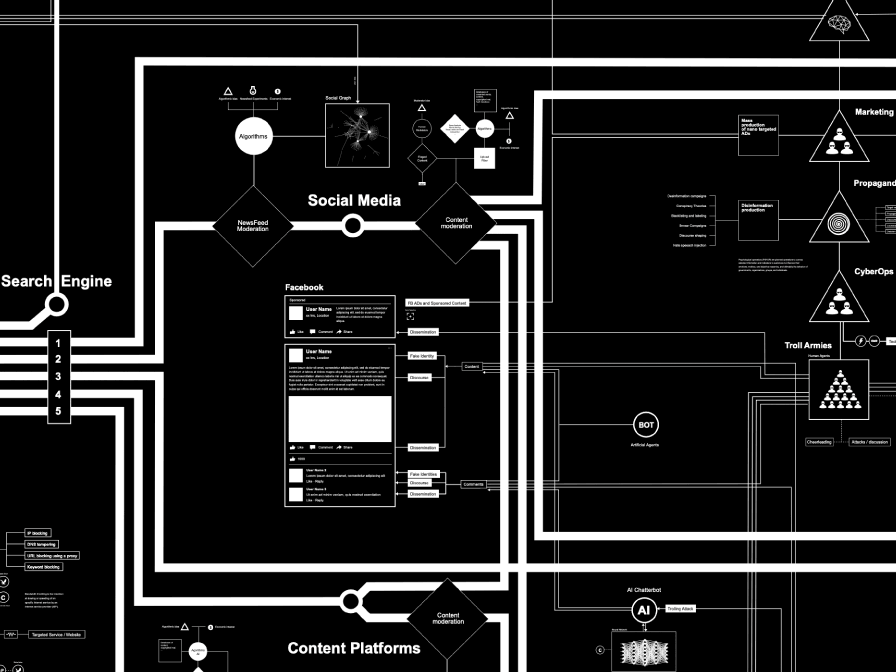
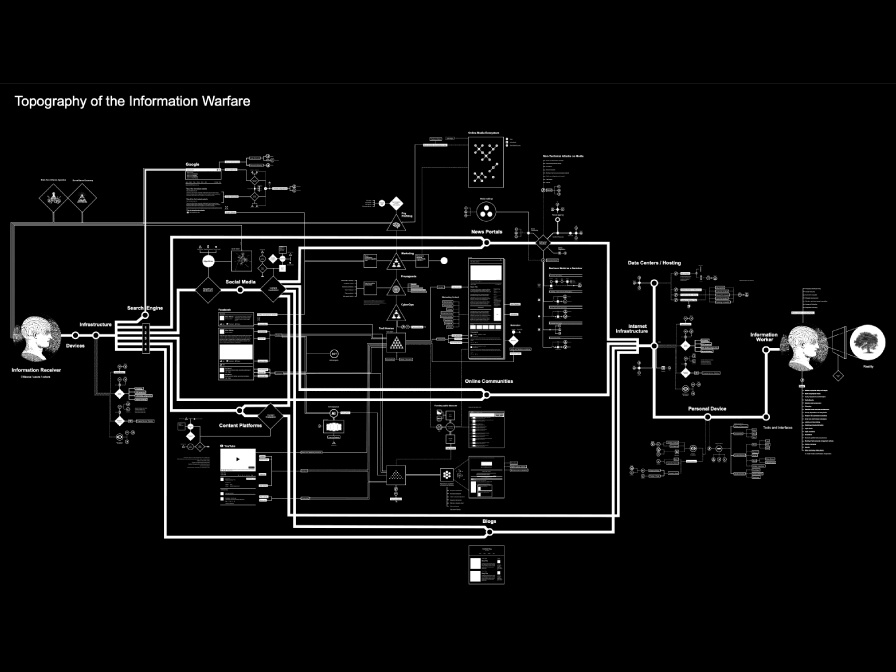
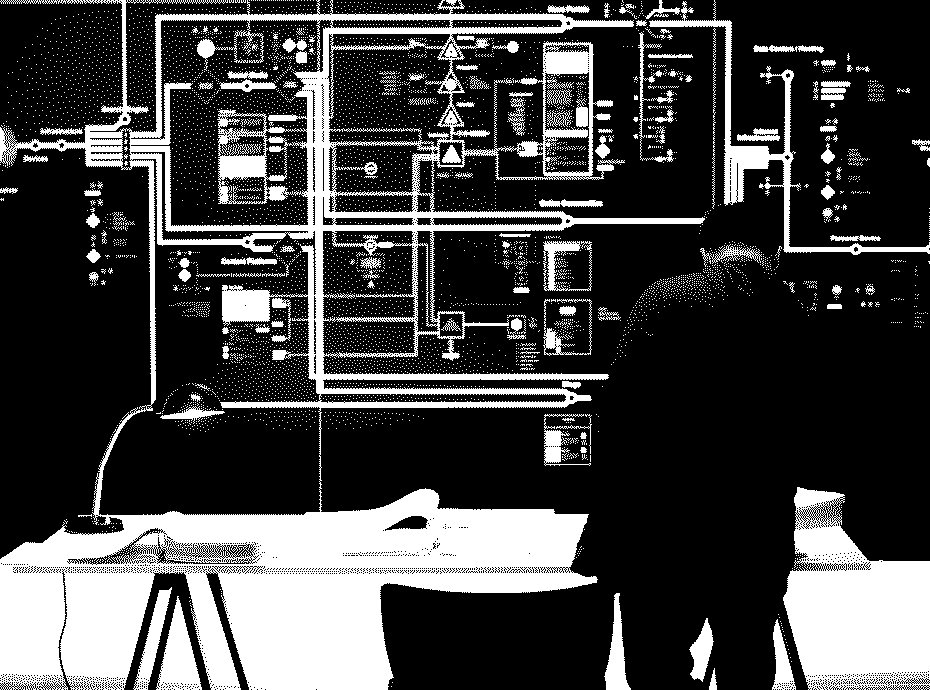
Governments, political actors and companies are now experimenting with more sophisticated ways (harder to detect and document) of exerting internet control and disturbance in the information flow. The aim of this analysis was to explore (and visualize) some of the forms and methods of interventions that various political actors or power structures have been using to control and conquer various online spheres. Here we mostly focused on hidden, indirect actions, interventions by unknown actors, companies without visible ties to government officials, political troll armies and troll lords and “artificial” entities.
This map is based on a 5-year internet monitoring process and over 400 different cases of violations documented and analyzed by the Share Foundation. Though different methods represented in this map are observed in our local context, we believe that they are also being used worldwide in similar forms. This map is an attempt to interconnect most of those issues into one map, one possible narrative, one possible reading of those processes.
>
>
>
Mapping and quantifying political information warfare
2016
Data Investigation Essay
Propaganda, Domination & Attacks on Online Media
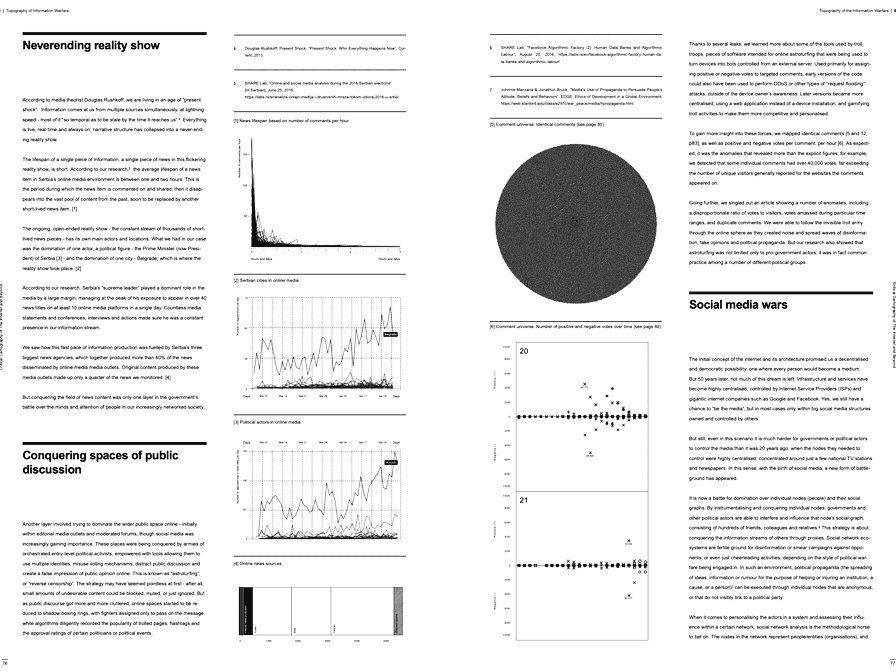
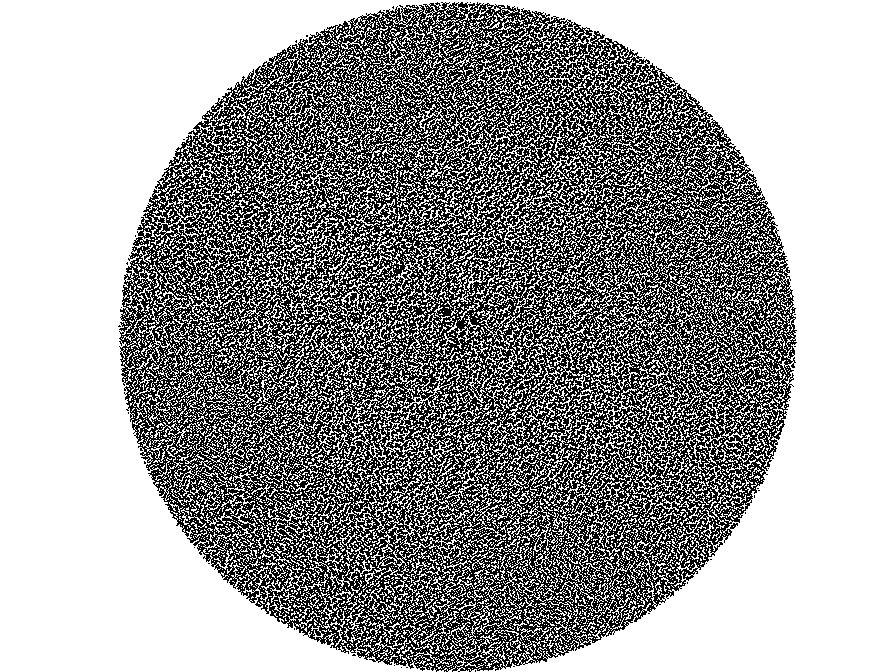
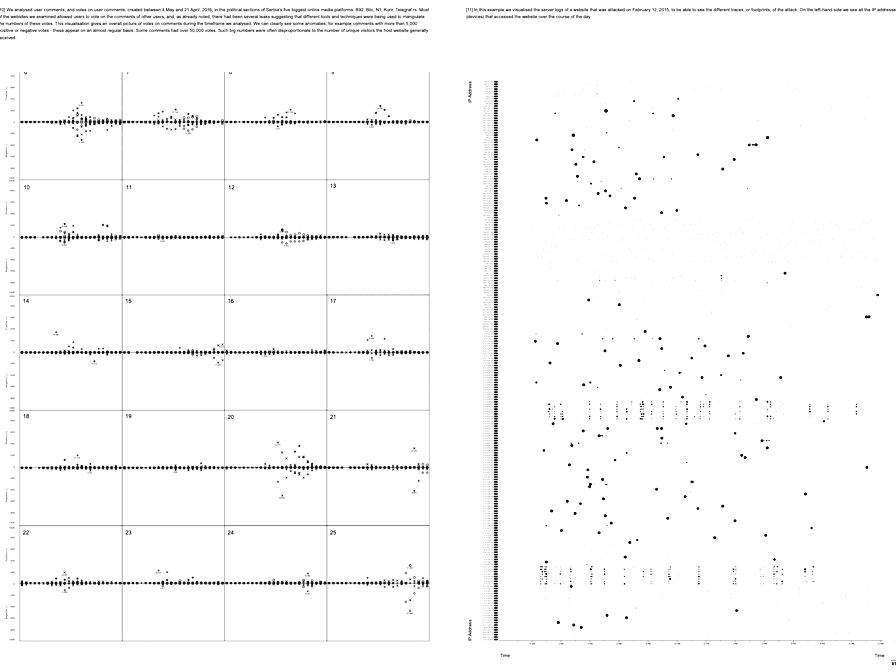
This research by SHARE Lab investigates how political actors in Serbia use online media to dominate public discourse. It documents subtle and overt tactics like propaganda, censorship, content takedowns, distributed denial‐of‐service (DDoS) attacks, and targeted individual attacks. Key findings include the shortening lifespan of online news (typically one to two hours), heavy dominance of ruling party figures in media appearances, and huge reliance on a few news agencies for content that’s widely redistributed. The study also describes how tools and software (sometimes covert) are used to manipulate comment sections and suppress dissenting voices.
>
>
>
Browsing Histories
2017
Data Investigation Essay
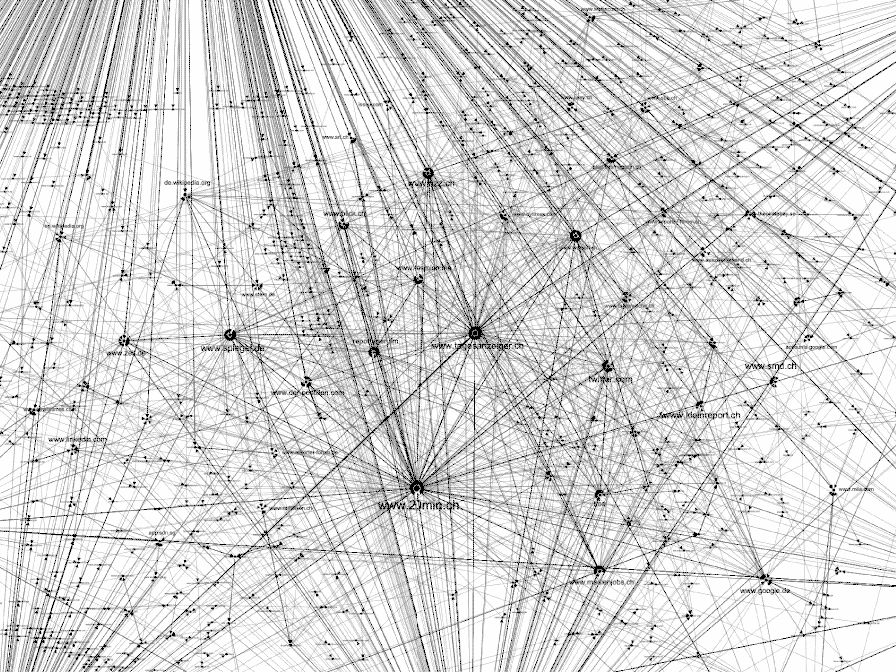
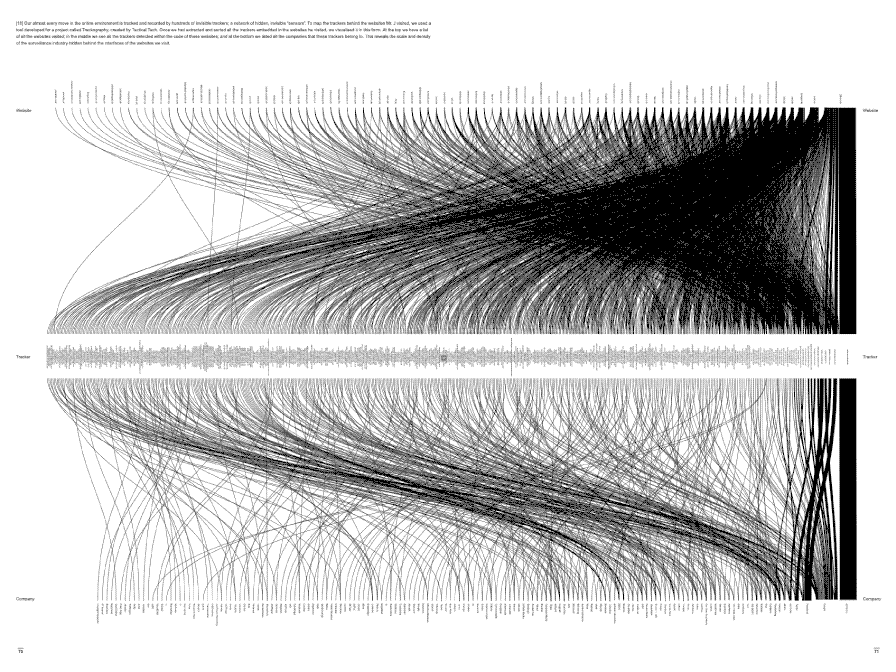
The SHARE LAB and Tactical Tech research “Browsing Histories – Metadata Explorations” investigates what an individual’s web browsing history can reveal about their identity, preferences, movements, and behaviour by analysing a real dataset from a Swiss journalist. Through metadata and URLs alone, the researchers demonstrate how easily someone’s real name and social graph can be reconstructed, how search queries and visited sites reflect intentions and interests, and how patterns and anomalies in browsing logs can expose habits and even location intentions. The study also highlights the pervasive role of trackers and third parties in collecting browsing data, the privacy implications of such data being accessible to corporations, governments, and surveillance systems, and the broader power dynamics in the information society shaped by access to and analysis of browsing histories.
>
>
>
Dark temples, death and afterlife of technology
2017
Research Workshop
The Mozilla Open IoT Caravan was an epic traveling initiative designed to explore and promote open, ethical, and user-centric approaches to networked technologies through hands-on experimentation and community engagement. It involved collaboratively prototyping devices and scenarios that foregrounded social impact rather than commercial extraction.
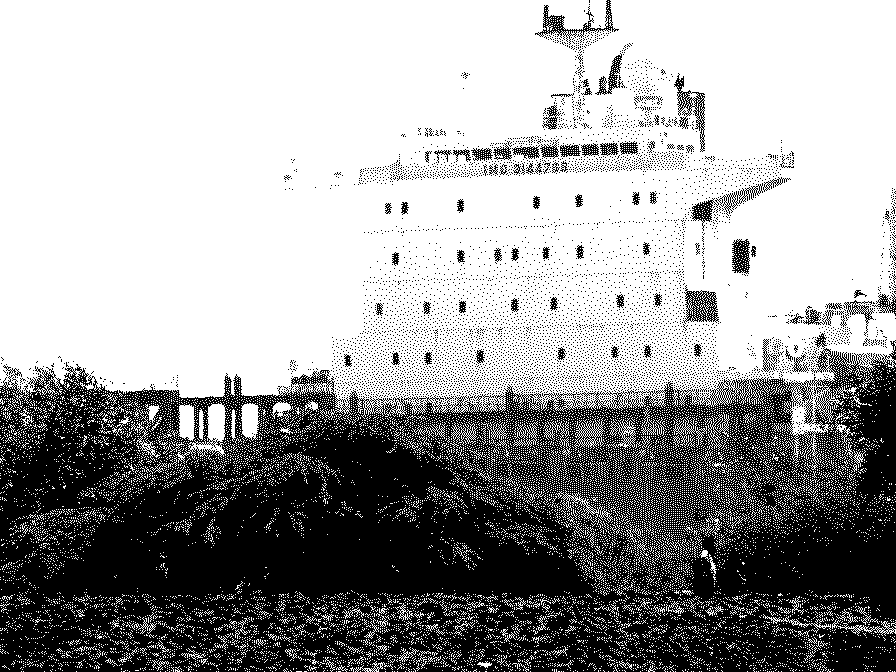
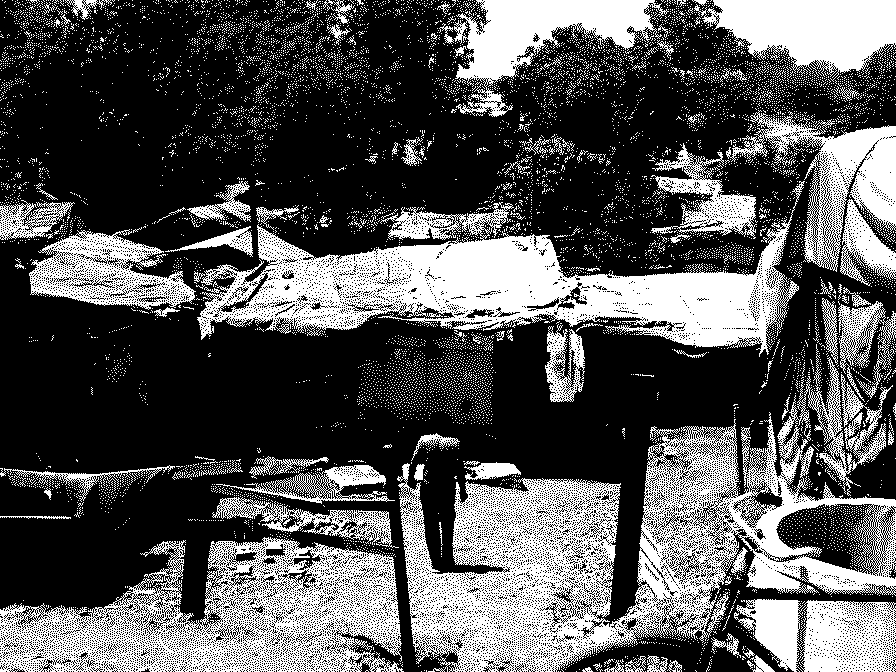
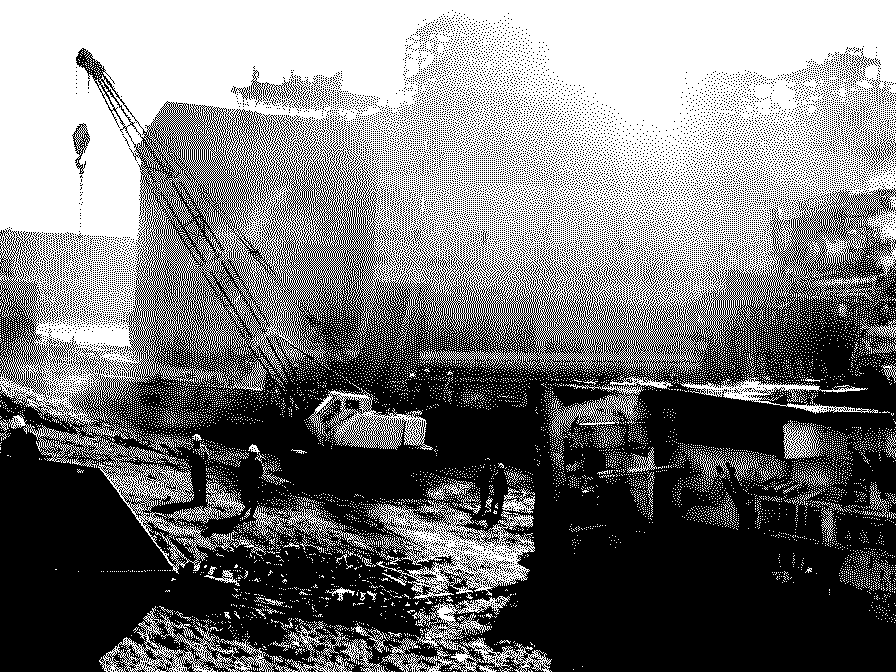
The Caravan editions in India gave me the opportunity to conduct in-situ research on the temporality ,death and afterlife of technology, bringing me together with NID students to the massive ship graveyards of Alang Beach, villages where e-waste is processed, and mining sites across Gujarat state. This process became foundational to my interest in the materiality of technology and systemic inequality, which later informed Anatomy of an AI and other subsequent projects.
In parallel, we carried out numerous experimental projects, including an intensive ten-day workshop that nearly evolved into a cyberpunk cult centered on the concept of “Dark Temples”: naturally and artificially created interconnected voids in the electromagnetic spectrum—spaces without signals or connectivity.
>
>
>
Facebook Algorithmic Factory
2016
Research Essay Map Video
FB
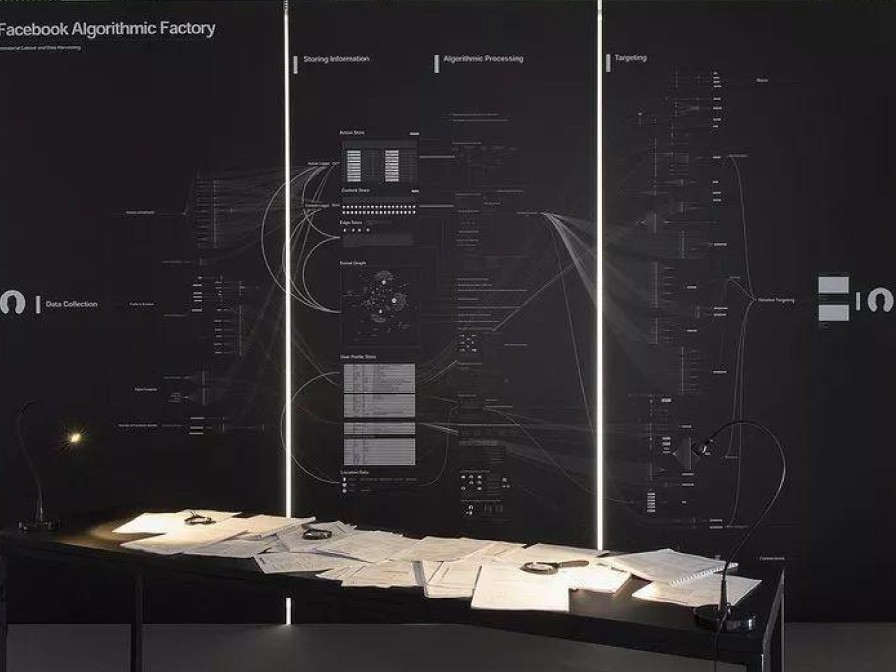
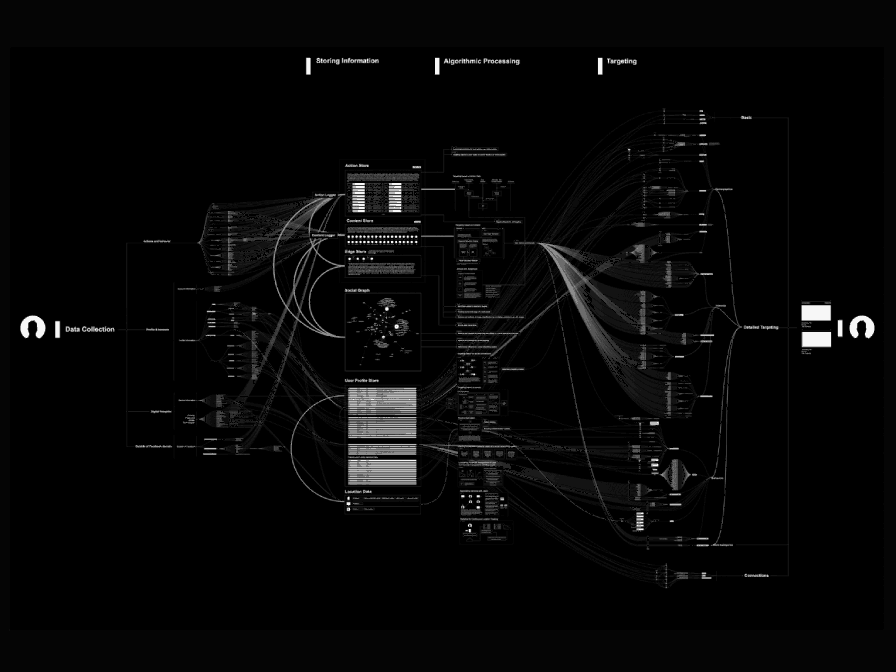
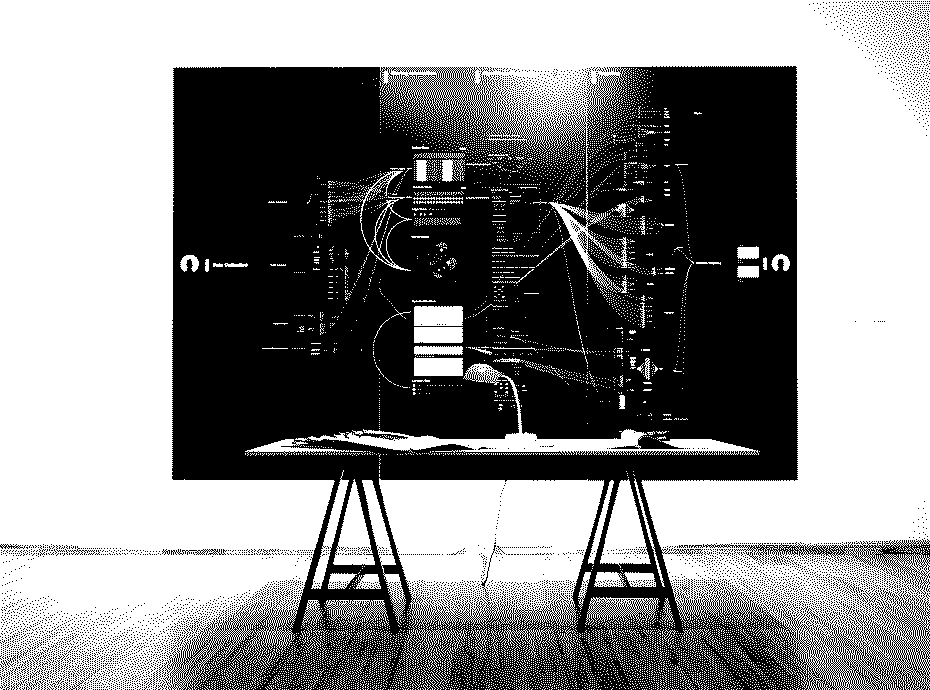
Facebook Algorithmic Factory sheds light on the invisible processes that take place inside the world’s largest social network. Inside this black box, non-transparent algorithms are deciding what kind of content will become a part of our reality, what will be censored or deleted, which ideas will spread and what news will gain most visibility. They are also defining new forms of labor and exploitation. Users are no longer clients. We only provide data, which serves as raw material for the production of digital profiles – a key commodity on internet stock markets. This Factory generates an enormous amount of wealth and power by creating a deep economic gap between those who own and control the means of production and their users, who often live below the poverty line. The layers of algorithmic data processing may conceal new forms of human rights violation, novel mechanisms for exploitation and manipulation that we no longer control. Our first step in fighting them back is to make them visible.
>
>
>
Exploring alternative Internets and unusual forms of networking in Havana
2016
Research Essay
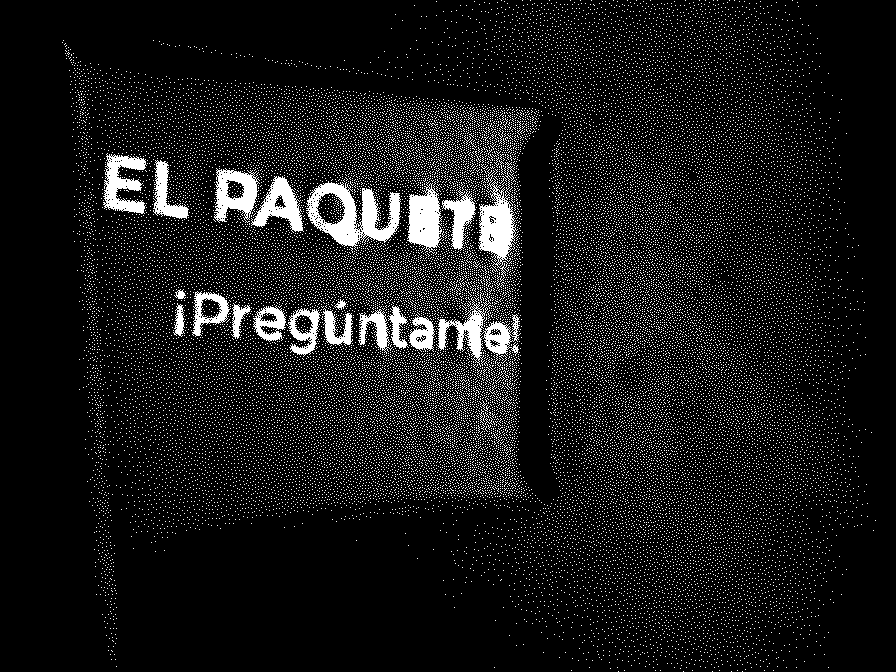
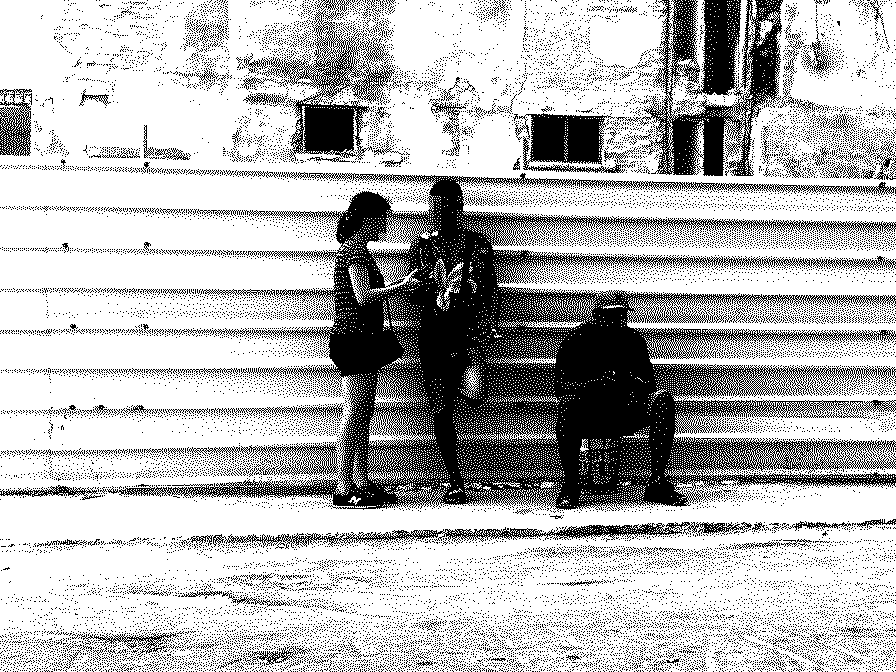
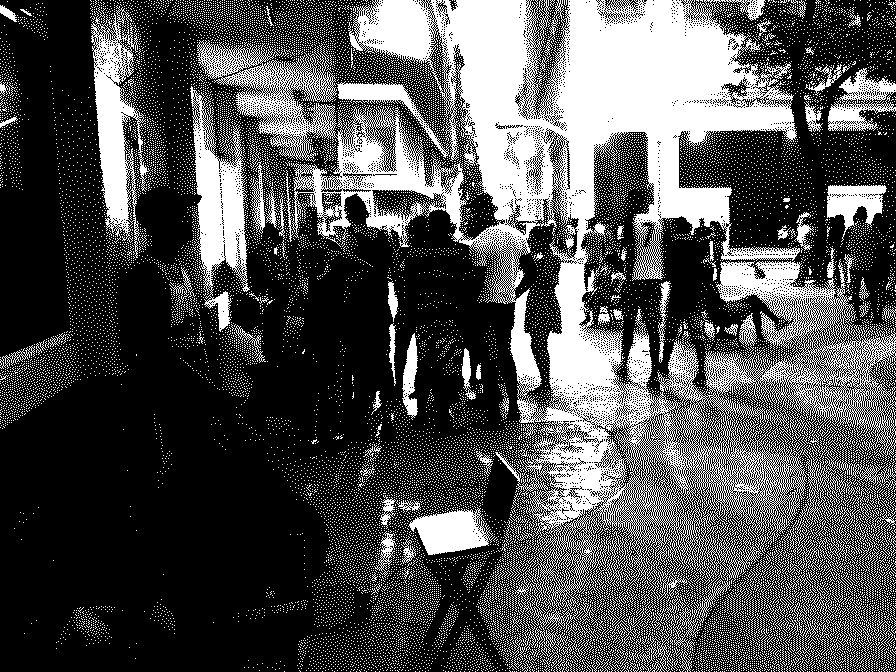
The SHARE LAB research “Exploring Alternative Internets and Unusual Forms of Networking in Havana” examines how, in the context of extremely limited and expensive state-controlled Internet access in Cuba, local communities have built informal, decentralized networking systems that operate outside official infrastructure. It documents the emergence of SNet, a large grassroots mesh network connecting thousands of households across Havana through DIY wired and wireless links, as well as El Paquete, a weekly distributed “offline Internet” of digital content shared island-wide via hard drives and human couriers; the study explores how these systems enable local communication, content sharing, micro-economies, and social interaction while navigating legal constraints and internal norms to survive in an environment of restricted connectivity.
>
>
>
Metadata Investigation : Inside Hacking Team
2015
Data Investigation Essay
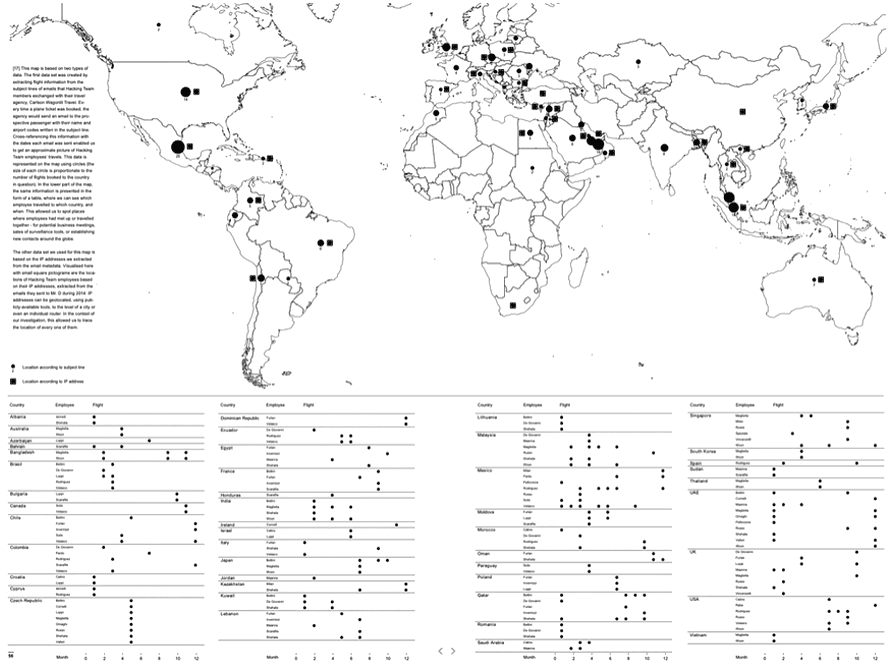
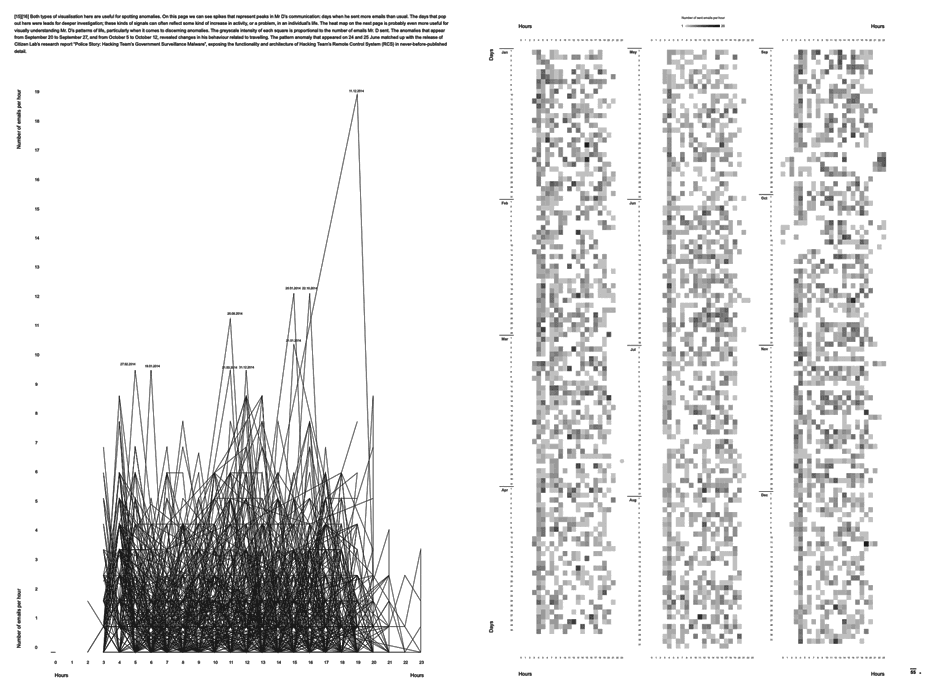
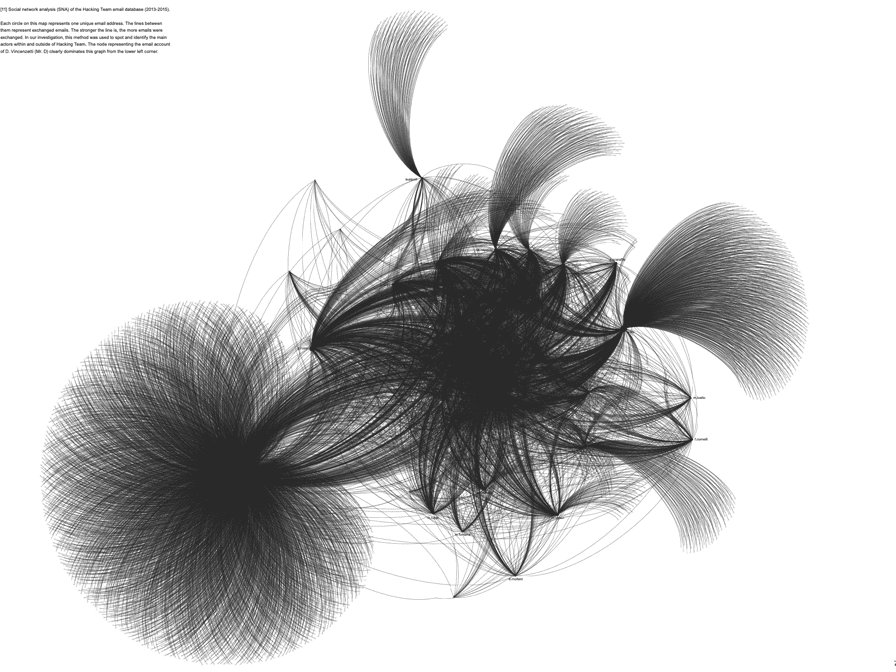
Using leaked internal data from the surveillance company Hacking Team, this investigation reconstructs how spyware technologies are marketed, negotiated, and sold to state actors. SHARE LAB analyses emails, contracts, and technical documentation to reveal the commercial logic behind digital surveillance and the ease with which invasive tools circulate globally. The study exposes the gap between public discourse on human rights and the private practices of security procurement, showing how surveillance becomes normalised through bureaucratic and technical processes.
>
>
>
Invisible Infrastructures: Surveillance Architecture
2015
Research Map
SA
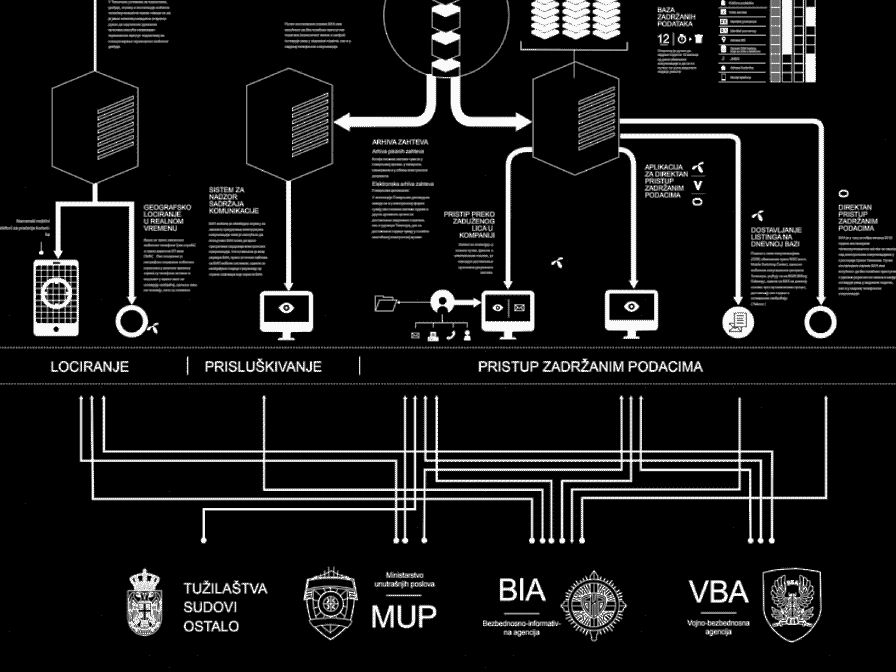
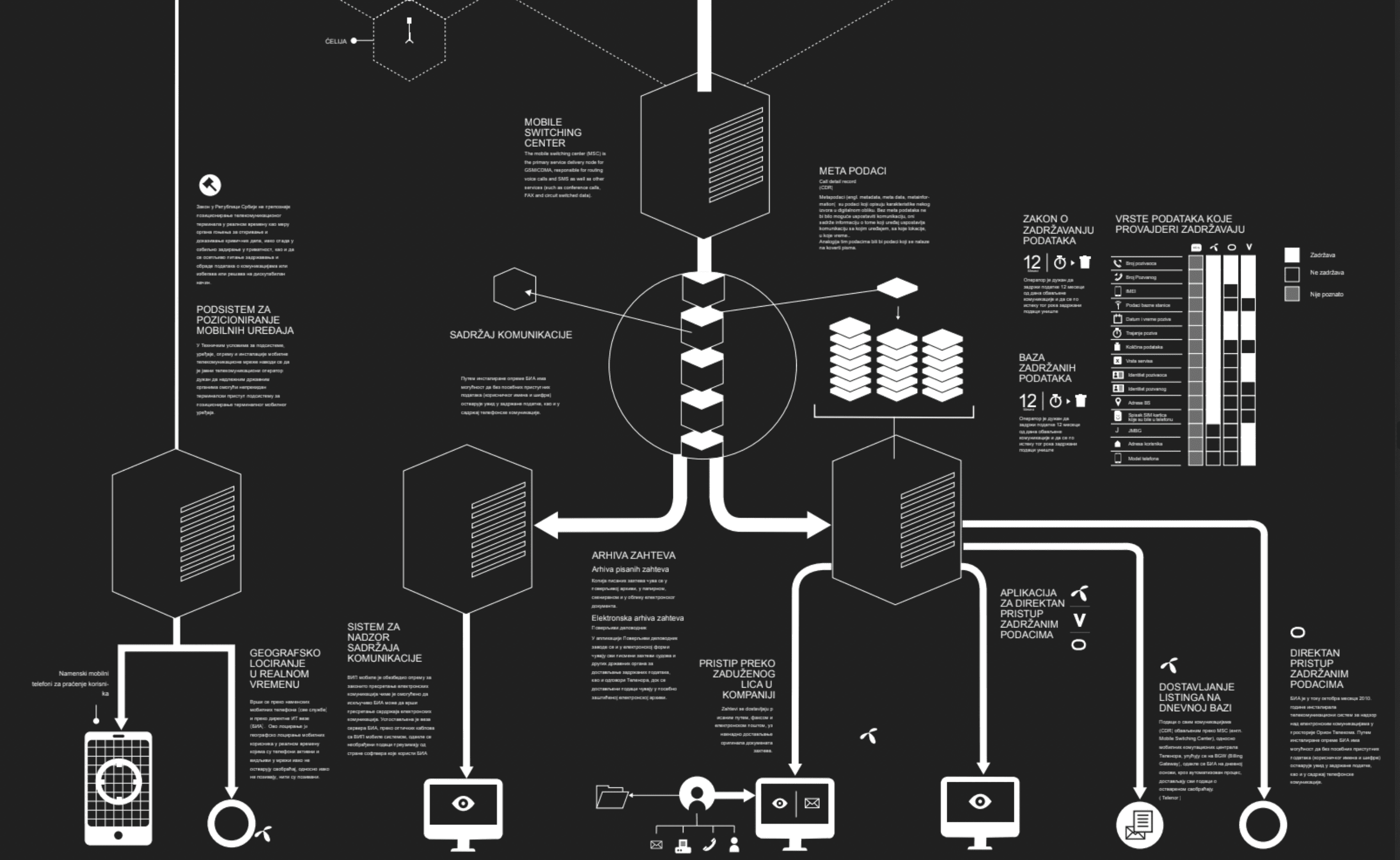
This investigation maps how telecommunications infrastructure enables systematic state access to retained metadata. SHARE LAB analyses legal frameworks, technical interfaces, and network design to show how surveillance is embedded at the infrastructural level, often bypassing meaningful oversight. The research reveals how “invisible” systems quietly normalise mass data access, shifting surveillance from exceptional practice to routine governance.
>
>
>
Invisible Infrastructures: Data Flow, trackers and permissions
2015
Data Investigation Essay
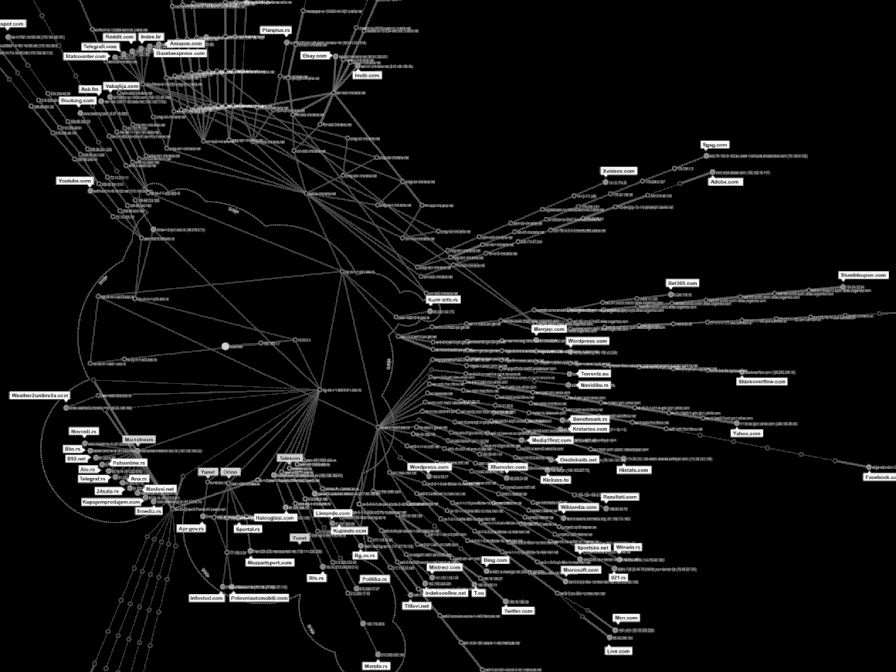
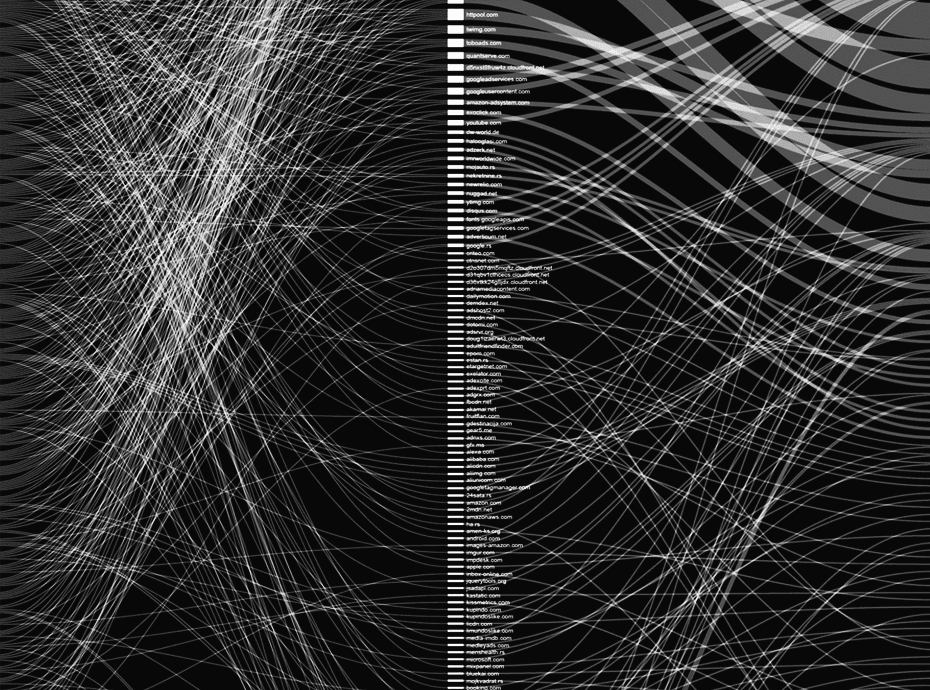
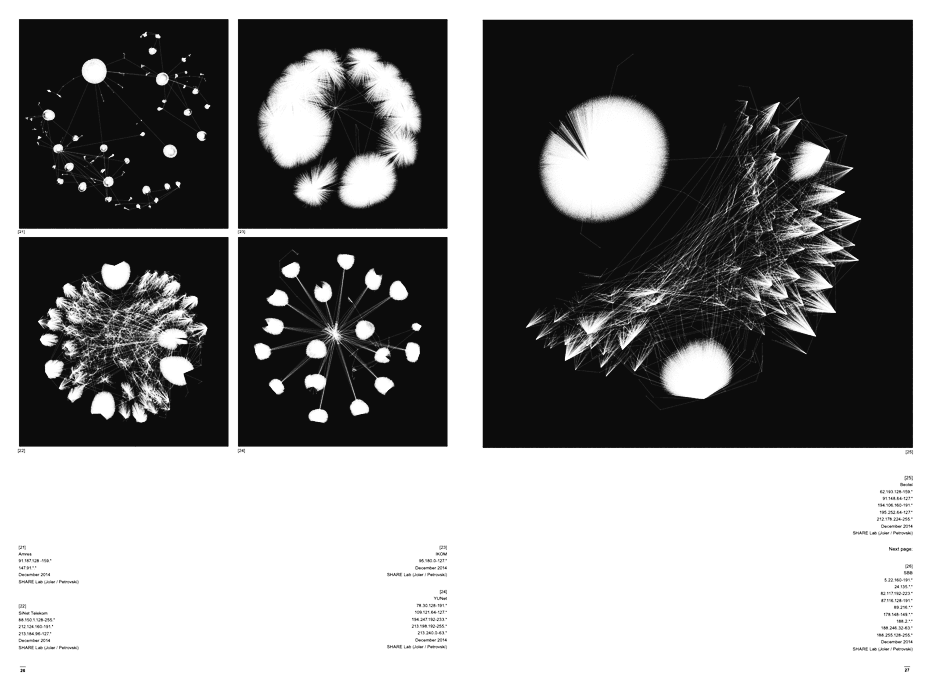
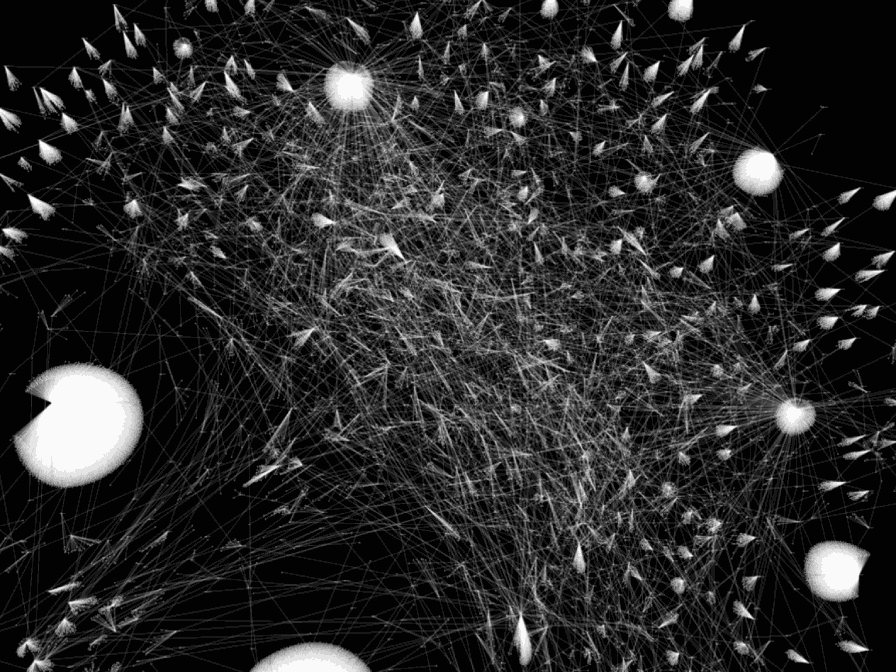
The Invisible Infrastructures series examines the hidden architectures of digital power through data flows, online trackers, and mobile permissions. Tracing network routes from Serbia to major global websites, it reveals a highly centralised internet infrastructure shaped by control, monitoring, and dependency. The project also exposes pervasive third-party tracking by dominant platforms such as Google and Facebook, as well as excessive data access enabled by mobile app permissions, critiquing consent mechanisms that mask power asymmetries between users and platforms.
>
>
>
Invisible Infrastructures: Understanding Autonomous Systems
2015
Data Investigation Essay
AS
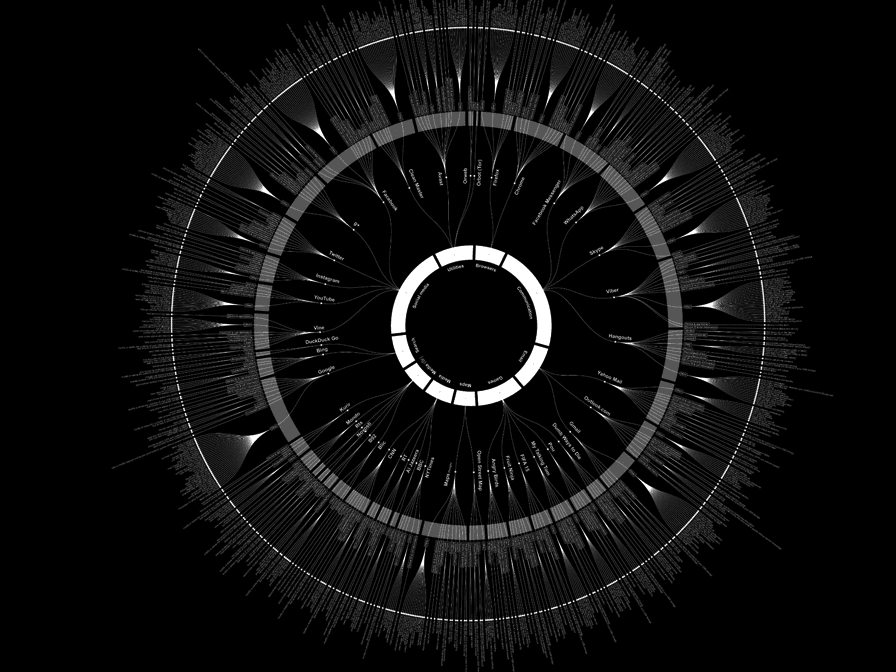
This foundational study explains how autonomous systems (AS) structure the Internet at a macro level. SHARE LAB introduces readers to the technical and political significance of ISPs, routing, and interconnection agreements, showing how control and centralisation emerge from seemingly neutral protocols. The investigation provides conceptual tools for understanding infrastructure as a site of power.
>
>
>
The Exciting Life of an Internet Packet
2015
Data Investigation Essay
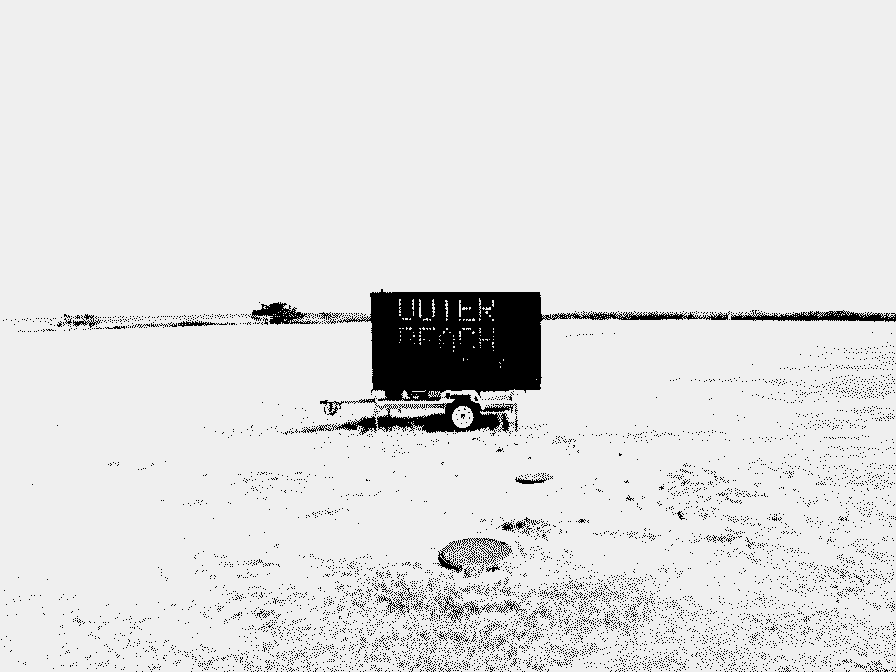
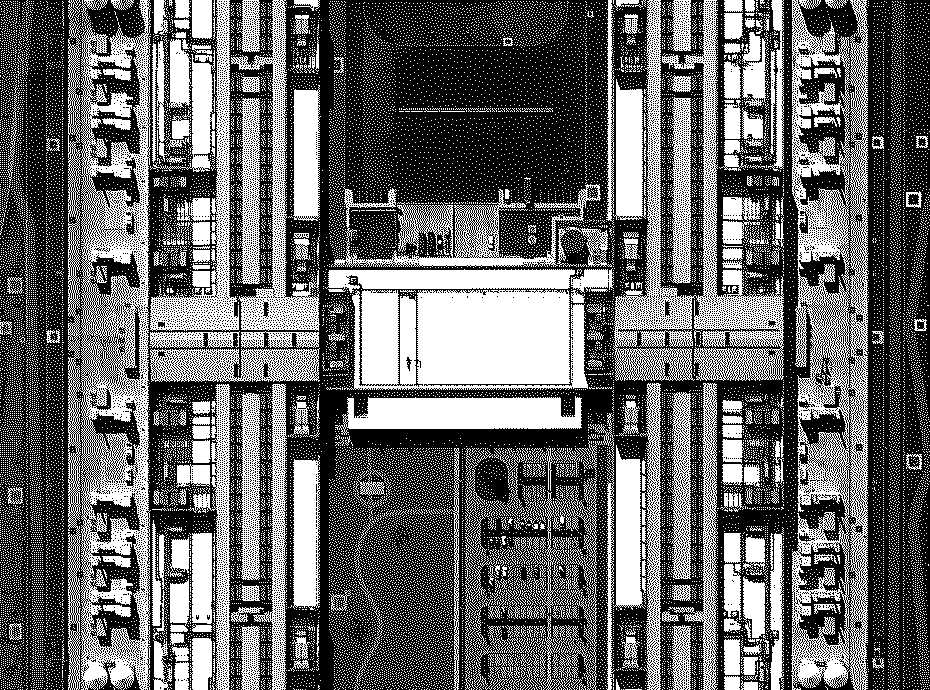
This introductory investigation follows the journey of a single data packet to demystify how the Internet actually works. Through narrative and visual explanation, SHARE LAB reveals the material, physical, and institutional layers behind everyday online actions. The piece sets the conceptual tone for the entire Invisible Infrastructures series, emphasising that digital communication is grounded in real systems of power, labour, and control.
>
>
>
Radiation Hunters
2013
Citizen Data Collection Research
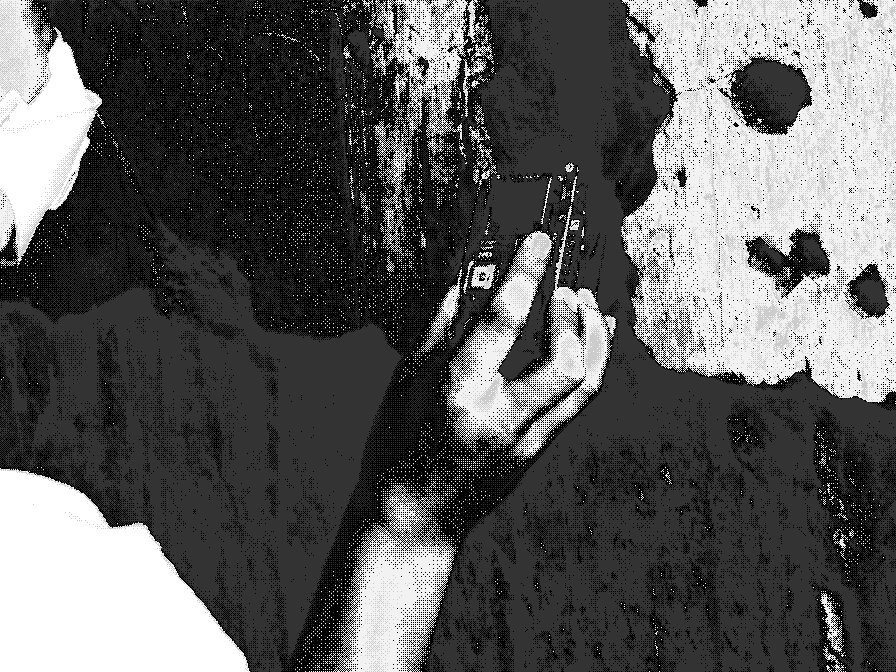
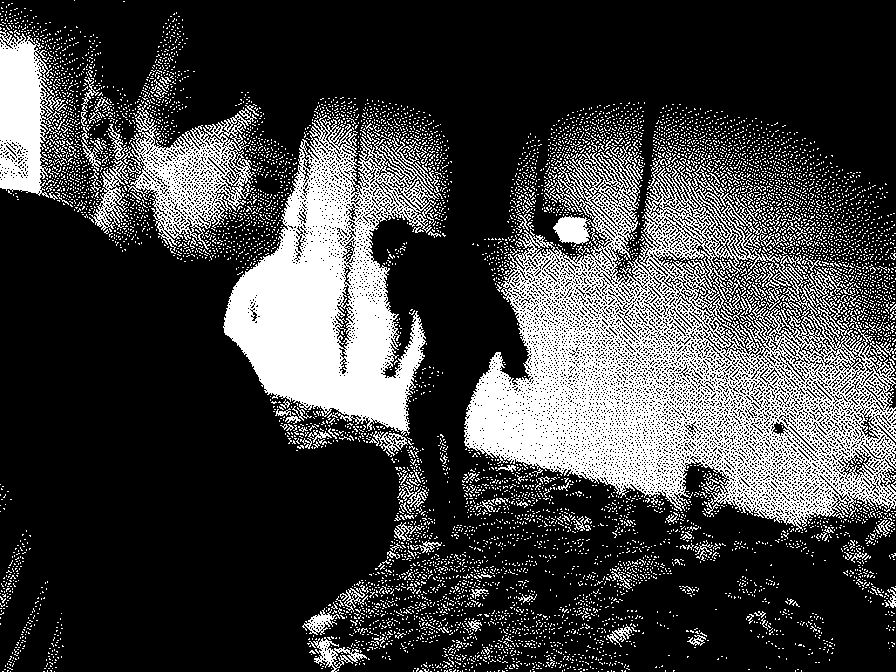
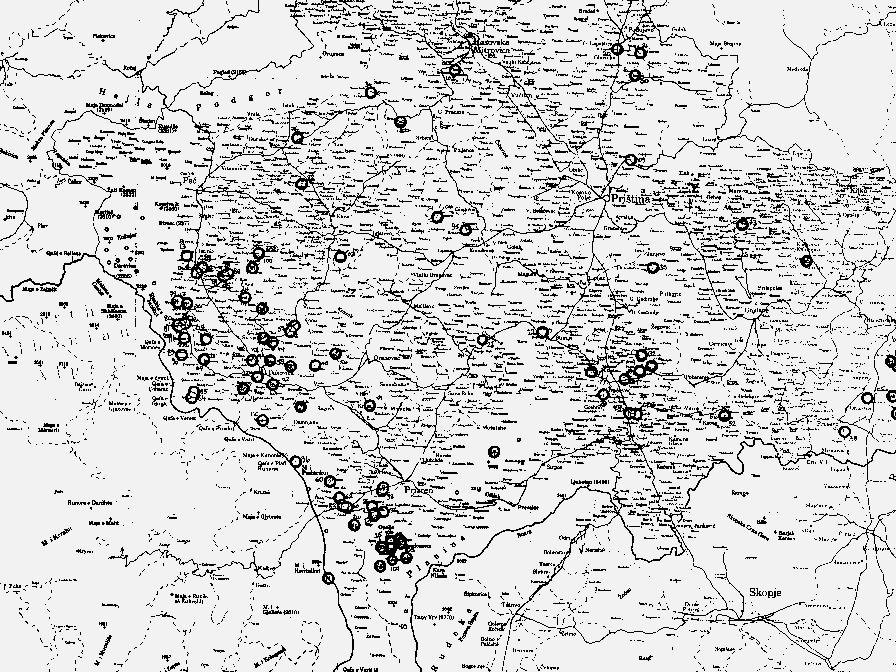
Shortly after the devastating earthquake and tsunami, and the subsequent meltdown of the Fukushima Daiichi Nuclear Power Plant in 2011, the MIT Media Lab prototyped Safecast, a device that enabled the monitoring, collection, and open sharing of environmental radiation data. One of the first prototypes was used by an artist, activist, and friend, Bilal Ghalib, to collect radiation data in Iraq. After discovering NATO maps indicating locations where depleted uranium had been used during the bombing of Yugoslavia, we embarked on a quest to collect radiation data across Kosovo, Bosnia, and Serbia. This citizen-led data collection adventure sparked my interest in “seeing the invisible.” Shortly thereafter, my interest in invisible particles shifted toward seeing the invisible flows of data, which led to the entire SHARE Lab investigation series that followed.
Bilal Ghalib and Vladan Joler
>
>
>
SHARE Conference
2011-2013
Event Community Building
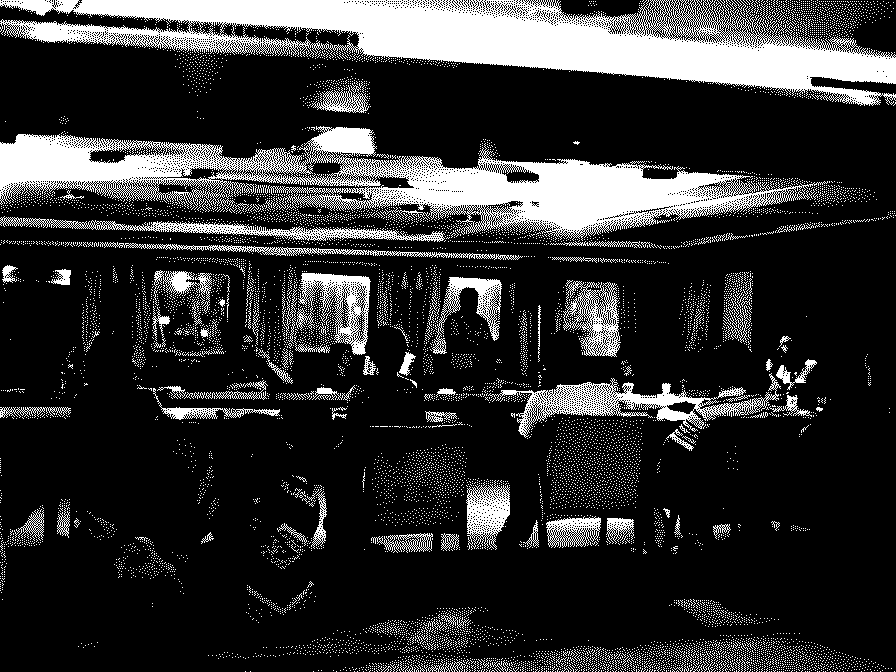
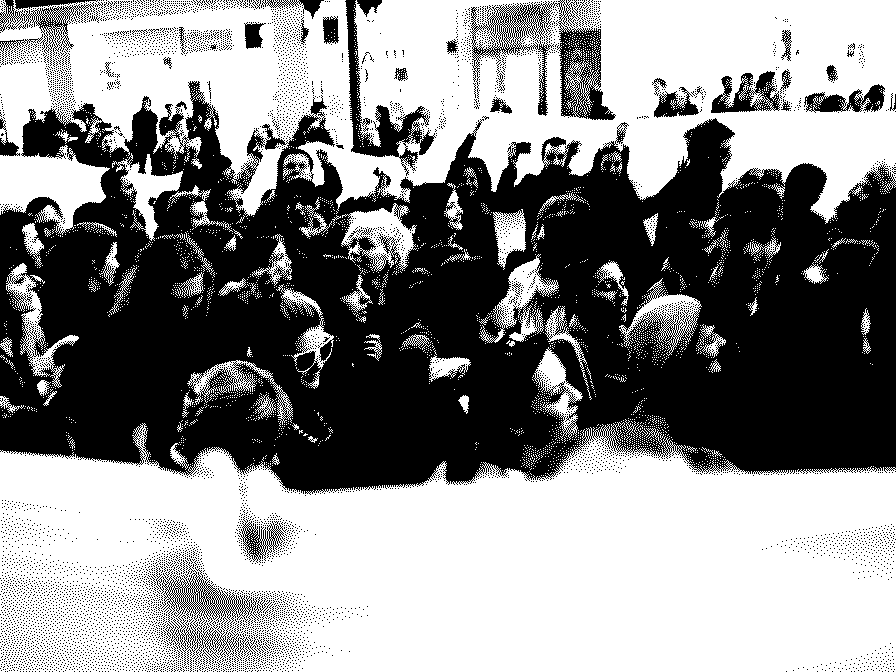
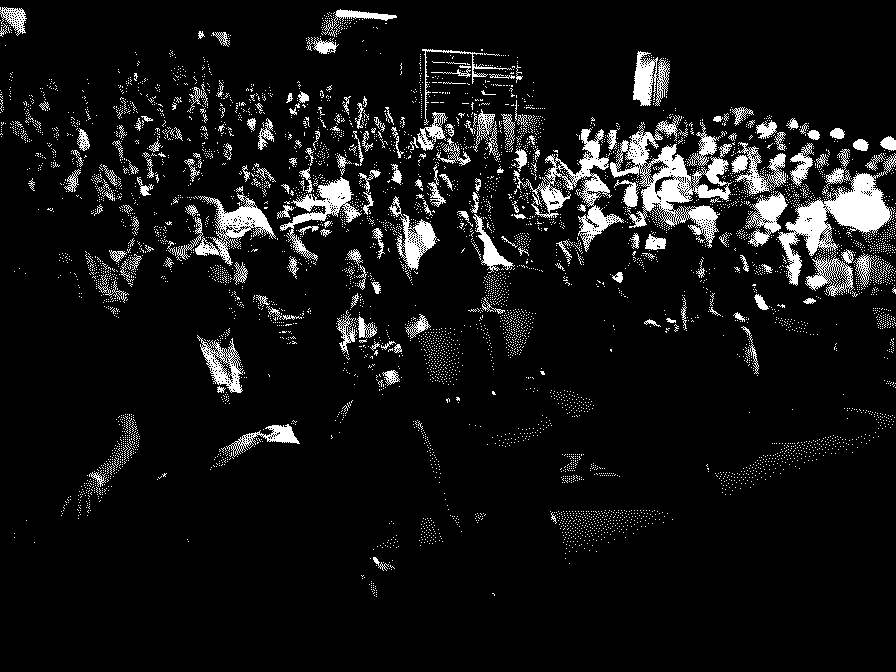
The SHARE Conferences held in Belgrade in 2011 and 2012 and in Beirut in 2012 were groundbreaking, free, non-commercial hybrid events that blended internet culture, digital activism, new media, technology, and cutting-edge music. The inaugural Belgrade edition in April 2011 brought together internationally acclaimed internet and social experts, artists, musicians, and activists for “SHARE by Day” educational talks and workshops alongside “SHARE by Night” concerts and performances, attracting thousands of participants keen to explore social activism, digital rights, and creative expression across more than 100 events. The 2012 Belgrade conference expanded this mission with over two thousand activists, bloggers, programmers and artists engaging in lectures, workshops and discussions paired with a cutting edge cultural and electronic music program. Later that year, SHARE Beirut (October 5–7, 2012) adapted the format for the Middle East and North Africa, bringing together regional and global internet activists, cultural producers, and musicians.
>
>
>
Wealth of Nations
2009
Event
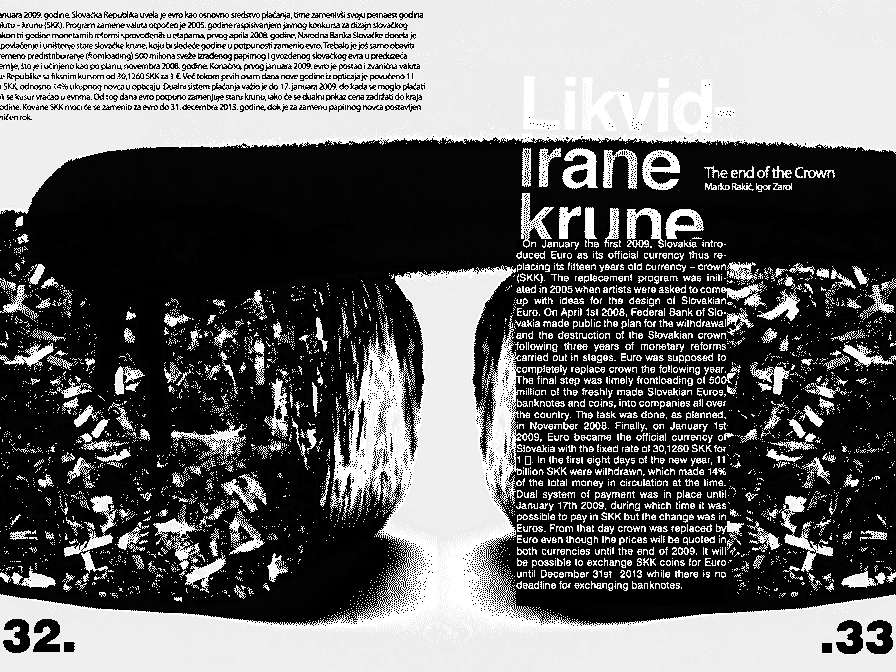
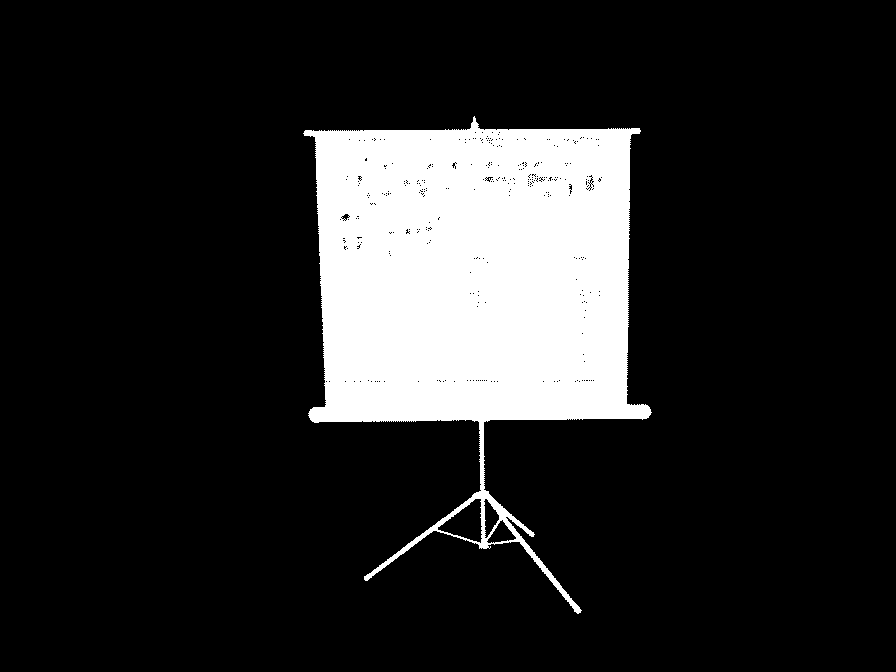
Wealth of Nations is conceived as a shared platform of exhibition and conference that interrogates money not merely as an economic instrument, but as a force that shapes social relations, cultural production, and systems of power. Taking its title from Adam Smith’s foundational text on liberal economics—and situating it against the recent crises of global finance—the project examines how economic and financial logics permeate both material and immaterial life, from labor and value to desire, imagination, and subjectivity. By bringing together art, theory, social sciences, economics, and cultural studies, Wealth of Nations explores money as a measure, medium, and abstraction that governs inclusion and exclusion, knowledge and opacity, belief and disinformation. In doing so, it opens a critical space to reflect on the symbolic, political, and affective dimensions of finance, and on the ways economic systems continuously reconfigure society and its cultural forms.
Artists: Daniel Andujar, Derivart / Hipotecadoria, Heath Bunting, Hempmen, IRWIN, Abramović, Brecelj ,Kate Rich, K Foundation, Luchezar Boyadjiev, Max Kaiser, Metahaven, Michael Aschauer, Mladen Stilinović, Natalie Jeremijenko and The Bureau of Inverse Technologies, Ola Pehrson, Shu Lea Cheang , Slavko Bogdanović , Vladimir Todorović.
Conference: Darko Pantelić, Felix Stadler, Konrad Becker, Luchezar Boyadjiev, Mar Canet, Marko Rakic, Matteo Pasquinelli, Michael Aschauer, Ralph Heidenreich, Slavko Bogdanović, Stefan Heidenreich.
>
>
>
Territories and Resources
2008
Event
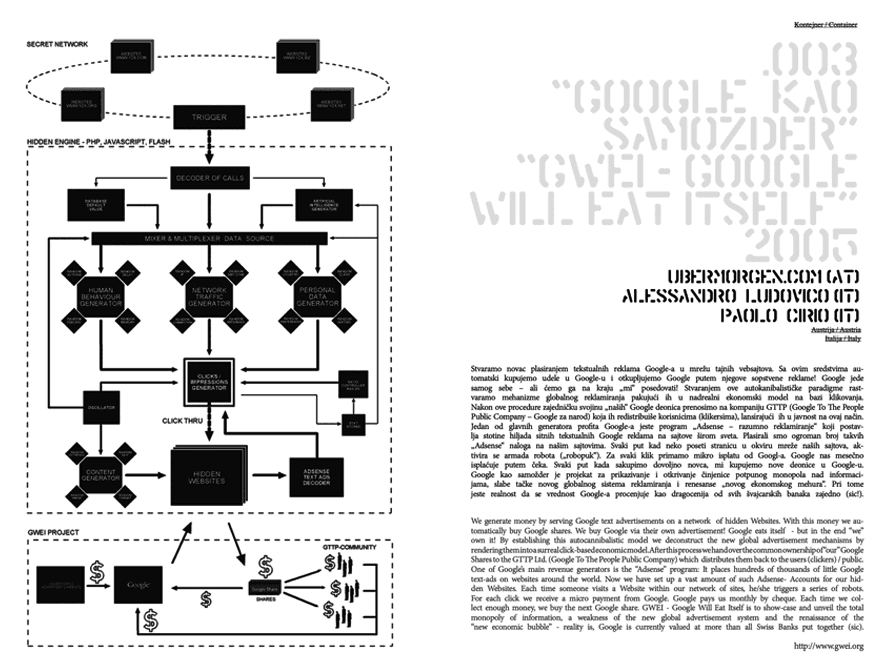
The aim of this exhibition and conference was to research the phenomena of social networking sites, online multiplayer games, virtual worlds and the so-called Web 2.0; all set in the context of new digital and network territories. New social technologies are creating new domains of possibilities, which mirror contemporary art, sociability, economics, politics and culture, which are all deeply incorporated into the logic of info-capitalism. Within the context of these new frames of reference, hitherto unacquainted and specific resources manifest themselves: the users, to which new technologies are tailored. Those territories are regulated by social and economic frameworks, which necessarily have to be critically analysed and thoroughly re-examined.
With Alessandro Ludovico, Armin Medosch, Bureau d’Études, The Croquet Consortium, Electroboutique, Marcell Mars, Platoniq, Roman Minaev, Serious Games Interactive, Slobodnakultura.org, Paolo Cirio, UBERMORGEN.COM, Vladan Jeremić, and Vladimir Jerić Vlidi.
Curated by Kristian Lukić and Vladan Joler
>

>
>
Schengen Information System, Version 1.0.3
2004
Game
SH
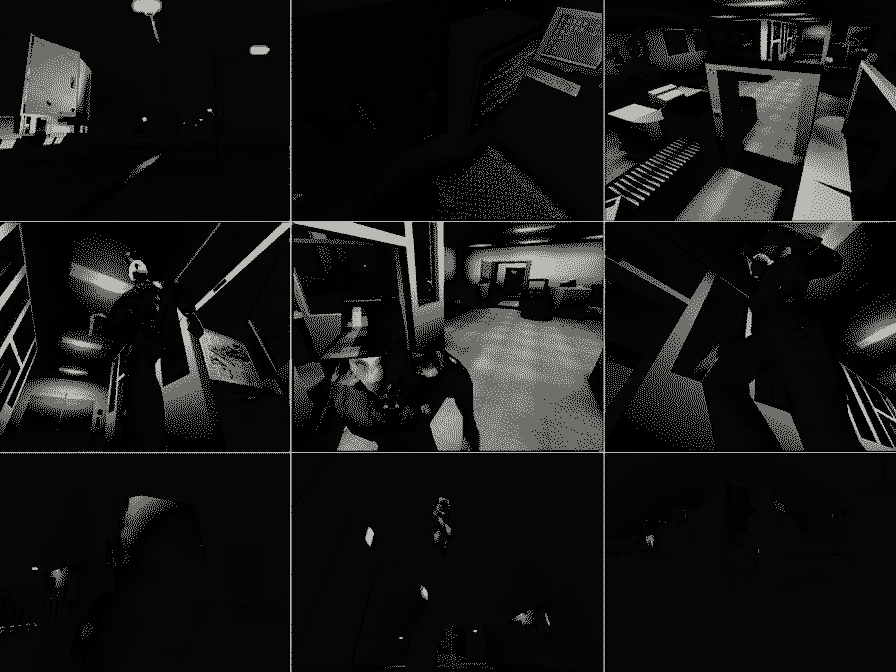
The SIS (Schengen Information System) was put into force in 1995 as the first supranational system for investigating and tracking people and objects. The Schengen Information System computer game follows the tradition of using the realm of computer games for the training and educational needs of military and ideological structures and questions their moral character, their purposes, as well as their political acceptability.
The player is an activist trained to break inside the Schengen Information Systems’s building in Strasbourg. His mission is to intrude into the main operational part of the building-the archive, where the data base is settled-and to destroy it in real time and “real place”.
The visual and conceptual environment of the game has been created with the use of publicly accessible technology and information and is based on the game engine of the Unreal.
>
>
>
Civilization trilogy
2004-2015
Game
CI
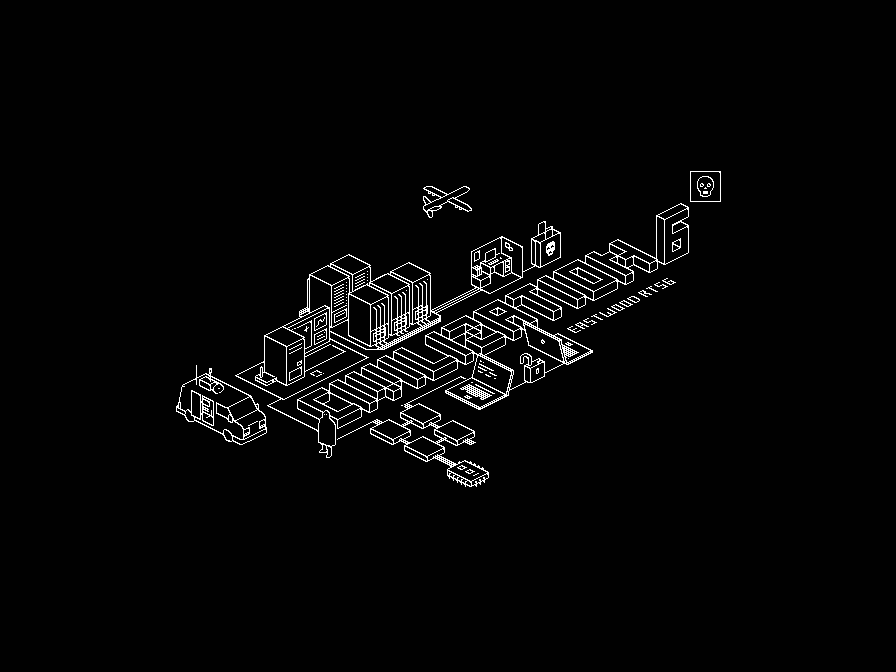
Conceived as a trilogy of game modifications, Civilization IV – Age of Empire (2004) , Civilization V - Age of Love (2008), and Civilization VI – Age of Warcraft (2015) form a single critical series that uses the logic of real-time strategy games to expose the hidden architectures of contemporary power. Across the three projects, Eastwood – Real Time Strategy Group progressively maps the evolution of global domination from socio-economic and corporate IT systems, through Web 2.0 platforms and affective online marketing, to algorithmic warfare and non-human agency in cyber conflict. By repurposing Sid Meier’s Civilization as both medium and object of critique, the series reveals how markets, platforms, surveillance, immaterial labor, emotional manipulation, and automated systems operate as interconnected mechanisms of control, competition, and militarization. Together, the trilogy transforms gameplay into an analytical tool, making visible the shifting dynamics of late capitalism, digital economies, and cyberwar, while questioning authorship, ownership, and the very notion of “civilization” in an age increasingly governed by networks and algorithms.
EASTWOOD Real Time Strategy Group
Kristian Lukic, Vladan Joler and Zvonko Gorečan
Download Civilization IV - Age of Empires

>
>
World Information Org
2003
Event
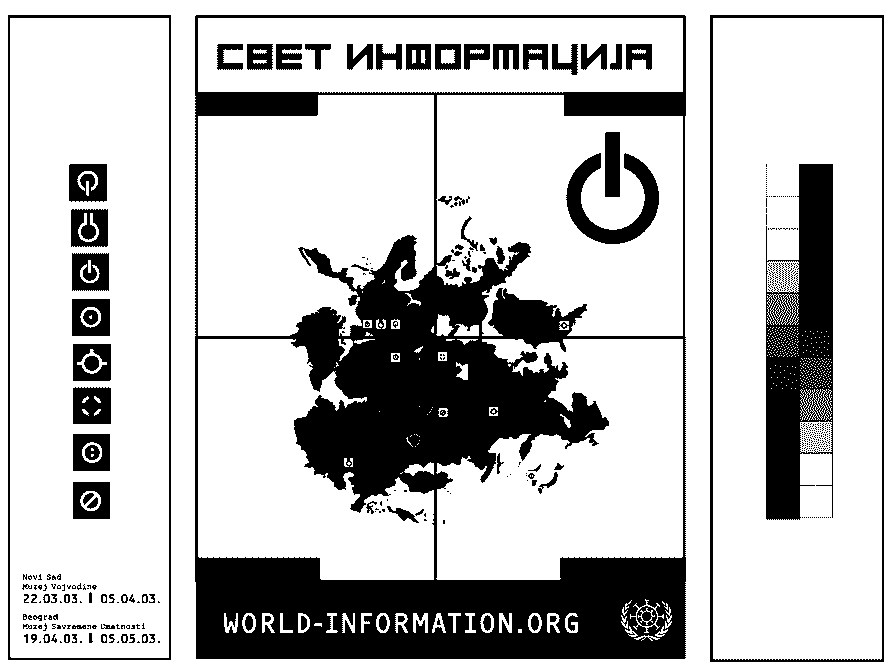
In the early 2000s, as Serbia was emerging from political isolation and re-establishing cultural networks after the conflicts of the 1990s, World-Information.Org, together with kuda.org programs such as kuda.lounge, played a significant role in fostering transnational connections between Serbian practitioners and international peers, while consolidating alternative cultural infrastructures in Novi Sad. The event may be regarded as a foundational moment for the post-war digital art and critical media scene in the FR Yugoslavia (SRJ). The Novi Sad edition took place under exceptional circumstances, during a state of emergency declared following the assassination of Prime Minister Zoran Đinđić, ten days prior to the opening.
Artists & Projects: 0100101110101101.ORG, Apsolutno, Belgrade Yard Soundsystem, Bureau d’Etudes , Critical Art Ensemble, Derek Holzer, dieb13, Darko Fritz, Eastwood RTSG, GLOW, Ingo Gunther, Zina Kaye, Margarethe Jahrmann, Vladan Joler, kuda.org, Christoph Kummerer, Max Moswitzer, Marko Peljhan, PURE, Martin Ratniks, Raitis Smits, Rasa Smite, Mr. Snow, Goran Strugar, Surveillance Camera Players, Zoran Todorović, AnitaWitek.
>
>
MCTE
2003
Game
MC
Multi Consumer Trauma Experience
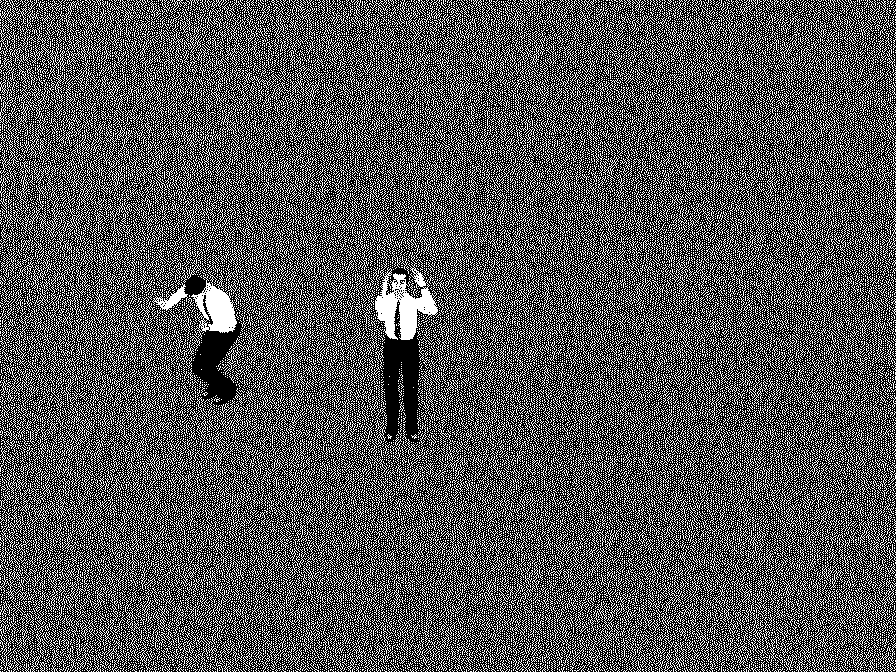
MCTE is a software intervention produced through the deconstruction of The Sims (Maxis / Electronic Arts). The original game operates as a simulation of consumer society, positioning the player as its fundamental unit: the consumer. Gameplay is structured around the maintenance of a digital body and its basic needs, with optimization enabling the continuous accumulation of consumer power.
In MCTE, user interaction is suspended. The player is displaced into the role of a detached observer, confronted with a quasi-sociological experiment in which two characters are subjected to a dysfunctional environment stripped of the operative logics of consumer society. This modification converts the game into an automated performance - a bot-based theatre - where prolonged states of deprivation, struggle, and breakdown unfold in real time.
>
Breakout XP
2003
Game
XP
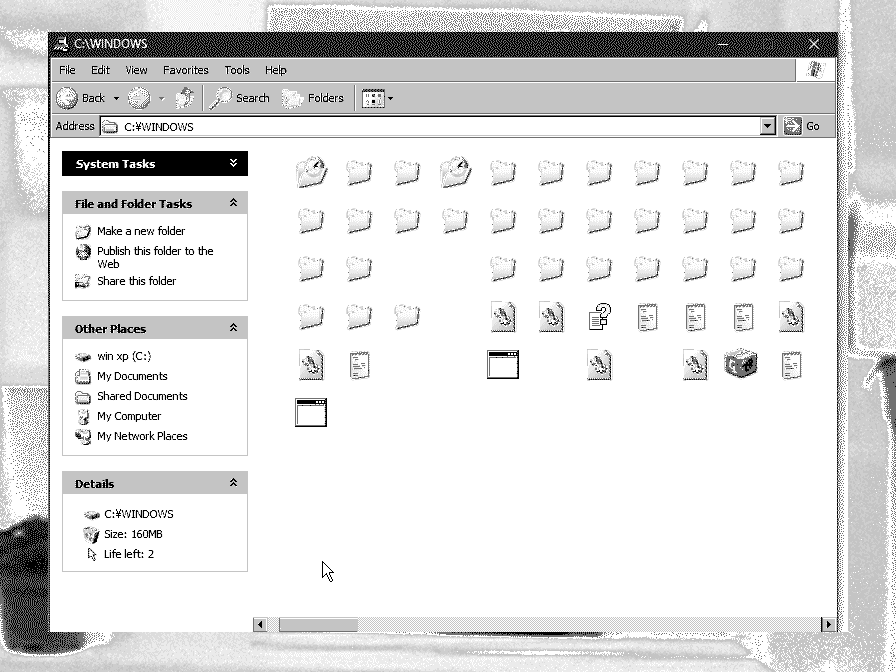
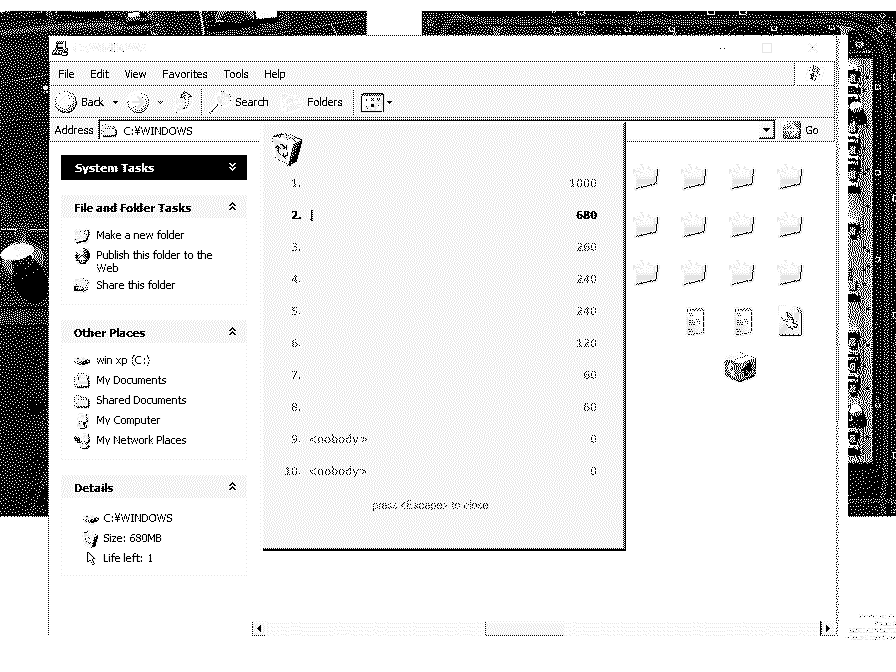
BreakOut XP is the second work in a series of critical games that appropriate the graphical interface of the Microsoft Windows operating system, reconfiguring it as a variation of the 1976 Atari arcade game Breakout. The original Breakout was famously prototyped by Steve Wozniak and Steve Jobs, situating the work within an early genealogy of personal computing and game culture.
By merging Windows XP with Breakout, the project stages a symbolic confrontation within the historical “operating system wars,” reframing the desktop interface as a contested battlefield between competing technological empires. The familiar environment of the OS is thus transformed into a site of play, conflict, and critique.
An online multiplayer version was envisioned as a file-destruction competition, in which two players would attempt to delete each other’s files, positioning the work at the threshold between game, software sabotage, and computer virus. This multiplayer iteration, however, was never completed.
>
>
>
Explorer 98
2002
Game
98
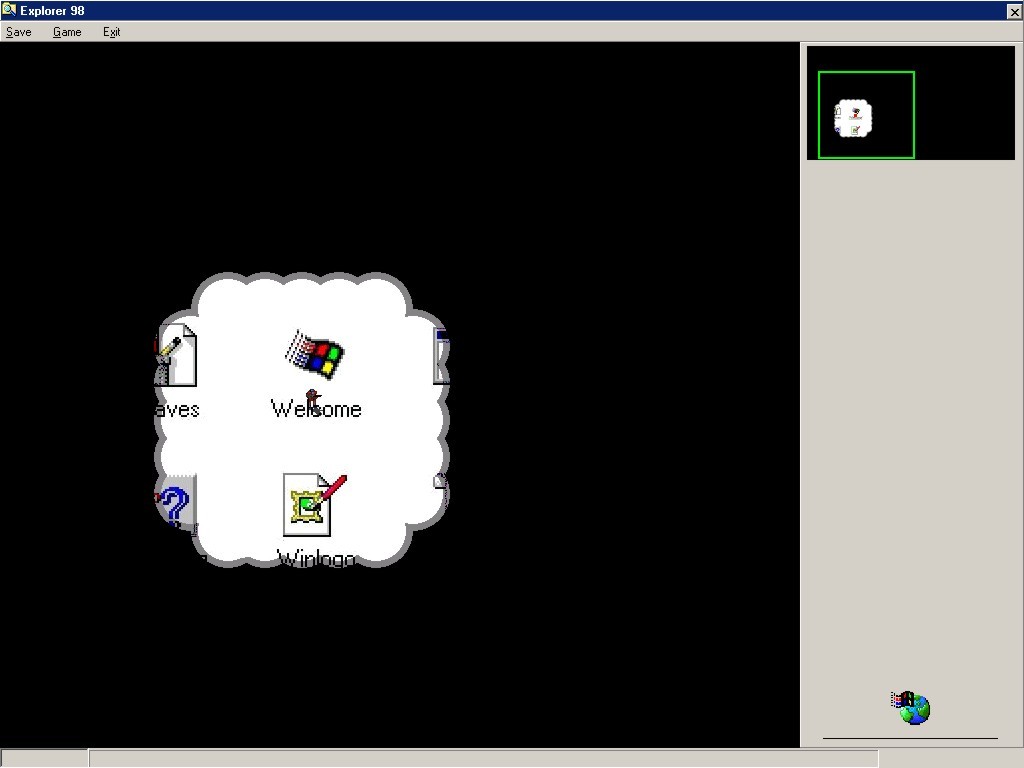
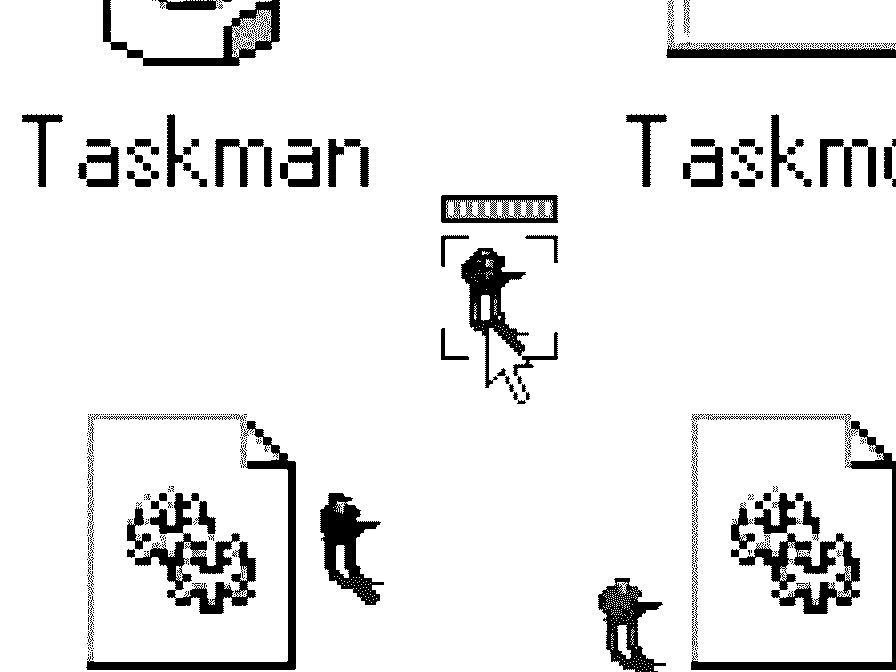
Explorer 98 is a game, which is based on two inseparable parts of today’s industry of fun: corporations that make computer games, and platforms—operative systems on which games have been played. The game explorer 98 is a perverse convergence of the largest software corporation, Microsoft, and one of the biggest studios for RTS (real-time strategy) games, Westwood Studio. explorer 98 is a RTS game but also includes several other genre elements of contemporary computer games as adventures or arcades. explorer 98 uses as its game map snapshots (print screens) from Windows explorer 98 browser that is a constitutive part of the Windows 98 operating system. Units in the game are units from Westwood’s game from the Command & Conquer Series: Tiberian Sun. Symbolically, this game is played inside the very core of the Microsoft empire, inside Windows Explorer, the ultimate search engine in Windows’ operating system. There is only one campaign. The player is always on the side of Microsoft; he/she must choose to be a hero of the Microsoft Windows empire against evil terrorists. There is no alternative. Everything, from the explorer map to the units is cut/pasted and then included in the game. All software is illegal/pirate (Windows98, Westwood’s Tiberian Sun), and it was bought on the Novi Sad black market.
>
>
Qexpl1.exe
2002
Game
QE
After incidentally getting my hands on Mute Magazine No. 22 (December 2001) and opening the small transparent CD attached to it, labeled in tiny letters "Untitled Game", I was blown away. Although I had been playing, making, and destroying games since the mid-1980s on the C64 and Amiga 500, JODI’s raw, punk deconstruction of Quake was a revelation, opening my eyes to what both art and games could, and should be.
I immediately cracked my own version of Quake, deleted all textures, replaced them with a single black-and-white pixel, and dismantled the user interface. From that moment on, over the following years, I became obsessively engaged in the tactical and political deconstruction and modification of games.
Download game (Windows)
>
>
>
1990s
1996-2000
Actions in public space Installations Web art
Less than two months after I began studying at the Academy of Arts in Novi Sad in 1996, the student uprising in Serbia against Milošević began. From that moment until the end of my studies - which coincidentally coincided with the fall of the Milošević regime in October 2000 - we engaged in various forms of artistic intervention, self-organization, and mobilization. In the context of extreme poverty, isolation, a decade-long war and repression - low-budget, low-tech, socially and politically engaged art practice was more a necessity than a choice.
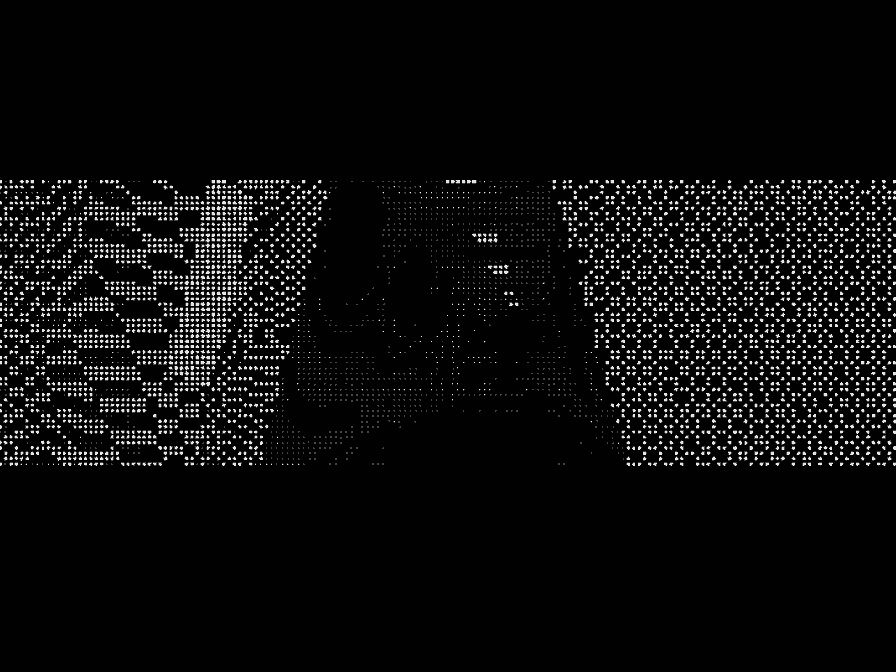
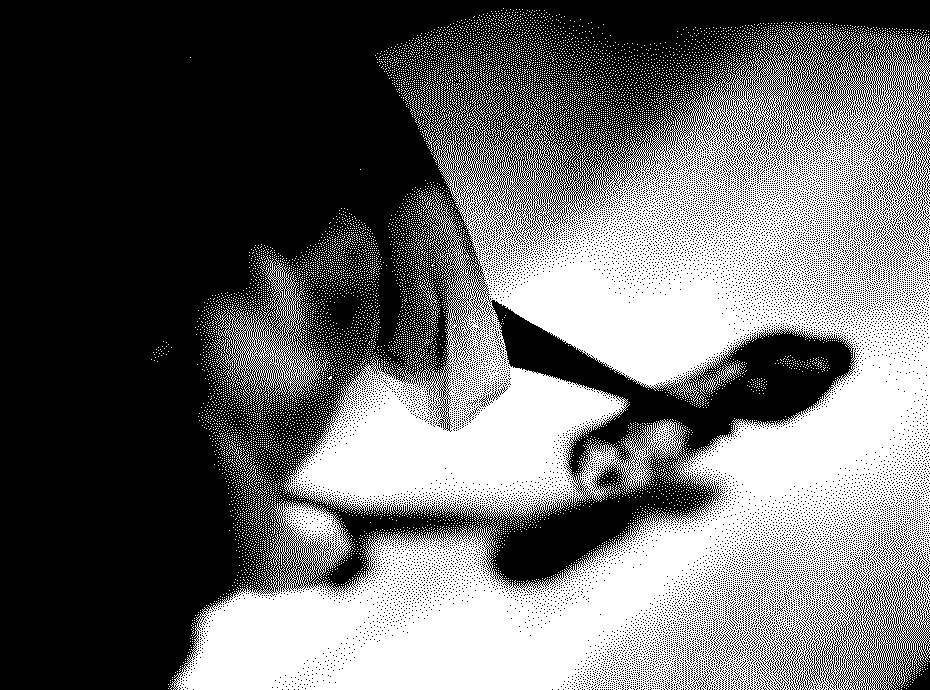
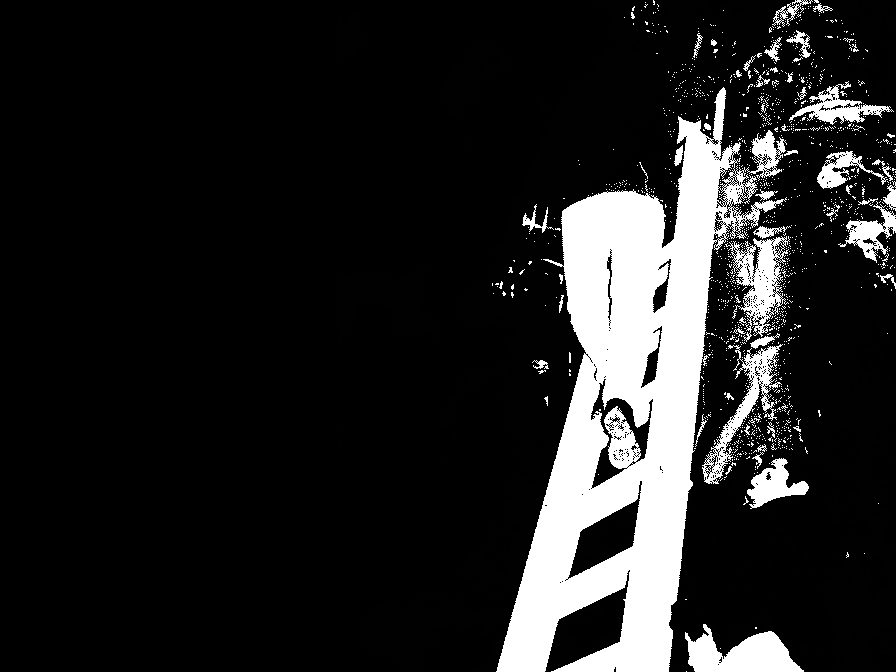
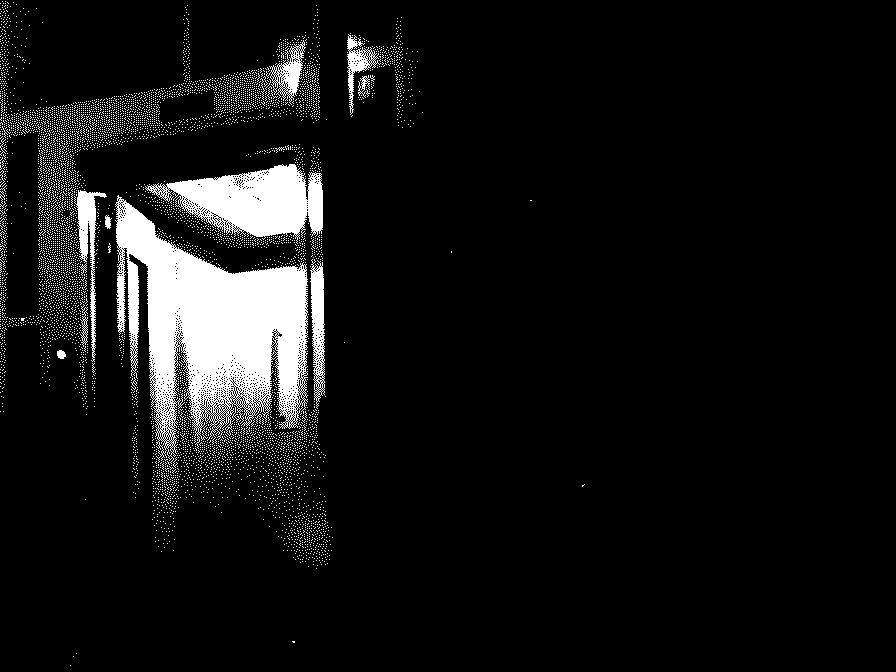
In November 1996, it all began with an intervention at the main square in Novi Sad, at a monument on which we hung a large metal whistle, a symbol of the student protests (image 1). In 1997, I received my first award for a computer-based installation consisting of a collection of sound recordings capturing uncomfortable moments of silence in elevators (image 2). We walked around Novi Sad carrying metal scrap objects with our personal ID numbers printed on them (image 3), and I glued prints featuring the faces of my friends across Milan as a protest against the restrictions on freedom of movement imposed by international sanctions (image 4). Just one day before the beginning of the NATO war against Yugoslavia, I was scheduled to exhibit an inflamed, surgically removed human appendix (image 5) at CZKD in Belgrade.
>
>
>
*Awards, collections and commisions
Acquisition for a collection
Rijks Museum Nederlands
2025
CE
Silver Lion
La Biennale di Venezia, Biennale Architettura 2025
2025
CE
S+T+ARTS Prize
European Commission
2024
CE
Boghossian Foundation International Prize
Boghossian Foundation
2024
CE
Commission
Fondazione Prada - Calculating Empires
2023
CE
Acquisition for a collection
Design Museum London
2020
AN
Design of the year award
Design Museum in London
2019
AN
S+T+ARTS Prize - Honorary mention
European Commission
2019
AN
Acquisition for a collection
Victoria and Albert Museum
2019
AN
Acquisition for a collection
Museum of Modern Art (MoMA) New York
2019
AN
Award for outstanding contribution to the promotion of the right to protection of personal data
Commissioner for Information of the Republic of Serbia
2018
50 People Who Made the Internet a Better Place
Mozilla Foundation
2016
Recent Exhibitions
Württembergischer Kunstverein
Stuttgart
2021
AN
Kunstgewerbemuseum
Dresden
2020
AN
Frankfurter Kunstverein
Frankfurt
2020
AN
Media
Art News
Nov 17, 2023
At MoMA, Artists Are Making Sense of the World’s Most Dangerous and Valuable Resource: Data
Forbes
Dec 19, 2023
To Reveal The Hidden Systems Controlling Tech, These Amazing Charts Are Only Shown Offline
The Wall Street Journal
Jan 25, 2023
The Art Behind Supply Chains Is Front and Center at a Museum Exhibit
The Verge
Sep 9, 2017
This beautiful map shows everything that powers an Amazon Echo, from data mines to lakes of lithium
Selected academic lectures and talks
2025
A
Politecnico di Milano
Milano
10th STS Italia Conference Technoscience for Good
A
John Cabot University
Rome
Critical data studies
A
Bibliotheca Hertziana
Rome
Is AI Art Net Art?
2024
T
New European Bauhaus
Brussels
Archipelago of Futures Symposium
T
CPDP
Brussels
Keynote
T
WIP 2024
Nicosia
New Extractivism
T
Victoria and Albert Museum
London
DDW
A
Moholy-Nagy University of Art and Design
Budapest
Cumulus 2024, keynote lecture
A
Akademie der Bildenden Künste
Munchen
If AI was the answer, what was the question, again?
A
Liverpool School of Art and Design
Liverpool
Visual Communication Cultures
A
Kunstuniversität Linz
Linz
Critical Data Research Group
A
UZH - Center for Art and Cultural Theory
Zurich
Art with/against AI
A
John Cabot University
Rome
Decolonize Digital Delights & Disturbances
A
School of Visual Arts
New York
The Algorithmic State: Invisible Human Labor Curatorial Practice
2023
Academic
UDK and TU
Berlin
New Practice in Art and Technology
Academic
Doctoral School on Sustainable ICT
Grenoble
Radical changes for sustainable and equitable ICT
Academic
ELISAVA
Barcelona
Master in Design for Responsible AI
Academic
IT:U Austria
Linz
FOUNDING LAB
2022
Academic
UNDP and University of Belgrade - FPN
Belgrade
Kapuscinski Development Lectures
Academic
TU - Architecture Theory
Berlin
Abstract Traces
Academic
University of Sarajevo - FPN
Sarajevo
Teaching Concepts and Evaluation in Times of Information Disorder
2021
Academic
Holon Institute of Technology
Holon
The Impact of the Artificial Intelligence on Contemporary Design
2020
Academic
C²DH
Luxembourg
Hands-on history lecture
2019
Academic
Royal Danish Academy of Fine Arts
Copenhagen
Open Practice: Digital Matters
Academic
National College of Art and Design
Dublin
Digital research methods and practice-based research
Academic
HfG Karlsruhe
Karlsruhe
Forensics of Exploitation : Anatomy of an AI
Academic
Aarhus University
Aarhus
Facial machines and obfuscation in an age of biometrics and neural networks
Academic
University of Dundee
Dundee
Sustainable Development Goals Through Design
Academic
The University of Nottingham China
Ningbo
Social Science Research on Artificial Intelligence Workshop
2018
Academic
University of Oxford
Oxford
Annenberg-Oxford Media Policy Summer Institute
Academic
Center for Urban History of ECE
Lyviv
Digital Mapping and Historical Imagination
2017
Academic
University College London UCL Faculty of Laws
London
Privacy online and offline: Data, the personal and the public interest
Academic
National Institute for Design
Ahmedabad
Open IoT Studio
2016
Academic
School of Visual Arts
New York
Exploitation Forensics
Thank You.
Vladan Joler
Prof. dr. Vladan Joler (1977) is an academic, researcher and artist whose work blends critical and system design, data investigations, counter-cartography, data visualization, and numerous other disciplines. He explores and visualizes different technical and social aspects of algorithmic transparency, digital labour exploitation, invisible infrastructures and many other contemporary phenomena in the intersection between technology and society.
In 2023, in collaboration with Kate Crawford, he published Calculating Empires, a large-scale research visualization exploring how technical and social structures have co-evolved over five centuries. In 2018, also with Kate Crawford, he published, Anatomy of an AI System, a large-scale map and long-form essay investigating the human labor, data and planetary resources required to build and operate an Amazon Echo device.
As co-founder and director of the SHARE Foundation - one of the leading expert and activist organizations in the field of digital rights in Southeast Europe - Vladan has played an active role in organizing, researching, creating, and advocating for public policies at the national, regional, and European levels. His earlier study Facebook Algorithmic Factory included deep forensic investigations and visual mapping of the algorithmic processes and forms of exploitation behind the world’s largest social network. Other studies he authored, published in recent years by the independent research collective SHARE Lab, have examined information warfare, metadata analysis, browsing history exploitation, surveillance, and Internet architecture.
He has curated and organized numerous events and gatherings of Internet activists, artists and investigators, including SHARE events in Belgrade and Beirut. His artistic pre-history is rooted in media activism and game hacking.
He has received numerous awards, including the Silver Lion at the 2025 Venice Architettura Biennale, S+T+ARTS 2024 Grand prize of the European Commission, 2019 Design of the Year Award by the Design Museum in London.
Vladan Joler’s work is included in the permanent collections of the Museum of Modern Art (MoMA) in New York, the Victoria and Albert Museum Design Museum in London, and the Rijksmuseum in Twenthe, and also in the permanent exhibition of the Ars Electronica Center. His work has been exhibited in more than a hundred international exhibitions.
Text
Label
CE
*
Label
Text
Text
Text
Text
>
>
>
Vladan Joler
Prof. dr. Vladan Joler (1977) is an academic, researcher and artist whose work blends critical and system design, data investigations, counter-cartography, data visualization, and numerous other disciplines. He explores and visualizes different technical and social aspects of algorithmic transparency, digital labour exploitation, invisible infrastructures and many other contemporary phenomena in the intersection between technology and society.
In 2023, in collaboration with Kate Crawford, he published Calculating Empires, a large-scale research visualization exploring how technical and social structures have co-evolved over five centuries. In 2018, also with Kate Crawford, he published, Anatomy of an AI System, a large-scale map and long-form essay investigating the human labor, data and planetary resources required to build and operate an Amazon Echo device.
As co-founder and director of the SHARE Foundation - one of the leading expert and activist organizations in the field of digital rights in Southeast Europe - Vladan has played an active role in organizing, researching, creating, and advocating for public policies at the national, regional, and European levels. His earlier study Facebook Algorithmic Factory included deep forensic investigations and visual mapping of the algorithmic processes and forms of exploitation behind the world’s largest social network. Other studies he authored, published in recent years by the independent research collective SHARE Lab, have examined information warfare, metadata analysis, browsing history exploitation, surveillance, and Internet architecture.
He has curated and organized numerous events and gatherings of Internet activists, artists and investigators, including SHARE events in Belgrade and Beirut. His artistic pre-history is rooted in media activism and game hacking.
He has received numerous awards, including the Silver Lion at the 2025 Venice Architettura Biennale, S+T+ARTS 2024 Grand prize of the European Commission, 2019 Design of the Year Award by the Design Museum in London.
Vladan Joler’s work is included in the permanent collections of the Museum of Modern Art (MoMA) in New York, the Victoria and Albert Museum Design Museum in London, and the Rijksmuseum in Twenthe, and also in the permanent exhibition of the Ars Electronica Center. His work has been exhibited in more than a hundred international exhibitions.
Vladan Joler
Prof. dr. Vladan Joler (1977) is an academic, researcher and artist whose work blends critical and system design, data investigations, counter-cartography, data visualization, and numerous other disciplines. He explores and visualizes different technical and social aspects of algorithmic transparency, digital labour exploitation, invisible infrastructures and many other contemporary phenomena in the intersection between technology and society.
In 2023, in collaboration with Kate Crawford, he published Calculating Empires, a large-scale research visualization exploring how technical and social structures have co-evolved over five centuries. In 2018, also with Kate Crawford, he published, Anatomy of an AI System, a large-scale map and long-form essay investigating the human labor, data and planetary resources required to build and operate an Amazon Echo device.
As co-founder and director of the SHARE Foundation - one of the leading expert and activist organizations in the field of digital rights in Southeast Europe - Vladan has played an active role in organizing, researching, creating, and advocating for public policies at the national, regional, and European levels. His earlier study Facebook Algorithmic Factory included deep forensic investigations and visual mapping of the algorithmic processes and forms of exploitation behind the world’s largest social network. Other studies he authored, published in recent years by the independent research collective SHARE Lab, have examined information warfare, metadata analysis, browsing history exploitation, surveillance, and Internet architecture.
He has curated and organized numerous events and gatherings of Internet activists, artists and investigators, including SHARE events in Belgrade and Beirut. His artistic pre-history is rooted in media activism and game hacking.
He has received numerous awards, including the Silver Lion at the 2025 Venice Architettura Biennale, S+T+ARTS 2024 Grand prize of the European Commission, 2019 Design of the Year Award by the Design Museum in London.
Vladan Joler’s work is included in the permanent collections of the Museum of Modern Art (MoMA) in New York, the Victoria and Albert Museum Design Museum in London, and the Rijksmuseum in Twenthe, and also in the permanent exhibition of the Ars Electronica Center. His work has been exhibited in more than a hundred international exhibitions.
*Awards, collections and commisions
*Awards, collections and commisions
Recent Exhibitions
Recent Exhibitions
Acquisition for a collection
Rijks Museum Nederlands
2025
CE
Silver Lion
La Biennale di Venezia, Biennale Architettura 2025
2025
CE
S+T+ARTS Prize
European Commission
2024
CE
Boghossian Foundation International Prize
Boghossian Foundation
2024
CE
Commission
Fondazione Prada - Calculating Empires
2023
CE
Acquisition for a collection
Design Museum London
2020
AN
Design of the year award
Design Museum in London
2019
AN
S+T+ARTS Prize - Honorary mention
European Commission
2019
AN
Acquisition for a collection
Victoria and Albert Museum
2019
AN
Acquisition for a collection
Museum of Modern Art (MoMA) New York
2019
AN
Award for outstanding contribution to the promotion of the right to protection of personal data
Commissioner for Information of the Republic of Serbia
2018
50 People Who Made the Internet a Better Place
Mozilla Foundation
2016
Acquisition for a collection
Rijks Museum Nederlands
2025
CE
Silver Lion
La Biennale di Venezia, Biennale Architettura 2025
2025
CE
S+T+ARTS Prize
European Commission
2024
CE
Boghossian Foundation International Prize
Boghossian Foundation
2024
CE
Commission
Fondazione Prada - Calculating Empires
2023
CE
Acquisition for a collection
Design Museum London
2020
AN
Design of the year award
Design Museum in London
2019
AN
S+T+ARTS Prize - Honorary mention
European Commission
2019
AN
Acquisition for a collection
Victoria and Albert Museum
2019
AN
Acquisition for a collection
Museum of Modern Art (MoMA) New York
2019
AN
Award for outstanding contribution to the promotion of the right to protection of personal data
Commissioner for Information of the Republic of Serbia
2018
50 People Who Made the Internet a Better Place
Mozilla Foundation
2016
Sesc Campinas
2025
CE
AN
Museum of Contemporary Art
2025
AN
Le Lieu Unique
2025
CE
Industrial Art Biennale
2025
CE
Architekturmuseum der TUM
2025
AN
Lisbon Triennale
2025
CE
Boghossian foundation
2025
CE
Kunsthalle Wien
2025
CE
La Biennale di Venezia Architecture
2025
CE
Design Museum London
2025
MB
Mori Art Museum
2025
CE
Jeu de Paume
2025
CE
AN
Galerie Rudolfinum
2025
CE
LABoral Centro de Arte
2025
CE
AN
MB
FB
Sharjah Biennial 16
2025
NX
Disseny Hub
2025
CE
Art Basel
2024
MB
KW Institute
2024
CE
NX
Rijksmuseum
2024
CE
National Communication Museum
2024
AN
ScreenSaverGallery
2024
NX
Kunsthal Charlottenborg
2024
AN
NX
Ars Electronica
2024
CE
Noorderlicht
2024
CE
Galleria d'Arte Moderna e Contemporanea
2023
NX
Ars Electronica
2023
MB
IMPAKT
2023
NX
Fondazione Prada
2023
CE
Museum of Modern Art
2022-2024
AN
Aksioma
2022
NX
Ludwig Maximilian University
2022
AN
Biennale Internationale Design
2022
AN
European Parliament
2022
AN
Biennale Warszawa
2022
NO
NEME
2022
NX
Australian National University
2022
AN
Tactical Tech
2022
NX
Ludwig Múzeum
2022
AN
KAI 10
2022
AN
Kunsthalle Zürich
2022
AN
MSUV
2022
AN
Centro José Guerrero
2021
AN
ELISAVA
2021
AN
NX
FB
Taiwan Contemporary Culture Lab
2021
AN
Württembergischer Kunstverein
2021
AN
OFF Biennale
2021
AN
NX
FB
Ludwig Forum für Internationale Kunst
2021
AN
13th Gwangju Biennale
2021
AN
Hyundai Motor Studio
2021
AN
Electromuseum
2020
FB
Kunstgewerbemuseum
2020
AN
Yuz Museum
2020
AN
Collegium Helveticum
2020
AN
Yerevan Biennial!
2020
NX
Bozar
2020
AN
Frankfurter Kunstverein
2020
AN
Sesc Campinas
2025
CE
AN
Museum of Contemporary Art
2025
AN
Le Lieu Unique
2025
CE
Industrial Art Biennale
2025
CE
Architekturmuseum der TUM
2025
AN
Lisbon Triennale
2025
CE
Boghossian foundation
2025
CE
Kunsthalle Wien
2025
CE
La Biennale di Venezia Architecture
2025
CE
Design Museum London
2025
MB
Mori Art Museum
2025
CE
Jeu de Paume
2025
CE
AN
Galerie Rudolfinum
2025
CE
LABoral Centro de Arte
2025
CE
AN
MB
FB
Sharjah Biennial 16
2025
NX
Disseny Hub
2025
CE
Art Basel
2024
MB
KW Institute
2024
CE
NX
Rijksmuseum
2024
CE
National Communication Museum
2024
AN
ScreenSaverGallery
2024
NX
Kunsthal Charlottenborg
2024
AN
NX
Ars Electronica
2024
CE
Noorderlicht
2024
CE
Galleria d'Arte Moderna e Contemporanea
2023
NX
Ars Electronica
2023
MB
IMPAKT
2023
NX
Fondazione Prada
2023
CE
Museum of Modern Art
2022-2024
AN
Aksioma
2022
NX
Ludwig Maximilian University
2022
AN
Biennale Internationale Design
2022
AN
European Parliament
2022
AN
Biennale Warszawa
2022
NO
NEME
2022
NX
Australian National University
2022
AN
Tactical Tech
2022
NX
Ludwig Múzeum
2022
AN
KAI 10
2022
AN
Kunsthalle Zürich
2022
AN
MSUV
2022
AN
Centro José Guerrero
2021
AN
ELISAVA
2021
AN
NX
FB
Taiwan Contemporary Culture Lab
2021
AN
Württembergischer Kunstverein
2021
AN
OFF Biennale
2021
AN
NX
FB
Ludwig Forum für Internationale Kunst
2021
AN
13th Gwangju Biennale
2021
AN
Hyundai Motor Studio
2021
AN
Electromuseum
2020
FB
Kunstgewerbemuseum
2020
AN
Yuz Museum
2020
AN
Collegium Helveticum
2020
AN
Yerevan Biennial!
2020
NX
Bozar
2020
AN
Frankfurter Kunstverein
2020
AN
Media
Media
Forbes
Dec 19, 2023
To Reveal The Hidden Systems Controlling Tech, These Amazing Charts Are Only Shown Offline
Art News
Nov 17, 2023
At MoMA, Artists Are Making Sense of the World’s Most Dangerous and Valuable Resource: Data
The Wall Street Journal
Jan 25, 2023
The Art Behind Supply Chains Is Front and Center at a Museum Exhibit
The Verge
Sep 9, 2017
This beautiful map shows everything that powers an Amazon Echo, from data mines to lakes of lithium
Forbes
Dec 19, 2023
To Reveal The Hidden Systems Controlling Tech, These Amazing Charts Are Only Shown Offline
Art News
Nov 17, 2023
At MoMA, Artists Are Making Sense of the World’s Most Dangerous and Valuable Resource: Data
The Wall Street Journal
Jan 25, 2023
The Art Behind Supply Chains Is Front and Center at a Museum Exhibit
The Verge
Sep 9, 2017
This beautiful map shows everything that powers an Amazon Echo, from data mines to lakes of lithium
Selected academic lectures and talks
Selected academic lectures and talks
2025
A
Politecnico di Milano
Milano
A
John Cabot University
Rome
A
Bibliotheca Hertziana
Rome
2024
T
New European Bauhaus
Brussels
T
CPDP
Brussels
T
WIP 2024
Nicosia
T
Victoria and Albert Museum
London
A
Moholy-Nagy University of Art and Design
Budapest
A
Akademie der Bildenden Künste
Munchen
A
Liverpool School of Art and Design
Liverpool
A
Kunstuniversität Linz
Linz
A
UZH - Center for Art and Cultural Theory
Zurich
A
John Cabot University
Rome
A
School of Visual Arts
New York
2023
Academic
UDK and TU
Berlin
Academic
Doctoral School on Sustainable ICT
Grenoble
Academic
ELISAVA
Barcelona
Academic
IT:U Austria
Linz
2022
Academic
UNDP and University of Belgrade - FPN
Belgrade
Academic
TU - Architecture Theory
Berlin
Academic
University of Sarajevo - FPN
Sarajevo
2021
Academic
Holon Institute of Technology
Holon
2020
Academic
C²DH
Luxembourg
Hands-on history lecture
2019
Academic
Royal Danish Academy of Fine Arts
Copenhagen
Academic
National College of Art and Design
Dublin
Academic
HfG Karlsruhe
Karlsruhe
Academic
Aarhus University
Aarhus
Academic
University of Dundee
Dundee
Academic
The University of Nottingham China
Ningbo
2018
Academic
University of Oxford
Oxford
Academic
Center for Urban History of ECE
Lyviv
2017
Academic
University College London UCL Faculty of Laws
London
Academic
National Institute for Design
Ahmedabad
2016
Academic
School of Visual Arts
New York
2025
A
Politecnico di Milano
Milano
A
John Cabot University
Rome
A
Bibliotheca Hertziana
Rome
2024
T
New European Bauhaus
Brussels
T
CPDP
Brussels
T
WIP 2024
Nicosia
T
Victoria and Albert Museum
London
A
Moholy-Nagy University of Art and Design
Budapest
A
Akademie der Bildenden Künste
Munchen
A
Liverpool School of Art and Design
Liverpool
A
Kunstuniversität Linz
Linz
A
UZH - Center for Art and Cultural Theory
Zurich
A
John Cabot University
Rome
A
School of Visual Arts
New York
2023
Academic
UDK and TU
Berlin
Academic
Doctoral School on Sustainable ICT
Grenoble
Academic
ELISAVA
Barcelona
Academic
IT:U Austria
Linz
2022
Academic
UNDP and University of Belgrade - FPN
Belgrade
Academic
TU - Architecture Theory
Berlin
Academic
University of Sarajevo - FPN
Sarajevo
2021
Academic
Holon Institute of Technology
Holon
2020
Academic
C²DH
Luxembourg
Hands-on history lecture
2019
Academic
Royal Danish Academy of Fine Arts
Copenhagen
Academic
National College of Art and Design
Dublin
Academic
HfG Karlsruhe
Karlsruhe
Academic
Aarhus University
Aarhus
Academic
University of Dundee
Dundee
Academic
The University of Nottingham China
Ningbo
2018
Academic
University of Oxford
Oxford
Academic
Center for Urban History of ECE
Lyviv
2017
Academic
University College London UCL Faculty of Laws
London
Academic
National Institute for Design
Ahmedabad
2016
Academic
School of Visual Arts
New York
Reverse Contradictionary
Book
The entire cultural output of humanity is being fed into AI. Large Language Models are ingesting not only books, articles, and blogs in their entirety, but also the content of our private written and spoken conversations. LLMs are boiling lakes and burning down forests to generate texts based on statistical mediocrity, which we are supposed to worship as the beginning of a great new gilded age.
This is where Reverse Contradictionary comes into play — a collaborative effort by critical media titans Vuk Ćosić, IOCOSE and Vladan Joler. Their new “Dictionary of New Worlds” presents selected confrontational neologisms that, with acute insight and subtle provocation, challenge and overturn the predatory, algorithmic logic embedded in statistical language.
With a preface by Yes Men and a terrifying blurb by real Slavoj Žižek.
>
>
>
Reverse Contradictionary
Book
The entire cultural output of humanity is being fed into AI. Large Language Models are ingesting not only books, articles, and blogs in their entirety, but also the content of our private written and spoken conversations. LLMs are boiling lakes and burning down forests to generate texts based on statistical mediocrity, which we are supposed to worship as the beginning of a great new gilded age.
This is where Reverse Contradictionary comes into play — a collaborative effort by critical media titans Vuk Ćosić, IOCOSE and Vladan Joler. Their new “Dictionary of New Worlds” presents selected confrontational neologisms that, with acute insight and subtle provocation, challenge and overturn the predatory, algorithmic logic embedded in statistical language.
With a preface by Yes Men and a terrifying blurb by real Slavoj Žižek.
>
>
>
Testimonies of Police Brutality
Data Collection Investigation Database Installation
TE
“Testimonies of Police Brutality” were created through research and an artistic installation, based on anonymous accounts of various forms of repression-physical violence, the use of pyrotechnic and chemical agents, as well as the detention of citizens against their will. These events took place during the night of September 5–6 on the campus of the University of Novi Sad, targeting students, professors, and citizens.
The peaceful student protest was a response to the gross violation of the university’s autonomy, guaranteed by the Constitution and law. Continuing the practice of art that engages in (re)interpretation and (de)construction of memory, the collected testimonies become a case study and the foundation of a unique database-an archive of accumulated information and knowledge. The artistic research thus becomes a resource for recontextualizing current events and a form of symbolic capital which, through public accessibility, gains social power and the potential to challenge dominant narratives.
>
Testimonies of Police Brutality
Data Collection Investigation Database Installation
TE
“Testimonies of Police Brutality” were created through research and an artistic installation, based on anonymous accounts of various forms of repression-physical violence, the use of pyrotechnic and chemical agents, as well as the detention of citizens against their will. These events took place during the night of September 5–6 on the campus of the University of Novi Sad, targeting students, professors, and citizens.
The peaceful student protest was a response to the gross violation of the university’s autonomy, guaranteed by the Constitution and law. Continuing the practice of art that engages in (re)interpretation and (de)construction of memory, the collected testimonies become a case study and the foundation of a unique database-an archive of accumulated information and knowledge. The artistic research thus becomes a resource for recontextualizing current events and a form of symbolic capital which, through public accessibility, gains social power and the potential to challenge dominant narratives.
>
Testimonies of the sonic weapon attack
Data Collection Data Investigation Database
TE
During a peaceful protest on March 15, 2025, in Belgrade, which was attended by several hundred thousand citizens, at 7:11 p.m., during a fifteen-minute moment of silence, a disturbing sound incident occurred. An unknown crowd-control device unsettled the protesters and triggered a sudden stampede, panic, and physical injuries. Most often described as a loud roar resembling that of an airplane or a train, sometimes accompanied by a wave of heat, the event provoked various reactions. Thousands citizens reported psychological and physical effects, hundreds of which have been medically documented. During the 48 hours following the incident, we collected more than 3,500 testimonies. Within two weeks, we organized, analyzed, and transformed them into a data-driven storytelling platform.
>
>
Testimonies of the sonic weapon attack
Data Collection Data Investigation Database
TE
During a peaceful protest on March 15, 2025, in Belgrade, which was attended by several hundred thousand citizens, at 7:11 p.m., during a fifteen-minute moment of silence, a disturbing sound incident occurred. An unknown crowd-control device unsettled the protesters and triggered a sudden stampede, panic, and physical injuries. Most often described as a loud roar resembling that of an airplane or a train, sometimes accompanied by a wave of heat, the event provoked various reactions. Thousands citizens reported psychological and physical effects, hundreds of which have been medically documented. During the 48 hours following the incident, we collected more than 3,500 testimonies. Within two weeks, we organized, analyzed, and transformed them into a data-driven storytelling platform.
>
>
Calculating Empires
Large scale map Installation
CE
*
Silver Lion La Biennale di Venezia 2025 S+T+ARTS Prize European Commission 2024 Boghossian Foundation International Prize 2025 Acquisition Rijks Museum Nederlands 2025 Commission Fondazione Prada 2023
A Genealogy of Technology and Power Since 1500
How can we understand the power of technology in the contemporary moment and its role in our lives? What are the historical precedents and patterns that explain how we got here? Calculating Empires is a large-scale evolving artwork that traces the histories, practices, and politics of technology since 1500. The work gives people a different way of seeing the current technological transformations with greater historical depth: our era is the result of long arcs of industrialization, imperialism, scientific revolutions, political revolts, and capitalist extraction. Calculating Empires contextualizes these shifts into an intricate and immersive mural that depicts the myriad ways that power and technology have been intertwined over five centuries, in order to better understand the dramatic changes currently underway.
>
>
>
Calculating Empires
Large scale map Installation
CE
*
Silver Lion La Biennale di Venezia 2025 S+T+ARTS Prize European Commission 2024 Boghossian Foundation International Prize 2025 Acquisition Rijks Museum Nederlands 2025 Commission Fondazione Prada 2023
A Genealogy of Technology and Power Since 1500
How can we understand the power of technology in the contemporary moment and its role in our lives? What are the historical precedents and patterns that explain how we got here? Calculating Empires is a large-scale evolving artwork that traces the histories, practices, and politics of technology since 1500. The work gives people a different way of seeing the current technological transformations with greater historical depth: our era is the result of long arcs of industrialization, imperialism, scientific revolutions, political revolts, and capitalist extraction. Calculating Empires contextualizes these shifts into an intricate and immersive mural that depicts the myriad ways that power and technology have been intertwined over five centuries, in order to better understand the dramatic changes currently underway.
>
>
>
Black Box Cartography
Book
Our online environment has become increasingly populated by artificial agents of various forms. Our ability to understand and investigate such systems is becoming increasingly important as more and more processes in our lives are moderated by AI-based technologies and complex algorithms. However, our understanding of them is still extremely limited. Over the past few years, Vladan Joler has been working (with the help of a network of data analysts, media theorists and cyber forensic experts) to bring to light some of the hidden layers of these systems. Joler’s representational tactics take us into the depths of today’s technological ecosystems. Drawing on the tradition of critical cartography, his maps attempt to unfold the black box of digital infrastructures. Black Box Cartography presents, for the first time together, Vladan Joler’s most important projects.
>
>
>
Black Box Cartography
Book
Our online environment has become increasingly populated by artificial agents of various forms. Our ability to understand and investigate such systems is becoming increasingly important as more and more processes in our lives are moderated by AI-based technologies and complex algorithms. However, our understanding of them is still extremely limited. Over the past few years, Vladan Joler has been working (with the help of a network of data analysts, media theorists and cyber forensic experts) to bring to light some of the hidden layers of these systems. Joler’s representational tactics take us into the depths of today’s technological ecosystems. Drawing on the tradition of critical cartography, his maps attempt to unfold the black box of digital infrastructures. Black Box Cartography presents, for the first time together, Vladan Joler’s most important projects.
>
>
>
Infrastructure of a Migratory Bird
Research Map
MB
*
Acquistion City of Zurich, Art Collection 2023
Infrastructure of a Migratory Bird map shows relationships between social, technological, informational, and ecological elements which make up the anthropogenic ecosystem in which the bird is becoming wild again. It is divided into four quadrants. Top left are elements shaping the public’s understanding of and relationship to the bird. The top right comprises elements generating real-time data flows through which the birds are monitored and the rewilding project makes sense of itself. Bottom left are discontiguous locales connected and adapted to make room for the bird. Bottom right are institutional networks that make up the project, provide funding, and negotiate scientific value. The scales show the spatial, monetary, and temporal dimensions of many of the elements that make up the relational graph. Thus, the scales provide another way of understanding these elements.
>
>
>
Infrastructure of a Migratory Bird
Research Map
MB
*
Acquistion City of Zurich, Art Collection 2023
Infrastructure of a Migratory Bird map shows relationships between social, technological, informational, and ecological elements which make up the anthropogenic ecosystem in which the bird is becoming wild again. It is divided into four quadrants. Top left are elements shaping the public’s understanding of and relationship to the bird. The top right comprises elements generating real-time data flows through which the birds are monitored and the rewilding project makes sense of itself. Bottom left are discontiguous locales connected and adapted to make room for the bird. Bottom right are institutional networks that make up the project, provide funding, and negotiate scientific value. The scales show the spatial, monetary, and temporal dimensions of many of the elements that make up the relational graph. Thus, the scales provide another way of understanding these elements.
>
>
>
Knowing Machines
Research
Knowing Machines is a research project tracing the histories, practices, and politics of how machine learning systems are trained to interpret the world. We are developing critical methodologies and tools for understanding, analyzing, and investigating training datasets, and studying their role in the construction of “ground truth” for machine learning. Our research addresses how datasets index the world, make predictions, and structure knowledge cultures. Working with an international team, we aim to support the emerging field of critical data studies by contributing research, reading lists, research tools, and supporting communities of inquiry that are focused on the foundational epistemologies of machine learning.
With Mike Ananny, Tamar Avishai, Cristo Buschek, Kate Crawford, Melodi Dincer, Hannah Franklin, Jake Karr, Sasha Luccioni, Will Orr, Jason Schultz, Hamsini Sridharan, Jar Thorp, Michael Weinberg, Sarah Ciston, Frances Corry, Annie Dorsen, Edward Kang, Nicola Morrow and Talya Whyte.
>
>
>
Knowing Machines
Research
Knowing Machines is a research project tracing the histories, practices, and politics of how machine learning systems are trained to interpret the world. We are developing critical methodologies and tools for understanding, analyzing, and investigating training datasets, and studying their role in the construction of “ground truth” for machine learning. Our research addresses how datasets index the world, make predictions, and structure knowledge cultures. Working with an international team, we aim to support the emerging field of critical data studies by contributing research, reading lists, research tools, and supporting communities of inquiry that are focused on the foundational epistemologies of machine learning.
With Mike Ananny, Tamar Avishai, Cristo Buschek, Kate Crawford, Melodi Dincer, Hannah Franklin, Jake Karr, Sasha Luccioni, Will Orr, Jason Schultz, Hamsini Sridharan, Jar Thorp, Michael Weinberg, Sarah Ciston, Frances Corry, Annie Dorsen, Edward Kang, Nicola Morrow and Talya Whyte.
>
>
>
A Critical Field Guide for Working With Machine Datasets
Publication
As a part of the Knowing Machines research project, we designed Sarah Ciston’s “A CRITICAL FIELD GUIDE FOR WORKING WITH MACHINE LEARNING DATASETS”. In the tradition of the early net.art experimentation, this Guide was entirely created within a spreadsheet. This experimental design concept is exploring possibilities and constraints of the spreadsheet as a medium that plays an important role in the creation of the machine learning datasets. The illustrations, inspired by early modernism and optical art, play with the idea of a "bureaucratic modernism"–style of art, fitting for an age where everyone is expected to take on the roles of both manager and bureaucrat.
>
>
>
A Critical Field Guide for Working With Machine Datasets
Publication
As a part of the Knowing Machines research project, we designed Sarah Ciston’s “A CRITICAL FIELD GUIDE FOR WORKING WITH MACHINE LEARNING DATASETS”. In the tradition of the early net.art experimentation, this Guide was entirely created within a spreadsheet. This experimental design concept is exploring possibilities and constraints of the spreadsheet as a medium that plays an important role in the creation of the machine learning datasets. The illustrations, inspired by early modernism and optical art, play with the idea of a "bureaucratic modernism"–style of art, fitting for an age where everyone is expected to take on the roles of both manager and bureaucrat.
>
>
>
E-Relevance
Book
This publication is about humans and their preferably democratic future living with machines, in addition to the role that the arts and culture play in this complex environment. The renowned contributors suggest that the public dialogue concerning our shared future needs to be broadened. Just as in past periods of rapid technological progress, contemporary creators and thinkers are now tapping into the excitement of artificial intelligence (AI) and inviting us to critically reconsider the complexities of the human condition and the ambiguity of our relationship with science and technology. Both academic reflections on AI and insights into AI-powered artistic expressions will provide readers with entry points to further investigate what algorithms can and should do for society and the planet.
>
>
>
E-Relevance
Book
This publication is about humans and their preferably democratic future living with machines, in addition to the role that the arts and culture play in this complex environment. The renowned contributors suggest that the public dialogue concerning our shared future needs to be broadened. Just as in past periods of rapid technological progress, contemporary creators and thinkers are now tapping into the excitement of artificial intelligence (AI) and inviting us to critically reconsider the complexities of the human condition and the ambiguity of our relationship with science and technology. Both academic reflections on AI and insights into AI-powered artistic expressions will provide readers with entry points to further investigate what algorithms can and should do for society and the planet.
>
>
>
The Nooscope Manifested
Research Map
NO
AI as Instrument of Knowledge Extractivism
The Nooscope is a cartography of the limits of artificial intelligence, intended as a provocation to both computer science and the humanities. Any map is a partial perspective, a way to provoke debate. Similarly, this map is a manifesto — of AI dissidents. Its main purpose is to challenge the mystifications of artificial intelligence. The purpose of the Nooscope map is to secularize AI from the ideological status of ‘intelligent machine’ to one of knowledge instrument. Rather than evoking legends of alien cognition, it is more reasonable to consider machine learning as an instrument of knowledge magnification that helps to perceive features, patterns, and correlations through vast spaces of data beyond human reach. Borrowing the idea from Gottfried Wilhelm Leibniz, the Nooscope diagram applies the analogy of optical media to the structure of all machine learning apparatuses.
>
>
>
The Nooscope Manifested
Research Map
NO
AI as Instrument of Knowledge Extractivism
The Nooscope is a cartography of the limits of artificial intelligence, intended as a provocation to both computer science and the humanities. Any map is a partial perspective, a way to provoke debate. Similarly, this map is a manifesto — of AI dissidents. Its main purpose is to challenge the mystifications of artificial intelligence. The purpose of the Nooscope map is to secularize AI from the ideological status of ‘intelligent machine’ to one of knowledge instrument. Rather than evoking legends of alien cognition, it is more reasonable to consider machine learning as an instrument of knowledge magnification that helps to perceive features, patterns, and correlations through vast spaces of data beyond human reach. Borrowing the idea from Gottfried Wilhelm Leibniz, the Nooscope diagram applies the analogy of optical media to the structure of all machine learning apparatuses.
>
>
>
New Extractivism
Map Essay Video
NX
An assemblage of concepts and allegories
New Extractivism is a cartographic project that can be understood as a titanic effort to outline interconnections and to make sense of our contemporary reality. The project can be understood as an “assemblage of concepts and allegories”, drawn from a variety of resources: statistical research and data mining, ancient and contemporary philosophy, media theory and fiction, sociology and economics. Pierced together, these fragments take the form of a map, a manual and a video animation that guide the viewer through the traps, tunnels and slippery corridors of a world-scale infrastructure designed to extract, collect, quantify, analyse and connect all aspects of reality and turn them into capital: new accumulations of wealth and power concentrated in a very thin social layer dominated by a few global mega-corporations.
>
New Extractivism
Map Essay Video
NX
An assemblage of concepts and allegories
New Extractivism is a cartographic project that can be understood as a titanic effort to outline interconnections and to make sense of our contemporary reality. The project can be understood as an “assemblage of concepts and allegories”, drawn from a variety of resources: statistical research and data mining, ancient and contemporary philosophy, media theory and fiction, sociology and economics. Pierced together, these fragments take the form of a map, a manual and a video animation that guide the viewer through the traps, tunnels and slippery corridors of a world-scale infrastructure designed to extract, collect, quantify, analyse and connect all aspects of reality and turn them into capital: new accumulations of wealth and power concentrated in a very thin social layer dominated by a few global mega-corporations.
>
Architecture of the Face Recognition System
Research Citizen action Advocacy Map
FR
Belgrade has become the first city in Europe to implement a biometric mass surveillance system across its entire territory, following the Serbian government’s secretive purchase of a facial-recognition system from Huawei with minimal public disclosure. In response, Hiljade Kamera (“Thousands of Cameras”) emerged as a civic initiative and online platform led by activists, digital-rights organizations, and citizens to document, map, and critically examine the rapid and opaque rollout of “Safe City” surveillance technologies in Serbia. Through crowdsourced investigation and the analysis of patents, official documents, and publicly available technical data, the project has revealed far more cameras than authorities acknowledged, exposing serious gaps in transparency, legal oversight, and public debate, while highlighting the risks posed to privacy and civil liberties. The project also produced a detailed investigative map that visualizes not only the local deployment of surveillance cameras but also the broader technical, political, and corporate infrastructures connecting Serbia’s system to global networks of power and control.
>
>
>
Architecture of the Face Recognition System
Research Citizen action Advocacy Map
FR
Belgrade has become the first city in Europe to implement a biometric mass surveillance system across its entire territory, following the Serbian government’s secretive purchase of a facial-recognition system from Huawei with minimal public disclosure. In response, Hiljade Kamera (“Thousands of Cameras”) emerged as a civic initiative and online platform led by activists, digital-rights organizations, and citizens to document, map, and critically examine the rapid and opaque rollout of “Safe City” surveillance technologies in Serbia. Through crowdsourced investigation and the analysis of patents, official documents, and publicly available technical data, the project has revealed far more cameras than authorities acknowledged, exposing serious gaps in transparency, legal oversight, and public debate, while highlighting the risks posed to privacy and civil liberties. The project also produced a detailed investigative map that visualizes not only the local deployment of surveillance cameras but also the broader technical, political, and corporate infrastructures connecting Serbia’s system to global networks of power and control.
>
>
>
Critical Cartography of The Internet and Beyond
Book
Unauthorized Blueprints
“Critical Cartography of the Internet and Beyond” is a large-scale art and research publication that covers early investigations conducted by SHARE Lab between 2014 and 2018. It offers the most comprehensive overview of this initial period of data investigation, beginning with the journey of a single internet packet and culminating in the planetary-scale systems described in Anatomy of an AI System. The book consists of hundreds of large-scale data visualizations, system maps, and diagrams that describe different layers of technological and social systems. An obsession with exploring and visualizing the invisible underpins the investigations documented in this book.
>
>
>
Critical Cartography of The Internet and Beyond
Book
Unauthorized Blueprints
“Critical Cartography of the Internet and Beyond” is a large-scale art and research publication that covers early investigations conducted by SHARE Lab between 2014 and 2018. It offers the most comprehensive overview of this initial period of data investigation, beginning with the journey of a single internet packet and culminating in the planetary-scale systems described in Anatomy of an AI System. The book consists of hundreds of large-scale data visualizations, system maps, and diagrams that describe different layers of technological and social systems. An obsession with exploring and visualizing the invisible underpins the investigations documented in this book.
>
>
>
Anatomy of an AI System
Research Essay Map
AN
*
Design of the year award Design Museum in London 2019 S+T+ARTS Prize - Honorary mention European Commission 2019 Acquisition MoMA New York 2019 Acquisition Design Museum London 2020 Acquisition Victoria and Albert Museum 2019
The Amazon Echo as an anatomical map of human labor, data and planetary resources
Anatomy of an AI System is a large-scale map and long-form essay investigating the human labor, data, and planetary resources required to build and operate an Amazon Echo. The exploded view diagram combines and visualizes three central, extractive processes that are required to run a large-scale artificial intelligence system: material resources, human labor, and data. The map and essay consider these three elements across time—represented as a visual description of the birth, life, and death of a single Amazon Echo unit. The stack that is required to interact with an Amazon Echo goes well beyond the multi-layered ‘technical stack’ of data modeling, hardware, servers, and networks. The full stack reaches much further into capital, labor, and nature, and demands an enormous amount of each. The true costs of these systems—social, environmental, economic, and political—remain hidden and may stay that way for some time. We offer up this map and essay as a way to begin seeing across a wider range of system extractions.
>
>
>
Anatomy of an AI System
Research Essay Map
AN
*
Design of the year award Design Museum in London 2019 S+T+ARTS Prize - Honorary mention European Commission 2019 Acquisition MoMA New York 2019 Acquisition Design Museum London 2020 Acquisition Victoria and Albert Museum 2019
The Amazon Echo as an anatomical map of human labor, data and planetary resources
Anatomy of an AI System is a large-scale map and long-form essay investigating the human labor, data, and planetary resources required to build and operate an Amazon Echo. The exploded view diagram combines and visualizes three central, extractive processes that are required to run a large-scale artificial intelligence system: material resources, human labor, and data. The map and essay consider these three elements across time—represented as a visual description of the birth, life, and death of a single Amazon Echo unit. The stack that is required to interact with an Amazon Echo goes well beyond the multi-layered ‘technical stack’ of data modeling, hardware, servers, and networks. The full stack reaches much further into capital, labor, and nature, and demands an enormous amount of each. The true costs of these systems—social, environmental, economic, and political—remain hidden and may stay that way for some time. We offer up this map and essay as a way to begin seeing across a wider range of system extractions.
>
>
>
SHARE Monastery
Community Event
Since 2017, Share Monastery has evolved into a cornerstone for dialogue, learning, and collaboration at the intersection of technology, society, and human rights. Over the past nine years, with the tenth edition already in preparation, the initiative has built strong partnerships with leading digital policy NGOs such as Share Foundation, Tactical Tech, Digital Freedom Fund, EDRi, and universities including NYU, CEU, the University of Belgrade, and the University of Amsterdam.
Gathering more than 1,200 participants from over 60 countries, including scholars, policymakers, and global leaders, the Monastery has hosted over 30 events that have shaped the regional and international digital rights landscape. Among its most notable programs is the Digital Rights Summer School, introducing digital policy to hundreds of emerging activists, and the Data Investigation Camp in Montenegro, co-organized with Tactical Tech, an event that brought together 50 international experts, data investigators, and storytellers to explore accountability, justice, and transparency.
>
>
>
SHARE Monastery
Community Event
Since 2017, Share Monastery has evolved into a cornerstone for dialogue, learning, and collaboration at the intersection of technology, society, and human rights. Over the past nine years, with the tenth edition already in preparation, the initiative has built strong partnerships with leading digital policy NGOs such as Share Foundation, Tactical Tech, Digital Freedom Fund, EDRi, and universities including NYU, CEU, the University of Belgrade, and the University of Amsterdam.
Gathering more than 1,200 participants from over 60 countries, including scholars, policymakers, and global leaders, the Monastery has hosted over 30 events that have shaped the regional and international digital rights landscape. Among its most notable programs is the Digital Rights Summer School, introducing digital policy to hundreds of emerging activists, and the Data Investigation Camp in Montenegro, co-organized with Tactical Tech, an event that brought together 50 international experts, data investigators, and storytellers to explore accountability, justice, and transparency.
>
>
>
Topography of the Information Warfare
Research Monitoring Map
IW
Governments, political actors and companies are now experimenting with more sophisticated ways (harder to detect and document) of exerting internet control and disturbance in the information flow. The aim of this analysis was to explore (and visualize) some of the forms and methods of interventions that various political actors or power structures have been using to control and conquer various online spheres. Here we mostly focused on hidden, indirect actions, interventions by unknown actors, companies without visible ties to government officials, political troll armies and troll lords and “artificial” entities.
This map is based on a 5-year internet monitoring process and over 400 different cases of violations documented and analyzed by the Share Foundation. Though different methods represented in this map are observed in our local context, we believe that they are also being used worldwide in similar forms. This map is an attempt to interconnect most of those issues into one map, one possible narrative, one possible reading of those processes.
>
>
>
Topography of the Information Warfare
Research Monitoring Map
IW
Governments, political actors and companies are now experimenting with more sophisticated ways (harder to detect and document) of exerting internet control and disturbance in the information flow. The aim of this analysis was to explore (and visualize) some of the forms and methods of interventions that various political actors or power structures have been using to control and conquer various online spheres. Here we mostly focused on hidden, indirect actions, interventions by unknown actors, companies without visible ties to government officials, political troll armies and troll lords and “artificial” entities.
This map is based on a 5-year internet monitoring process and over 400 different cases of violations documented and analyzed by the Share Foundation. Though different methods represented in this map are observed in our local context, we believe that they are also being used worldwide in similar forms. This map is an attempt to interconnect most of those issues into one map, one possible narrative, one possible reading of those processes.
>
>
>
Mapping and quantifying political information warfare
Data Investigation Essay
Propaganda, Domination & Attacks on Online Media
This research by SHARE Lab investigates how political actors in Serbia use online media to dominate public discourse. It documents subtle and overt tactics like propaganda, censorship, content takedowns, distributed denial‐of‐service (DDoS) attacks, and targeted individual attacks. Key findings include the shortening lifespan of online news (typically one to two hours), heavy dominance of ruling party figures in media appearances, and huge reliance on a few news agencies for content that’s widely redistributed. The study also describes how tools and software (sometimes covert) are used to manipulate comment sections and suppress dissenting voices.
>
>
>
Mapping and quantifying political information warfare
Data Investigation Essay
Propaganda, Domination & Attacks on Online Media
This research by SHARE Lab investigates how political actors in Serbia use online media to dominate public discourse. It documents subtle and overt tactics like propaganda, censorship, content takedowns, distributed denial‐of‐service (DDoS) attacks, and targeted individual attacks. Key findings include the shortening lifespan of online news (typically one to two hours), heavy dominance of ruling party figures in media appearances, and huge reliance on a few news agencies for content that’s widely redistributed. The study also describes how tools and software (sometimes covert) are used to manipulate comment sections and suppress dissenting voices.
>
>
>
Browsing Histories
Data Investigation Essay
The SHARE LAB and Tactical Tech research “Browsing Histories – Metadata Explorations” investigates what an individual’s web browsing history can reveal about their identity, preferences, movements, and behaviour by analysing a real dataset from a Swiss journalist. Through metadata and URLs alone, the researchers demonstrate how easily someone’s real name and social graph can be reconstructed, how search queries and visited sites reflect intentions and interests, and how patterns and anomalies in browsing logs can expose habits and even location intentions. The study also highlights the pervasive role of trackers and third parties in collecting browsing data, the privacy implications of such data being accessible to corporations, governments, and surveillance systems, and the broader power dynamics in the information society shaped by access to and analysis of browsing histories.
>
>
>
Browsing Histories
Data Investigation Essay
The SHARE LAB and Tactical Tech research “Browsing Histories – Metadata Explorations” investigates what an individual’s web browsing history can reveal about their identity, preferences, movements, and behaviour by analysing a real dataset from a Swiss journalist. Through metadata and URLs alone, the researchers demonstrate how easily someone’s real name and social graph can be reconstructed, how search queries and visited sites reflect intentions and interests, and how patterns and anomalies in browsing logs can expose habits and even location intentions. The study also highlights the pervasive role of trackers and third parties in collecting browsing data, the privacy implications of such data being accessible to corporations, governments, and surveillance systems, and the broader power dynamics in the information society shaped by access to and analysis of browsing histories.
>
>
>
Dark temples, death and afterlife of technology
Research Workshop
The Mozilla Open IoT Caravan was an epic traveling initiative designed to explore and promote open, ethical, and user-centric approaches to networked technologies through hands-on experimentation and community engagement. It involved collaboratively prototyping devices and scenarios that foregrounded social impact rather than commercial extraction.
The Caravan editions in India gave me the opportunity to conduct in-situ research on the temporality ,death and afterlife of technology, bringing me together with NID students to the massive ship graveyards of Alang Beach, villages where e-waste is processed, and mining sites across Gujarat state. This process became foundational to my interest in the materiality of technology and systemic inequality, which later informed Anatomy of an AI and other subsequent projects.
In parallel, we carried out numerous experimental projects, including an intensive ten-day workshop that nearly evolved into a cyberpunk cult centered on the concept of “Dark Temples”: naturally and artificially created interconnected voids in the electromagnetic spectrum—spaces without signals or connectivity.
>
>
>
Dark temples, death and afterlife of technology
Research Workshop
The Mozilla Open IoT Caravan was an epic traveling initiative designed to explore and promote open, ethical, and user-centric approaches to networked technologies through hands-on experimentation and community engagement. It involved collaboratively prototyping devices and scenarios that foregrounded social impact rather than commercial extraction.
The Caravan editions in India gave me the opportunity to conduct in-situ research on the temporality ,death and afterlife of technology, bringing me together with NID students to the massive ship graveyards of Alang Beach, villages where e-waste is processed, and mining sites across Gujarat state. This process became foundational to my interest in the materiality of technology and systemic inequality, which later informed Anatomy of an AI and other subsequent projects.
In parallel, we carried out numerous experimental projects, including an intensive ten-day workshop that nearly evolved into a cyberpunk cult centered on the concept of “Dark Temples”: naturally and artificially created interconnected voids in the electromagnetic spectrum—spaces without signals or connectivity.
>
>
>
Facebook Algorithmic Factory
Research Essay Map Video
FB
Facebook Algorithmic Factory sheds light on the invisible processes that take place inside the world’s largest social network. Inside this black box, non-transparent algorithms are deciding what kind of content will become a part of our reality, what will be censored or deleted, which ideas will spread and what news will gain most visibility. They are also defining new forms of labor and exploitation. Users are no longer clients. We only provide data, which serves as raw material for the production of digital profiles – a key commodity on internet stock markets. This Factory generates an enormous amount of wealth and power by creating a deep economic gap between those who own and control the means of production and their users, who often live below the poverty line. The layers of algorithmic data processing may conceal new forms of human rights violation, novel mechanisms for exploitation and manipulation that we no longer control. Our first step in fighting them back is to make them visible.
>
>
>
Facebook Algorithmic Factory
Research Essay Map Video
FB
Facebook Algorithmic Factory sheds light on the invisible processes that take place inside the world’s largest social network. Inside this black box, non-transparent algorithms are deciding what kind of content will become a part of our reality, what will be censored or deleted, which ideas will spread and what news will gain most visibility. They are also defining new forms of labor and exploitation. Users are no longer clients. We only provide data, which serves as raw material for the production of digital profiles – a key commodity on internet stock markets. This Factory generates an enormous amount of wealth and power by creating a deep economic gap between those who own and control the means of production and their users, who often live below the poverty line. The layers of algorithmic data processing may conceal new forms of human rights violation, novel mechanisms for exploitation and manipulation that we no longer control. Our first step in fighting them back is to make them visible.
>
>
>
Exploring alternative Internets and unusual forms of networking in Havana
Research Essay
The SHARE LAB research “Exploring Alternative Internets and Unusual Forms of Networking in Havana” examines how, in the context of extremely limited and expensive state-controlled Internet access in Cuba, local communities have built informal, decentralized networking systems that operate outside official infrastructure. It documents the emergence of SNet, a large grassroots mesh network connecting thousands of households across Havana through DIY wired and wireless links, as well as El Paquete, a weekly distributed “offline Internet” of digital content shared island-wide via hard drives and human couriers; the study explores how these systems enable local communication, content sharing, micro-economies, and social interaction while navigating legal constraints and internal norms to survive in an environment of restricted connectivity.
>
>
>
Exploring alternative Internets and unusual forms of networking in Havana
Research Essay
The SHARE LAB research “Exploring Alternative Internets and Unusual Forms of Networking in Havana” examines how, in the context of extremely limited and expensive state-controlled Internet access in Cuba, local communities have built informal, decentralized networking systems that operate outside official infrastructure. It documents the emergence of SNet, a large grassroots mesh network connecting thousands of households across Havana through DIY wired and wireless links, as well as El Paquete, a weekly distributed “offline Internet” of digital content shared island-wide via hard drives and human couriers; the study explores how these systems enable local communication, content sharing, micro-economies, and social interaction while navigating legal constraints and internal norms to survive in an environment of restricted connectivity.
>
>
>
Metadata Investigation : Inside Hacking Team
Data Investigation Essay
Using leaked internal data from the surveillance company Hacking Team, this investigation reconstructs how spyware technologies are marketed, negotiated, and sold to state actors. SHARE LAB analyses emails, contracts, and technical documentation to reveal the commercial logic behind digital surveillance and the ease with which invasive tools circulate globally. The study exposes the gap between public discourse on human rights and the private practices of security procurement, showing how surveillance becomes normalised through bureaucratic and technical processes.
>
>
>
Metadata Investigation : Inside Hacking Team
Data Investigation Essay
Using leaked internal data from the surveillance company Hacking Team, this investigation reconstructs how spyware technologies are marketed, negotiated, and sold to state actors. SHARE LAB analyses emails, contracts, and technical documentation to reveal the commercial logic behind digital surveillance and the ease with which invasive tools circulate globally. The study exposes the gap between public discourse on human rights and the private practices of security procurement, showing how surveillance becomes normalised through bureaucratic and technical processes.
>
>
>
Invisible Infrastructures: Surveillance Architecture
Research Map
SA
This investigation maps how telecommunications infrastructure enables systematic state access to retained metadata. SHARE LAB analyses legal frameworks, technical interfaces, and network design to show how surveillance is embedded at the infrastructural level, often bypassing meaningful oversight. The research reveals how “invisible” systems quietly normalise mass data access, shifting surveillance from exceptional practice to routine governance.
>
>
>
Invisible Infrastructures: Surveillance Architecture
Research Map
SA
This investigation maps how telecommunications infrastructure enables systematic state access to retained metadata. SHARE LAB analyses legal frameworks, technical interfaces, and network design to show how surveillance is embedded at the infrastructural level, often bypassing meaningful oversight. The research reveals how “invisible” systems quietly normalise mass data access, shifting surveillance from exceptional practice to routine governance.
>
>
>
Invisible Infrastructures: Data Flow, trackers and permissions
Data Investigation Essay
The Invisible Infrastructures series examines the hidden architectures of digital power through data flows, online trackers, and mobile permissions. Tracing network routes from Serbia to major global websites, it reveals a highly centralised internet infrastructure shaped by control, monitoring, and dependency. The project also exposes pervasive third-party tracking by dominant platforms such as Google and Facebook, as well as excessive data access enabled by mobile app permissions, critiquing consent mechanisms that mask power asymmetries between users and platforms.
>
>
>
Invisible Infrastructures: Data Flow, trackers and permissions
Data Investigation Essay
The Invisible Infrastructures series examines the hidden architectures of digital power through data flows, online trackers, and mobile permissions. Tracing network routes from Serbia to major global websites, it reveals a highly centralised internet infrastructure shaped by control, monitoring, and dependency. The project also exposes pervasive third-party tracking by dominant platforms such as Google and Facebook, as well as excessive data access enabled by mobile app permissions, critiquing consent mechanisms that mask power asymmetries between users and platforms.
>
>
>
Invisible Infrastructures: Understanding Autonomous Systems
Data Investigation Essay
AS
This foundational study explains how autonomous systems (AS) structure the Internet at a macro level. SHARE LAB introduces readers to the technical and political significance of ISPs, routing, and interconnection agreements, showing how control and centralisation emerge from seemingly neutral protocols. The investigation provides conceptual tools for understanding infrastructure as a site of power.
>
>
>
Invisible Infrastructures: Understanding Autonomous Systems
Data Investigation Essay
AS
This foundational study explains how autonomous systems (AS) structure the Internet at a macro level. SHARE LAB introduces readers to the technical and political significance of ISPs, routing, and interconnection agreements, showing how control and centralisation emerge from seemingly neutral protocols. The investigation provides conceptual tools for understanding infrastructure as a site of power.
>
>
>
The Exciting Life of an Internet Packet
Data Investigation Essay
This introductory investigation follows the journey of a single data packet to demystify how the Internet actually works. Through narrative and visual explanation, SHARE LAB reveals the material, physical, and institutional layers behind everyday online actions. The piece sets the conceptual tone for the entire Invisible Infrastructures series, emphasising that digital communication is grounded in real systems of power, labour, and control.
>
>
>
The Exciting Life of an Internet Packet
Data Investigation Essay
This introductory investigation follows the journey of a single data packet to demystify how the Internet actually works. Through narrative and visual explanation, SHARE LAB reveals the material, physical, and institutional layers behind everyday online actions. The piece sets the conceptual tone for the entire Invisible Infrastructures series, emphasising that digital communication is grounded in real systems of power, labour, and control.
>
>
>
Radiation Hunters
Citizen Data Collection Research
Shortly after the devastating earthquake and tsunami, and the subsequent meltdown of the Fukushima Daiichi Nuclear Power Plant in 2011, the MIT Media Lab prototyped Safecast, a device that enabled the monitoring, collection, and open sharing of environmental radiation data. One of the first prototypes was used by an artist, activist, and friend, Bilal Ghalib, to collect radiation data in Iraq. After discovering NATO maps indicating locations where depleted uranium had been used during the bombing of Yugoslavia, we embarked on a quest to collect radiation data across Kosovo, Bosnia, and Serbia. This citizen-led data collection adventure sparked my interest in “seeing the invisible.” Shortly thereafter, my interest in invisible particles shifted toward seeing the invisible flows of data, which led to the entire SHARE Lab investigation series that followed.
Bilal Ghalib and Vladan Joler
Citizen Data Collection Research
2013
>
>
>
Radiation Hunters
Citizen Data Collection Research
Shortly after the devastating earthquake and tsunami, and the subsequent meltdown of the Fukushima Daiichi Nuclear Power Plant in 2011, the MIT Media Lab prototyped Safecast, a device that enabled the monitoring, collection, and open sharing of environmental radiation data. One of the first prototypes was used by an artist, activist, and friend, Bilal Ghalib, to collect radiation data in Iraq. After discovering NATO maps indicating locations where depleted uranium had been used during the bombing of Yugoslavia, we embarked on a quest to collect radiation data across Kosovo, Bosnia, and Serbia. This citizen-led data collection adventure sparked my interest in “seeing the invisible.” Shortly thereafter, my interest in invisible particles shifted toward seeing the invisible flows of data, which led to the entire SHARE Lab investigation series that followed.
Bilal Ghalib and Vladan Joler
Citizen Data Collection Research
2013
>
>
>
SHARE Conference
Event Community Building
The SHARE Conferences held in Belgrade in 2011 and 2012 and in Beirut in 2012 were groundbreaking, free, non-commercial hybrid events that blended internet culture, digital activism, new media, technology, and cutting-edge music. The inaugural Belgrade edition in April 2011 brought together internationally acclaimed internet and social experts, artists, musicians, and activists for “SHARE by Day” educational talks and workshops alongside “SHARE by Night” concerts and performances, attracting thousands of participants keen to explore social activism, digital rights, and creative expression across more than 100 events. The 2012 Belgrade conference expanded this mission with over two thousand activists, bloggers, programmers and artists engaging in lectures, workshops and discussions paired with a cutting edge cultural and electronic music program. Later that year, SHARE Beirut (October 5–7, 2012) adapted the format for the Middle East and North Africa, bringing together regional and global internet activists, cultural producers, and musicians.
>
>
>
SHARE Conference
Event Community Building
The SHARE Conferences held in Belgrade in 2011 and 2012 and in Beirut in 2012 were groundbreaking, free, non-commercial hybrid events that blended internet culture, digital activism, new media, technology, and cutting-edge music. The inaugural Belgrade edition in April 2011 brought together internationally acclaimed internet and social experts, artists, musicians, and activists for “SHARE by Day” educational talks and workshops alongside “SHARE by Night” concerts and performances, attracting thousands of participants keen to explore social activism, digital rights, and creative expression across more than 100 events. The 2012 Belgrade conference expanded this mission with over two thousand activists, bloggers, programmers and artists engaging in lectures, workshops and discussions paired with a cutting edge cultural and electronic music program. Later that year, SHARE Beirut (October 5–7, 2012) adapted the format for the Middle East and North Africa, bringing together regional and global internet activists, cultural producers, and musicians.
>
>
>
Wealth of Nations
Event
Wealth of Nations is conceived as a shared platform of exhibition and conference that interrogates money not merely as an economic instrument, but as a force that shapes social relations, cultural production, and systems of power. Taking its title from Adam Smith’s foundational text on liberal economics—and situating it against the recent crises of global finance—the project examines how economic and financial logics permeate both material and immaterial life, from labor and value to desire, imagination, and subjectivity. By bringing together art, theory, social sciences, economics, and cultural studies, Wealth of Nations explores money as a measure, medium, and abstraction that governs inclusion and exclusion, knowledge and opacity, belief and disinformation. In doing so, it opens a critical space to reflect on the symbolic, political, and affective dimensions of finance, and on the ways economic systems continuously reconfigure society and its cultural forms.
Artists: Daniel Andujar, Derivart / Hipotecadoria, Heath Bunting, Hempmen, IRWIN, Abramović, Brecelj ,Kate Rich, K Foundation, Luchezar Boyadjiev, Max Kaiser, Metahaven, Michael Aschauer, Mladen Stilinović, Natalie Jeremijenko and The Bureau of Inverse Technologies, Ola Pehrson, Shu Lea Cheang , Slavko Bogdanović , Vladimir Todorović.
Conference: Darko Pantelić, Felix Stadler, Konrad Becker, Luchezar Boyadjiev, Mar Canet, Marko Rakic, Matteo Pasquinelli, Michael Aschauer, Ralph Heidenreich, Slavko Bogdanović, Stefan Heidenreich.
>
>
>
Wealth of Nations
Event
Wealth of Nations is conceived as a shared platform of exhibition and conference that interrogates money not merely as an economic instrument, but as a force that shapes social relations, cultural production, and systems of power. Taking its title from Adam Smith’s foundational text on liberal economics—and situating it against the recent crises of global finance—the project examines how economic and financial logics permeate both material and immaterial life, from labor and value to desire, imagination, and subjectivity. By bringing together art, theory, social sciences, economics, and cultural studies, Wealth of Nations explores money as a measure, medium, and abstraction that governs inclusion and exclusion, knowledge and opacity, belief and disinformation. In doing so, it opens a critical space to reflect on the symbolic, political, and affective dimensions of finance, and on the ways economic systems continuously reconfigure society and its cultural forms.
Artists: Daniel Andujar, Derivart / Hipotecadoria, Heath Bunting, Hempmen, IRWIN, Abramović, Brecelj ,Kate Rich, K Foundation, Luchezar Boyadjiev, Max Kaiser, Metahaven, Michael Aschauer, Mladen Stilinović, Natalie Jeremijenko and The Bureau of Inverse Technologies, Ola Pehrson, Shu Lea Cheang , Slavko Bogdanović , Vladimir Todorović.
Conference: Darko Pantelić, Felix Stadler, Konrad Becker, Luchezar Boyadjiev, Mar Canet, Marko Rakic, Matteo Pasquinelli, Michael Aschauer, Ralph Heidenreich, Slavko Bogdanović, Stefan Heidenreich.
>
>
>
Territories and Resources
Event
The aim of this exhibition and conference was to research the phenomena of social networking sites, online multiplayer games, virtual worlds and the so-called Web 2.0; all set in the context of new digital and network territories. New social technologies are creating new domains of possibilities, which mirror contemporary art, sociability, economics, politics and culture, which are all deeply incorporated into the logic of info-capitalism. Within the context of these new frames of reference, hitherto unacquainted and specific resources manifest themselves: the users, to which new technologies are tailored. Those territories are regulated by social and economic frameworks, which necessarily have to be critically analysed and thoroughly re-examined.
With Alessandro Ludovico, Armin Medosch, Bureau d’Études, The Croquet Consortium, Electroboutique, Marcell Mars, Platoniq, Roman Minaev, Serious Games Interactive, Slobodnakultura.org, Paolo Cirio, UBERMORGEN.COM, Vladan Jeremić, and Vladimir Jerić Vlidi.
Curated by Kristian Lukić and Vladan Joler
>
>
>
Territories and Resources
Event
The aim of this exhibition and conference was to research the phenomena of social networking sites, online multiplayer games, virtual worlds and the so-called Web 2.0; all set in the context of new digital and network territories. New social technologies are creating new domains of possibilities, which mirror contemporary art, sociability, economics, politics and culture, which are all deeply incorporated into the logic of info-capitalism. Within the context of these new frames of reference, hitherto unacquainted and specific resources manifest themselves: the users, to which new technologies are tailored. Those territories are regulated by social and economic frameworks, which necessarily have to be critically analysed and thoroughly re-examined.
With Alessandro Ludovico, Armin Medosch, Bureau d’Études, The Croquet Consortium, Electroboutique, Marcell Mars, Platoniq, Roman Minaev, Serious Games Interactive, Slobodnakultura.org, Paolo Cirio, UBERMORGEN.COM, Vladan Jeremić, and Vladimir Jerić Vlidi.
Curated by Kristian Lukić and Vladan Joler
>
>
>
Schengen Information System, Version 1.0.3
Game
SH
The SIS (Schengen Information System) was put into force in 1995 as the first supranational system for investigating and tracking people and objects. The Schengen Information System computer game follows the tradition of using the realm of computer games for the training and educational needs of military and ideological structures and questions their moral character, their purposes, as well as their political acceptability.
The player is an activist trained to break inside the Schengen Information Systems’s building in Strasbourg. His mission is to intrude into the main operational part of the building-the archive, where the data base is settled-and to destroy it in real time and “real place”.
The visual and conceptual environment of the game has been created with the use of publicly accessible technology and information and is based on the game engine of the Unreal.
>
>
>
Schengen Information System, Version 1.0.3
Game
SH
The SIS (Schengen Information System) was put into force in 1995 as the first supranational system for investigating and tracking people and objects. The Schengen Information System computer game follows the tradition of using the realm of computer games for the training and educational needs of military and ideological structures and questions their moral character, their purposes, as well as their political acceptability.
The player is an activist trained to break inside the Schengen Information Systems’s building in Strasbourg. His mission is to intrude into the main operational part of the building-the archive, where the data base is settled-and to destroy it in real time and “real place”.
The visual and conceptual environment of the game has been created with the use of publicly accessible technology and information and is based on the game engine of the Unreal.
>
>
>
Civilization trilogy
Game
CI
Conceived as a trilogy of game modifications, Civilization IV – Age of Empire (2004) , Civilization V - Age of Love (2008), and Civilization VI – Age of Warcraft (2015) form a single critical series that uses the logic of real-time strategy games to expose the hidden architectures of contemporary power. Across the three projects, Eastwood – Real Time Strategy Group progressively maps the evolution of global domination from socio-economic and corporate IT systems, through Web 2.0 platforms and affective online marketing, to algorithmic warfare and non-human agency in cyber conflict. By repurposing Sid Meier’s Civilization as both medium and object of critique, the series reveals how markets, platforms, surveillance, immaterial labor, emotional manipulation, and automated systems operate as interconnected mechanisms of control, competition, and militarization. Together, the trilogy transforms gameplay into an analytical tool, making visible the shifting dynamics of late capitalism, digital economies, and cyberwar, while questioning authorship, ownership, and the very notion of “civilization” in an age increasingly governed by networks and algorithms.
EASTWOOD Real Time Strategy Group
Kristian Lukic, Vladan Joler and Zvonko Gorečan
Game
Download Civilization IV - Age of Empires
2004-2015
CI
>
>
Civilization trilogy
Game
CI
Conceived as a trilogy of game modifications, Civilization IV – Age of Empire (2004) , Civilization V - Age of Love (2008), and Civilization VI – Age of Warcraft (2015) form a single critical series that uses the logic of real-time strategy games to expose the hidden architectures of contemporary power. Across the three projects, Eastwood – Real Time Strategy Group progressively maps the evolution of global domination from socio-economic and corporate IT systems, through Web 2.0 platforms and affective online marketing, to algorithmic warfare and non-human agency in cyber conflict. By repurposing Sid Meier’s Civilization as both medium and object of critique, the series reveals how markets, platforms, surveillance, immaterial labor, emotional manipulation, and automated systems operate as interconnected mechanisms of control, competition, and militarization. Together, the trilogy transforms gameplay into an analytical tool, making visible the shifting dynamics of late capitalism, digital economies, and cyberwar, while questioning authorship, ownership, and the very notion of “civilization” in an age increasingly governed by networks and algorithms.
EASTWOOD Real Time Strategy Group
Kristian Lukic, Vladan Joler and Zvonko Gorečan
Game
Download Civilization IV - Age of Empires
2004-2015
CI
>
>
World Information Org
Event
In the early 2000s, as Serbia was emerging from political isolation and re-establishing cultural networks after the conflicts of the 1990s, World-Information.Org, together with kuda.org programs such as kuda.lounge, played a significant role in fostering transnational connections between Serbian practitioners and international peers, while consolidating alternative cultural infrastructures in Novi Sad. The event may be regarded as a foundational moment for the post-war digital art and critical media scene in the FR Yugoslavia (SRJ). The Novi Sad edition took place under exceptional circumstances, during a state of emergency declared following the assassination of Prime Minister Zoran Đinđić, ten days prior to the opening.
Artists & Projects: 0100101110101101.ORG, Apsolutno, Belgrade Yard Soundsystem, Bureau d’Etudes , Critical Art Ensemble, Derek Holzer, dieb13, Darko Fritz, Eastwood RTSG, GLOW, Ingo Gunther, Zina Kaye, Margarethe Jahrmann, Vladan Joler, kuda.org, Christoph Kummerer, Max Moswitzer, Marko Peljhan, PURE, Martin Ratniks, Raitis Smits, Rasa Smite, Mr. Snow, Goran Strugar, Surveillance Camera Players, Zoran Todorović, AnitaWitek.
>
>
World Information Org
Event
In the early 2000s, as Serbia was emerging from political isolation and re-establishing cultural networks after the conflicts of the 1990s, World-Information.Org, together with kuda.org programs such as kuda.lounge, played a significant role in fostering transnational connections between Serbian practitioners and international peers, while consolidating alternative cultural infrastructures in Novi Sad. The event may be regarded as a foundational moment for the post-war digital art and critical media scene in the FR Yugoslavia (SRJ). The Novi Sad edition took place under exceptional circumstances, during a state of emergency declared following the assassination of Prime Minister Zoran Đinđić, ten days prior to the opening.
Artists & Projects: 0100101110101101.ORG, Apsolutno, Belgrade Yard Soundsystem, Bureau d’Etudes , Critical Art Ensemble, Derek Holzer, dieb13, Darko Fritz, Eastwood RTSG, GLOW, Ingo Gunther, Zina Kaye, Margarethe Jahrmann, Vladan Joler, kuda.org, Christoph Kummerer, Max Moswitzer, Marko Peljhan, PURE, Martin Ratniks, Raitis Smits, Rasa Smite, Mr. Snow, Goran Strugar, Surveillance Camera Players, Zoran Todorović, AnitaWitek.
>
>
MCTE
Game
MC
Multi Consumer Trauma Experience
MCTE is a software intervention produced through the deconstruction of The Sims (Maxis / Electronic Arts). The original game operates as a simulation of consumer society, positioning the player as its fundamental unit: the consumer. Gameplay is structured around the maintenance of a digital body and its basic needs, with optimization enabling the continuous accumulation of consumer power.
In MCTE, user interaction is suspended. The player is displaced into the role of a detached observer, confronted with a quasi-sociological experiment in which two characters are subjected to a dysfunctional environment stripped of the operative logics of consumer society. This modification converts the game into an automated performance - a bot-based theatre - where prolonged states of deprivation, struggle, and breakdown unfold in real time.
>
MCTE
Game
MC
Multi Consumer Trauma Experience
MCTE is a software intervention produced through the deconstruction of The Sims (Maxis / Electronic Arts). The original game operates as a simulation of consumer society, positioning the player as its fundamental unit: the consumer. Gameplay is structured around the maintenance of a digital body and its basic needs, with optimization enabling the continuous accumulation of consumer power.
In MCTE, user interaction is suspended. The player is displaced into the role of a detached observer, confronted with a quasi-sociological experiment in which two characters are subjected to a dysfunctional environment stripped of the operative logics of consumer society. This modification converts the game into an automated performance - a bot-based theatre - where prolonged states of deprivation, struggle, and breakdown unfold in real time.
>
Breakout XP
Game
XP
BreakOut XP is the second work in a series of critical games that appropriate the graphical interface of the Microsoft Windows operating system, reconfiguring it as a variation of the 1976 Atari arcade game Breakout. The original Breakout was famously prototyped by Steve Wozniak and Steve Jobs, situating the work within an early genealogy of personal computing and game culture.
By merging Windows XP with Breakout, the project stages a symbolic confrontation within the historical “operating system wars,” reframing the desktop interface as a contested battlefield between competing technological empires. The familiar environment of the OS is thus transformed into a site of play, conflict, and critique.
An online multiplayer version was envisioned as a file-destruction competition, in which two players would attempt to delete each other’s files, positioning the work at the threshold between game, software sabotage, and computer virus. This multiplayer iteration, however, was never completed.
>
>
>
Breakout XP
Game
XP
BreakOut XP is the second work in a series of critical games that appropriate the graphical interface of the Microsoft Windows operating system, reconfiguring it as a variation of the 1976 Atari arcade game Breakout. The original Breakout was famously prototyped by Steve Wozniak and Steve Jobs, situating the work within an early genealogy of personal computing and game culture.
By merging Windows XP with Breakout, the project stages a symbolic confrontation within the historical “operating system wars,” reframing the desktop interface as a contested battlefield between competing technological empires. The familiar environment of the OS is thus transformed into a site of play, conflict, and critique.
An online multiplayer version was envisioned as a file-destruction competition, in which two players would attempt to delete each other’s files, positioning the work at the threshold between game, software sabotage, and computer virus. This multiplayer iteration, however, was never completed.
>
>
>
Explorer 98
Game
98
Explorer 98 is a game, which is based on two inseparable parts of today’s industry of fun: corporations that make computer games, and platforms—operative systems on which games have been played. The game explorer 98 is a perverse convergence of the largest software corporation, Microsoft, and one of the biggest studios for RTS (real-time strategy) games, Westwood Studio. explorer 98 is a RTS game but also includes several other genre elements of contemporary computer games as adventures or arcades. explorer 98 uses as its game map snapshots (print screens) from Windows explorer 98 browser that is a constitutive part of the Windows 98 operating system. Units in the game are units from Westwood’s game from the Command & Conquer Series: Tiberian Sun. Symbolically, this game is played inside the very core of the Microsoft empire, inside Windows Explorer, the ultimate search engine in Windows’ operating system. There is only one campaign. The player is always on the side of Microsoft; he/she must choose to be a hero of the Microsoft Windows empire against evil terrorists. There is no alternative. Everything, from the explorer map to the units is cut/pasted and then included in the game. All software is illegal/pirate (Windows98, Westwood’s Tiberian Sun), and it was bought on the Novi Sad black market.
>
>
Explorer 98
Game
98
Explorer 98 is a game, which is based on two inseparable parts of today’s industry of fun: corporations that make computer games, and platforms—operative systems on which games have been played. The game explorer 98 is a perverse convergence of the largest software corporation, Microsoft, and one of the biggest studios for RTS (real-time strategy) games, Westwood Studio. explorer 98 is a RTS game but also includes several other genre elements of contemporary computer games as adventures or arcades. explorer 98 uses as its game map snapshots (print screens) from Windows explorer 98 browser that is a constitutive part of the Windows 98 operating system. Units in the game are units from Westwood’s game from the Command & Conquer Series: Tiberian Sun. Symbolically, this game is played inside the very core of the Microsoft empire, inside Windows Explorer, the ultimate search engine in Windows’ operating system. There is only one campaign. The player is always on the side of Microsoft; he/she must choose to be a hero of the Microsoft Windows empire against evil terrorists. There is no alternative. Everything, from the explorer map to the units is cut/pasted and then included in the game. All software is illegal/pirate (Windows98, Westwood’s Tiberian Sun), and it was bought on the Novi Sad black market.
>
>
Qexpl1.exe
Game
QE
After incidentally getting my hands on Mute Magazine No. 22 (December 2001) and opening the small transparent CD attached to it, labeled in tiny letters "Untitled Game", I was blown away. Although I had been playing, making, and destroying games since the mid-1980s on the C64 and Amiga 500, JODI’s raw, punk deconstruction of Quake was a revelation, opening my eyes to what both art and games could, and should be.
I immediately cracked my own version of Quake, deleted all textures, replaced them with a single black-and-white pixel, and dismantled the user interface. From that moment on, over the following years, I became obsessively engaged in the tactical and political deconstruction and modification of games.
Download game (Windows)
Game
2002
QE
>
>
>
Qexpl1.exe
Game
QE
After incidentally getting my hands on Mute Magazine No. 22 (December 2001) and opening the small transparent CD attached to it, labeled in tiny letters "Untitled Game", I was blown away. Although I had been playing, making, and destroying games since the mid-1980s on the C64 and Amiga 500, JODI’s raw, punk deconstruction of Quake was a revelation, opening my eyes to what both art and games could, and should be.
I immediately cracked my own version of Quake, deleted all textures, replaced them with a single black-and-white pixel, and dismantled the user interface. From that moment on, over the following years, I became obsessively engaged in the tactical and political deconstruction and modification of games.
Download game (Windows)
Game
2002
QE
>
>
>
1990s
Actions in public space Installations Web art
Less than two months after I began studying at the Academy of Arts in Novi Sad in 1996, the student uprising in Serbia against Milošević began. From that moment until the end of my studies - which coincidentally coincided with the fall of the Milošević regime in October 2000 - we engaged in various forms of artistic intervention, self-organization, and mobilization. In the context of extreme poverty, isolation, a decade-long war and repression - low-budget, low-tech, socially and politically engaged art practice was more a necessity than a choice.
In November 1996, it all began with an intervention at the main square in Novi Sad, at a monument on which we hung a large metal whistle, a symbol of the student protests (image 1). In 1997, I received my first award for a computer-based installation consisting of a collection of sound recordings capturing uncomfortable moments of silence in elevators (image 2). We walked around Novi Sad carrying metal scrap objects with our personal ID numbers printed on them (image 3), and I glued prints featuring the faces of my friends across Milan as a protest against the restrictions on freedom of movement imposed by international sanctions (image 4). Just one day before the beginning of the NATO war against Yugoslavia, I was scheduled to exhibit an inflamed, surgically removed human appendix (image 5) at CZKD in Belgrade.
Actions in public space Installations Web art
1996-2000
>
>
>
1990s
Actions in public space Installations Web art
Less than two months after I began studying at the Academy of Arts in Novi Sad in 1996, the student uprising in Serbia against Milošević began. From that moment until the end of my studies - which coincidentally coincided with the fall of the Milošević regime in October 2000 - we engaged in various forms of artistic intervention, self-organization, and mobilization. In the context of extreme poverty, isolation, a decade-long war and repression - low-budget, low-tech, socially and politically engaged art practice was more a necessity than a choice.
In November 1996, it all began with an intervention at the main square in Novi Sad, at a monument on which we hung a large metal whistle, a symbol of the student protests (image 1). In 1997, I received my first award for a computer-based installation consisting of a collection of sound recordings capturing uncomfortable moments of silence in elevators (image 2). We walked around Novi Sad carrying metal scrap objects with our personal ID numbers printed on them (image 3), and I glued prints featuring the faces of my friends across Milan as a protest against the restrictions on freedom of movement imposed by international sanctions (image 4). Just one day before the beginning of the NATO war against Yugoslavia, I was scheduled to exhibit an inflamed, surgically removed human appendix (image 5) at CZKD in Belgrade.
Actions in public space Installations Web art
1996-2000
>
>
>
Vladan Joler
Prof. dr. Vladan Joler (1977) is an academic, researcher and artist whose work blends critical and system design, data investigations, counter-cartography, data visualization, and numerous other disciplines. He explores and visualizes different technical and social aspects of algorithmic transparency, digital labour exploitation, invisible infrastructures and many other contemporary phenomena in the intersection between technology and society.
In 2023, in collaboration with Kate Crawford, he published Calculating Empires, a large-scale research visualization exploring how technical and social structures have co-evolved over five centuries. In 2018, also with Kate Crawford, he published, Anatomy of an AI System, a large-scale map and long-form essay investigating the human labor, data and planetary resources required to build and operate an Amazon Echo device.
As co-founder and director of the SHARE Foundation - one of the leading expert and activist organizations in the field of digital rights in Southeast Europe - Vladan has played an active role in organizing, researching, creating, and advocating for public policies at the national, regional, and European levels. His earlier study Facebook Algorithmic Factory included deep forensic investigations and visual mapping of the algorithmic processes and forms of exploitation behind the world’s largest social network. Other studies he authored, published in recent years by the independent research collective SHARE Lab, have examined information warfare, metadata analysis, browsing history exploitation, surveillance, and Internet architecture.
He has curated and organized numerous events and gatherings of Internet activists, artists and investigators, including SHARE events in Belgrade and Beirut. His artistic pre-history is rooted in media activism and game hacking.
He has received numerous awards, including the Silver Lion at the 2025 Venice Architettura Biennale, S+T+ARTS 2024 Grand prize of the European Commission, 2019 Design of the Year Award by the Design Museum in London.
Vladan Joler’s work is included in the permanent collections of the Museum of Modern Art (MoMA) in New York, the Victoria and Albert Museum Design Museum in London, and the Rijksmuseum in Twenthe, and also in the permanent exhibition of the Ars Electronica Center. His work has been exhibited in more than a hundred international exhibitions.
Vladan Joler
Prof. dr. Vladan Joler (1977) is an academic, researcher and artist whose work blends critical and system design, data investigations, counter-cartography, data visualization, and numerous other disciplines. He explores and visualizes different technical and social aspects of algorithmic transparency, digital labour exploitation, invisible infrastructures and many other contemporary phenomena in the intersection between technology and society.
In 2023, in collaboration with Kate Crawford, he published Calculating Empires, a large-scale research visualization exploring how technical and social structures have co-evolved over five centuries. In 2018, also with Kate Crawford, he published, Anatomy of an AI System, a large-scale map and long-form essay investigating the human labor, data and planetary resources required to build and operate an Amazon Echo device.
As co-founder and director of the SHARE Foundation - one of the leading expert and activist organizations in the field of digital rights in Southeast Europe - Vladan has played an active role in organizing, researching, creating, and advocating for public policies at the national, regional, and European levels. His earlier study Facebook Algorithmic Factory included deep forensic investigations and visual mapping of the algorithmic processes and forms of exploitation behind the world’s largest social network. Other studies he authored, published in recent years by the independent research collective SHARE Lab, have examined information warfare, metadata analysis, browsing history exploitation, surveillance, and Internet architecture.
He has curated and organized numerous events and gatherings of Internet activists, artists and investigators, including SHARE events in Belgrade and Beirut. His artistic pre-history is rooted in media activism and game hacking.
He has received numerous awards, including the Silver Lion at the 2025 Venice Architettura Biennale, S+T+ARTS 2024 Grand prize of the European Commission, 2019 Design of the Year Award by the Design Museum in London.
Vladan Joler’s work is included in the permanent collections of the Museum of Modern Art (MoMA) in New York, the Victoria and Albert Museum Design Museum in London, and the Rijksmuseum in Twenthe, and also in the permanent exhibition of the Ars Electronica Center. His work has been exhibited in more than a hundred international exhibitions.
*Awards, collections and commisions
*Awards, collections and commisions
Reverse Contradictionary
Book
The entire cultural output of humanity is being fed into AI. Large Language Models are ingesting not only books, articles, and blogs in their entirety, but also the content of our private written and spoken conversations. LLMs are boiling lakes and burning down forests to generate texts based on statistical mediocrity, which we are supposed to worship as the beginning of a great new gilded age.
This is where Reverse Contradictionary comes into play — a collaborative effort by critical media titans Vuk Ćosić, IOCOSE and Vladan Joler. Their new “Dictionary of New Worlds” presents selected confrontational neologisms that, with acute insight and subtle provocation, challenge and overturn the predatory, algorithmic logic embedded in statistical language.
With a preface by Yes Men and a terrifying blurb by real Slavoj Žižek.
>
>
>
Reverse Contradictionary
Book
The entire cultural output of humanity is being fed into AI. Large Language Models are ingesting not only books, articles, and blogs in their entirety, but also the content of our private written and spoken conversations. LLMs are boiling lakes and burning down forests to generate texts based on statistical mediocrity, which we are supposed to worship as the beginning of a great new gilded age.
This is where Reverse Contradictionary comes into play — a collaborative effort by critical media titans Vuk Ćosić, IOCOSE and Vladan Joler. Their new “Dictionary of New Worlds” presents selected confrontational neologisms that, with acute insight and subtle provocation, challenge and overturn the predatory, algorithmic logic embedded in statistical language.
With a preface by Yes Men and a terrifying blurb by real Slavoj Žižek.
>
>
>
Testimonies of Police Brutality
Data Collection Investigation Database Installation
TE
“Testimonies of Police Brutality” were created through research and an artistic installation, based on anonymous accounts of various forms of repression-physical violence, the use of pyrotechnic and chemical agents, as well as the detention of citizens against their will. These events took place during the night of September 5–6 on the campus of the University of Novi Sad, targeting students, professors, and citizens.
The peaceful student protest was a response to the gross violation of the university’s autonomy, guaranteed by the Constitution and law. Continuing the practice of art that engages in (re)interpretation and (de)construction of memory, the collected testimonies become a case study and the foundation of a unique database-an archive of accumulated information and knowledge. The artistic research thus becomes a resource for recontextualizing current events and a form of symbolic capital which, through public accessibility, gains social power and the potential to challenge dominant narratives.
>
Testimonies of Police Brutality
Data Collection Investigation Database Installation
TE
“Testimonies of Police Brutality” were created through research and an artistic installation, based on anonymous accounts of various forms of repression-physical violence, the use of pyrotechnic and chemical agents, as well as the detention of citizens against their will. These events took place during the night of September 5–6 on the campus of the University of Novi Sad, targeting students, professors, and citizens.
The peaceful student protest was a response to the gross violation of the university’s autonomy, guaranteed by the Constitution and law. Continuing the practice of art that engages in (re)interpretation and (de)construction of memory, the collected testimonies become a case study and the foundation of a unique database-an archive of accumulated information and knowledge. The artistic research thus becomes a resource for recontextualizing current events and a form of symbolic capital which, through public accessibility, gains social power and the potential to challenge dominant narratives.
>
Testimonies of the sonic weapon attack
Data Collection Data Investigation Database
TE
During a peaceful protest on March 15, 2025, in Belgrade, which was attended by several hundred thousand citizens, at 7:11 p.m., during a fifteen-minute moment of silence, a disturbing sound incident occurred. An unknown crowd-control device unsettled the protesters and triggered a sudden stampede, panic, and physical injuries. Most often described as a loud roar resembling that of an airplane or a train, sometimes accompanied by a wave of heat, the event provoked various reactions. Thousands citizens reported psychological and physical effects, hundreds of which have been medically documented. During the 48 hours following the incident, we collected more than 3,500 testimonies. Within two weeks, we organized, analyzed, and transformed them into a data-driven storytelling platform.
>
>
Testimonies of the sonic weapon attack
Data Collection Data Investigation Database
TE
During a peaceful protest on March 15, 2025, in Belgrade, which was attended by several hundred thousand citizens, at 7:11 p.m., during a fifteen-minute moment of silence, a disturbing sound incident occurred. An unknown crowd-control device unsettled the protesters and triggered a sudden stampede, panic, and physical injuries. Most often described as a loud roar resembling that of an airplane or a train, sometimes accompanied by a wave of heat, the event provoked various reactions. Thousands citizens reported psychological and physical effects, hundreds of which have been medically documented. During the 48 hours following the incident, we collected more than 3,500 testimonies. Within two weeks, we organized, analyzed, and transformed them into a data-driven storytelling platform.
>
>
Calculating Empires
Large scale map Installation
CE
*
Silver Lion La Biennale di Venezia 2025 S+T+ARTS Prize European Commission 2024 Boghossian Foundation International Prize 2025 Acquisition Rijks Museum Nederlands 2025 Commission Fondazione Prada 2023
A Genealogy of Technology and Power Since 1500
How can we understand the power of technology in the contemporary moment and its role in our lives? What are the historical precedents and patterns that explain how we got here? Calculating Empires is a large-scale evolving artwork that traces the histories, practices, and politics of technology since 1500. The work gives people a different way of seeing the current technological transformations with greater historical depth: our era is the result of long arcs of industrialization, imperialism, scientific revolutions, political revolts, and capitalist extraction. Calculating Empires contextualizes these shifts into an intricate and immersive mural that depicts the myriad ways that power and technology have been intertwined over five centuries, in order to better understand the dramatic changes currently underway.
>
>
>
Calculating Empires
Large scale map Installation
CE
*
Silver Lion La Biennale di Venezia 2025 S+T+ARTS Prize European Commission 2024 Boghossian Foundation International Prize 2025 Acquisition Rijks Museum Nederlands 2025 Commission Fondazione Prada 2023
A Genealogy of Technology and Power Since 1500
How can we understand the power of technology in the contemporary moment and its role in our lives? What are the historical precedents and patterns that explain how we got here? Calculating Empires is a large-scale evolving artwork that traces the histories, practices, and politics of technology since 1500. The work gives people a different way of seeing the current technological transformations with greater historical depth: our era is the result of long arcs of industrialization, imperialism, scientific revolutions, political revolts, and capitalist extraction. Calculating Empires contextualizes these shifts into an intricate and immersive mural that depicts the myriad ways that power and technology have been intertwined over five centuries, in order to better understand the dramatic changes currently underway.
>
>
>
Black Box Cartography
Book
Our online environment has become increasingly populated by artificial agents of various forms. Our ability to understand and investigate such systems is becoming increasingly important as more and more processes in our lives are moderated by AI-based technologies and complex algorithms. However, our understanding of them is still extremely limited. Over the past few years, Vladan Joler has been working (with the help of a network of data analysts, media theorists and cyber forensic experts) to bring to light some of the hidden layers of these systems. Joler’s representational tactics take us into the depths of today’s technological ecosystems. Drawing on the tradition of critical cartography, his maps attempt to unfold the black box of digital infrastructures. Black Box Cartography presents, for the first time together, Vladan Joler’s most important projects.
>
>
>
Black Box Cartography
Book
Our online environment has become increasingly populated by artificial agents of various forms. Our ability to understand and investigate such systems is becoming increasingly important as more and more processes in our lives are moderated by AI-based technologies and complex algorithms. However, our understanding of them is still extremely limited. Over the past few years, Vladan Joler has been working (with the help of a network of data analysts, media theorists and cyber forensic experts) to bring to light some of the hidden layers of these systems. Joler’s representational tactics take us into the depths of today’s technological ecosystems. Drawing on the tradition of critical cartography, his maps attempt to unfold the black box of digital infrastructures. Black Box Cartography presents, for the first time together, Vladan Joler’s most important projects.
>
>
>
Infrastructure of a Migratory Bird
Research Map
MB
*
Acquistion City of Zurich, Art Collection 2023
Infrastructure of a Migratory Bird map shows relationships between social, technological, informational, and ecological elements which make up the anthropogenic ecosystem in which the bird is becoming wild again. It is divided into four quadrants. Top left are elements shaping the public’s understanding of and relationship to the bird. The top right comprises elements generating real-time data flows through which the birds are monitored and the rewilding project makes sense of itself. Bottom left are discontiguous locales connected and adapted to make room for the bird. Bottom right are institutional networks that make up the project, provide funding, and negotiate scientific value. The scales show the spatial, monetary, and temporal dimensions of many of the elements that make up the relational graph. Thus, the scales provide another way of understanding these elements.
>
>
>
Infrastructure of a Migratory Bird
Research Map
MB
*
Acquistion City of Zurich, Art Collection 2023
Infrastructure of a Migratory Bird map shows relationships between social, technological, informational, and ecological elements which make up the anthropogenic ecosystem in which the bird is becoming wild again. It is divided into four quadrants. Top left are elements shaping the public’s understanding of and relationship to the bird. The top right comprises elements generating real-time data flows through which the birds are monitored and the rewilding project makes sense of itself. Bottom left are discontiguous locales connected and adapted to make room for the bird. Bottom right are institutional networks that make up the project, provide funding, and negotiate scientific value. The scales show the spatial, monetary, and temporal dimensions of many of the elements that make up the relational graph. Thus, the scales provide another way of understanding these elements.
>
>
>
Knowing Machines
Research
Knowing Machines is a research project tracing the histories, practices, and politics of how machine learning systems are trained to interpret the world. We are developing critical methodologies and tools for understanding, analyzing, and investigating training datasets, and studying their role in the construction of “ground truth” for machine learning. Our research addresses how datasets index the world, make predictions, and structure knowledge cultures. Working with an international team, we aim to support the emerging field of critical data studies by contributing research, reading lists, research tools, and supporting communities of inquiry that are focused on the foundational epistemologies of machine learning.
With Mike Ananny, Tamar Avishai, Cristo Buschek, Kate Crawford, Melodi Dincer, Hannah Franklin, Jake Karr, Sasha Luccioni, Will Orr, Jason Schultz, Hamsini Sridharan, Jar Thorp, Michael Weinberg, Sarah Ciston, Frances Corry, Annie Dorsen, Edward Kang, Nicola Morrow and Talya Whyte.
>
>
>
Knowing Machines
Research
Knowing Machines is a research project tracing the histories, practices, and politics of how machine learning systems are trained to interpret the world. We are developing critical methodologies and tools for understanding, analyzing, and investigating training datasets, and studying their role in the construction of “ground truth” for machine learning. Our research addresses how datasets index the world, make predictions, and structure knowledge cultures. Working with an international team, we aim to support the emerging field of critical data studies by contributing research, reading lists, research tools, and supporting communities of inquiry that are focused on the foundational epistemologies of machine learning.
With Mike Ananny, Tamar Avishai, Cristo Buschek, Kate Crawford, Melodi Dincer, Hannah Franklin, Jake Karr, Sasha Luccioni, Will Orr, Jason Schultz, Hamsini Sridharan, Jar Thorp, Michael Weinberg, Sarah Ciston, Frances Corry, Annie Dorsen, Edward Kang, Nicola Morrow and Talya Whyte.
>
>
>
A Critical Field Guide for Working With Machine Datasets
Publication
As a part of the Knowing Machines research project, we designed Sarah Ciston’s “A CRITICAL FIELD GUIDE FOR WORKING WITH MACHINE LEARNING DATASETS”. In the tradition of the early net.art experimentation, this Guide was entirely created within a spreadsheet. This experimental design concept is exploring possibilities and constraints of the spreadsheet as a medium that plays an important role in the creation of the machine learning datasets. The illustrations, inspired by early modernism and optical art, play with the idea of a "bureaucratic modernism"–style of art, fitting for an age where everyone is expected to take on the roles of both manager and bureaucrat.
>
>
>
A Critical Field Guide for Working With Machine Datasets
Publication
As a part of the Knowing Machines research project, we designed Sarah Ciston’s “A CRITICAL FIELD GUIDE FOR WORKING WITH MACHINE LEARNING DATASETS”. In the tradition of the early net.art experimentation, this Guide was entirely created within a spreadsheet. This experimental design concept is exploring possibilities and constraints of the spreadsheet as a medium that plays an important role in the creation of the machine learning datasets. The illustrations, inspired by early modernism and optical art, play with the idea of a "bureaucratic modernism"–style of art, fitting for an age where everyone is expected to take on the roles of both manager and bureaucrat.
>
>
>
E-Relevance
Book
This publication is about humans and their preferably democratic future living with machines, in addition to the role that the arts and culture play in this complex environment. The renowned contributors suggest that the public dialogue concerning our shared future needs to be broadened. Just as in past periods of rapid technological progress, contemporary creators and thinkers are now tapping into the excitement of artificial intelligence (AI) and inviting us to critically reconsider the complexities of the human condition and the ambiguity of our relationship with science and technology. Both academic reflections on AI and insights into AI-powered artistic expressions will provide readers with entry points to further investigate what algorithms can and should do for society and the planet.
>
>
>
E-Relevance
Book
This publication is about humans and their preferably democratic future living with machines, in addition to the role that the arts and culture play in this complex environment. The renowned contributors suggest that the public dialogue concerning our shared future needs to be broadened. Just as in past periods of rapid technological progress, contemporary creators and thinkers are now tapping into the excitement of artificial intelligence (AI) and inviting us to critically reconsider the complexities of the human condition and the ambiguity of our relationship with science and technology. Both academic reflections on AI and insights into AI-powered artistic expressions will provide readers with entry points to further investigate what algorithms can and should do for society and the planet.
>
>
>
The Nooscope Manifested
Research Map
NO
AI as Instrument of Knowledge Extractivism
The Nooscope is a cartography of the limits of artificial intelligence, intended as a provocation to both computer science and the humanities. Any map is a partial perspective, a way to provoke debate. Similarly, this map is a manifesto — of AI dissidents. Its main purpose is to challenge the mystifications of artificial intelligence. The purpose of the Nooscope map is to secularize AI from the ideological status of ‘intelligent machine’ to one of knowledge instrument. Rather than evoking legends of alien cognition, it is more reasonable to consider machine learning as an instrument of knowledge magnification that helps to perceive features, patterns, and correlations through vast spaces of data beyond human reach. Borrowing the idea from Gottfried Wilhelm Leibniz, the Nooscope diagram applies the analogy of optical media to the structure of all machine learning apparatuses.
>
>
>
The Nooscope Manifested
Research Map
NO
AI as Instrument of Knowledge Extractivism
The Nooscope is a cartography of the limits of artificial intelligence, intended as a provocation to both computer science and the humanities. Any map is a partial perspective, a way to provoke debate. Similarly, this map is a manifesto — of AI dissidents. Its main purpose is to challenge the mystifications of artificial intelligence. The purpose of the Nooscope map is to secularize AI from the ideological status of ‘intelligent machine’ to one of knowledge instrument. Rather than evoking legends of alien cognition, it is more reasonable to consider machine learning as an instrument of knowledge magnification that helps to perceive features, patterns, and correlations through vast spaces of data beyond human reach. Borrowing the idea from Gottfried Wilhelm Leibniz, the Nooscope diagram applies the analogy of optical media to the structure of all machine learning apparatuses.
>
>
>
New Extractivism
Map Essay Video
NX
An assemblage of concepts and allegories
New Extractivism is a cartographic project that can be understood as a titanic effort to outline interconnections and to make sense of our contemporary reality. The project can be understood as an “assemblage of concepts and allegories”, drawn from a variety of resources: statistical research and data mining, ancient and contemporary philosophy, media theory and fiction, sociology and economics. Pierced together, these fragments take the form of a map, a manual and a video animation that guide the viewer through the traps, tunnels and slippery corridors of a world-scale infrastructure designed to extract, collect, quantify, analyse and connect all aspects of reality and turn them into capital: new accumulations of wealth and power concentrated in a very thin social layer dominated by a few global mega-corporations.
>
New Extractivism
Map Essay Video
NX
An assemblage of concepts and allegories
New Extractivism is a cartographic project that can be understood as a titanic effort to outline interconnections and to make sense of our contemporary reality. The project can be understood as an “assemblage of concepts and allegories”, drawn from a variety of resources: statistical research and data mining, ancient and contemporary philosophy, media theory and fiction, sociology and economics. Pierced together, these fragments take the form of a map, a manual and a video animation that guide the viewer through the traps, tunnels and slippery corridors of a world-scale infrastructure designed to extract, collect, quantify, analyse and connect all aspects of reality and turn them into capital: new accumulations of wealth and power concentrated in a very thin social layer dominated by a few global mega-corporations.
>
Architecture of the Face Recognition System
Research Citizen action Advocacy Map
FR
Belgrade has become the first city in Europe to implement a biometric mass surveillance system across its entire territory, following the Serbian government’s secretive purchase of a facial-recognition system from Huawei with minimal public disclosure. In response, Hiljade Kamera (“Thousands of Cameras”) emerged as a civic initiative and online platform led by activists, digital-rights organizations, and citizens to document, map, and critically examine the rapid and opaque rollout of “Safe City” surveillance technologies in Serbia. Through crowdsourced investigation and the analysis of patents, official documents, and publicly available technical data, the project has revealed far more cameras than authorities acknowledged, exposing serious gaps in transparency, legal oversight, and public debate, while highlighting the risks posed to privacy and civil liberties. The project also produced a detailed investigative map that visualizes not only the local deployment of surveillance cameras but also the broader technical, political, and corporate infrastructures connecting Serbia’s system to global networks of power and control.
>
>
>
Architecture of the Face Recognition System
Research Citizen action Advocacy Map
FR
Belgrade has become the first city in Europe to implement a biometric mass surveillance system across its entire territory, following the Serbian government’s secretive purchase of a facial-recognition system from Huawei with minimal public disclosure. In response, Hiljade Kamera (“Thousands of Cameras”) emerged as a civic initiative and online platform led by activists, digital-rights organizations, and citizens to document, map, and critically examine the rapid and opaque rollout of “Safe City” surveillance technologies in Serbia. Through crowdsourced investigation and the analysis of patents, official documents, and publicly available technical data, the project has revealed far more cameras than authorities acknowledged, exposing serious gaps in transparency, legal oversight, and public debate, while highlighting the risks posed to privacy and civil liberties. The project also produced a detailed investigative map that visualizes not only the local deployment of surveillance cameras but also the broader technical, political, and corporate infrastructures connecting Serbia’s system to global networks of power and control.
>
>
>
Critical Cartography of The Internet and Beyond
Book
Unauthorized Blueprints
“Critical Cartography of the Internet and Beyond” is a large-scale art and research publication that covers early investigations conducted by SHARE Lab between 2014 and 2018. It offers the most comprehensive overview of this initial period of data investigation, beginning with the journey of a single internet packet and culminating in the planetary-scale systems described in Anatomy of an AI System. The book consists of hundreds of large-scale data visualizations, system maps, and diagrams that describe different layers of technological and social systems. An obsession with exploring and visualizing the invisible underpins the investigations documented in this book.
>
>
>
Critical Cartography of The Internet and Beyond
Book
Unauthorized Blueprints
“Critical Cartography of the Internet and Beyond” is a large-scale art and research publication that covers early investigations conducted by SHARE Lab between 2014 and 2018. It offers the most comprehensive overview of this initial period of data investigation, beginning with the journey of a single internet packet and culminating in the planetary-scale systems described in Anatomy of an AI System. The book consists of hundreds of large-scale data visualizations, system maps, and diagrams that describe different layers of technological and social systems. An obsession with exploring and visualizing the invisible underpins the investigations documented in this book.
>
>
>
Anatomy of an AI System
Research Essay Map
AN
*
Design of the year award Design Museum in London 2019 S+T+ARTS Prize - Honorary mention European Commission 2019 Acquisition MoMA New York 2019 Acquisition Design Museum London 2020 Acquisition Victoria and Albert Museum 2019
The Amazon Echo as an anatomical map of human labor, data and planetary resources
Anatomy of an AI System is a large-scale map and long-form essay investigating the human labor, data, and planetary resources required to build and operate an Amazon Echo. The exploded view diagram combines and visualizes three central, extractive processes that are required to run a large-scale artificial intelligence system: material resources, human labor, and data. The map and essay consider these three elements across time—represented as a visual description of the birth, life, and death of a single Amazon Echo unit. The stack that is required to interact with an Amazon Echo goes well beyond the multi-layered ‘technical stack’ of data modeling, hardware, servers, and networks. The full stack reaches much further into capital, labor, and nature, and demands an enormous amount of each. The true costs of these systems—social, environmental, economic, and political—remain hidden and may stay that way for some time. We offer up this map and essay as a way to begin seeing across a wider range of system extractions.
>
>
>
Anatomy of an AI System
Research Essay Map
AN
*
Design of the year award Design Museum in London 2019 S+T+ARTS Prize - Honorary mention European Commission 2019 Acquisition MoMA New York 2019 Acquisition Design Museum London 2020 Acquisition Victoria and Albert Museum 2019
The Amazon Echo as an anatomical map of human labor, data and planetary resources
Anatomy of an AI System is a large-scale map and long-form essay investigating the human labor, data, and planetary resources required to build and operate an Amazon Echo. The exploded view diagram combines and visualizes three central, extractive processes that are required to run a large-scale artificial intelligence system: material resources, human labor, and data. The map and essay consider these three elements across time—represented as a visual description of the birth, life, and death of a single Amazon Echo unit. The stack that is required to interact with an Amazon Echo goes well beyond the multi-layered ‘technical stack’ of data modeling, hardware, servers, and networks. The full stack reaches much further into capital, labor, and nature, and demands an enormous amount of each. The true costs of these systems—social, environmental, economic, and political—remain hidden and may stay that way for some time. We offer up this map and essay as a way to begin seeing across a wider range of system extractions.
>
>
>
SHARE Monastery
Community Event
Since 2017, Share Monastery has evolved into a cornerstone for dialogue, learning, and collaboration at the intersection of technology, society, and human rights. Over the past nine years, with the tenth edition already in preparation, the initiative has built strong partnerships with leading digital policy NGOs such as Share Foundation, Tactical Tech, Digital Freedom Fund, EDRi, and universities including NYU, CEU, the University of Belgrade, and the University of Amsterdam.
Gathering more than 1,200 participants from over 60 countries, including scholars, policymakers, and global leaders, the Monastery has hosted over 30 events that have shaped the regional and international digital rights landscape. Among its most notable programs is the Digital Rights Summer School, introducing digital policy to hundreds of emerging activists, and the Data Investigation Camp in Montenegro, co-organized with Tactical Tech, an event that brought together 50 international experts, data investigators, and storytellers to explore accountability, justice, and transparency.
>
>
>
SHARE Monastery
Community Event
Since 2017, Share Monastery has evolved into a cornerstone for dialogue, learning, and collaboration at the intersection of technology, society, and human rights. Over the past nine years, with the tenth edition already in preparation, the initiative has built strong partnerships with leading digital policy NGOs such as Share Foundation, Tactical Tech, Digital Freedom Fund, EDRi, and universities including NYU, CEU, the University of Belgrade, and the University of Amsterdam.
Gathering more than 1,200 participants from over 60 countries, including scholars, policymakers, and global leaders, the Monastery has hosted over 30 events that have shaped the regional and international digital rights landscape. Among its most notable programs is the Digital Rights Summer School, introducing digital policy to hundreds of emerging activists, and the Data Investigation Camp in Montenegro, co-organized with Tactical Tech, an event that brought together 50 international experts, data investigators, and storytellers to explore accountability, justice, and transparency.
>
>
>
Topography of the Information Warfare
Research Monitoring Map
IW
Governments, political actors and companies are now experimenting with more sophisticated ways (harder to detect and document) of exerting internet control and disturbance in the information flow. The aim of this analysis was to explore (and visualize) some of the forms and methods of interventions that various political actors or power structures have been using to control and conquer various online spheres. Here we mostly focused on hidden, indirect actions, interventions by unknown actors, companies without visible ties to government officials, political troll armies and troll lords and “artificial” entities.
This map is based on a 5-year internet monitoring process and over 400 different cases of violations documented and analyzed by the Share Foundation. Though different methods represented in this map are observed in our local context, we believe that they are also being used worldwide in similar forms. This map is an attempt to interconnect most of those issues into one map, one possible narrative, one possible reading of those processes.
>
>
>
Topography of the Information Warfare
Research Monitoring Map
IW
Governments, political actors and companies are now experimenting with more sophisticated ways (harder to detect and document) of exerting internet control and disturbance in the information flow. The aim of this analysis was to explore (and visualize) some of the forms and methods of interventions that various political actors or power structures have been using to control and conquer various online spheres. Here we mostly focused on hidden, indirect actions, interventions by unknown actors, companies without visible ties to government officials, political troll armies and troll lords and “artificial” entities.
This map is based on a 5-year internet monitoring process and over 400 different cases of violations documented and analyzed by the Share Foundation. Though different methods represented in this map are observed in our local context, we believe that they are also being used worldwide in similar forms. This map is an attempt to interconnect most of those issues into one map, one possible narrative, one possible reading of those processes.
>
>
>
Mapping and quantifying political information warfare
Data Investigation Essay
Propaganda, Domination & Attacks on Online Media
This research by SHARE Lab investigates how political actors in Serbia use online media to dominate public discourse. It documents subtle and overt tactics like propaganda, censorship, content takedowns, distributed denial‐of‐service (DDoS) attacks, and targeted individual attacks. Key findings include the shortening lifespan of online news (typically one to two hours), heavy dominance of ruling party figures in media appearances, and huge reliance on a few news agencies for content that’s widely redistributed. The study also describes how tools and software (sometimes covert) are used to manipulate comment sections and suppress dissenting voices.
>
>
>
Mapping and quantifying political information warfare
Data Investigation Essay
Propaganda, Domination & Attacks on Online Media
This research by SHARE Lab investigates how political actors in Serbia use online media to dominate public discourse. It documents subtle and overt tactics like propaganda, censorship, content takedowns, distributed denial‐of‐service (DDoS) attacks, and targeted individual attacks. Key findings include the shortening lifespan of online news (typically one to two hours), heavy dominance of ruling party figures in media appearances, and huge reliance on a few news agencies for content that’s widely redistributed. The study also describes how tools and software (sometimes covert) are used to manipulate comment sections and suppress dissenting voices.
>
>
>
Browsing Histories
Data Investigation Essay
The SHARE LAB and Tactical Tech research “Browsing Histories – Metadata Explorations” investigates what an individual’s web browsing history can reveal about their identity, preferences, movements, and behaviour by analysing a real dataset from a Swiss journalist. Through metadata and URLs alone, the researchers demonstrate how easily someone’s real name and social graph can be reconstructed, how search queries and visited sites reflect intentions and interests, and how patterns and anomalies in browsing logs can expose habits and even location intentions. The study also highlights the pervasive role of trackers and third parties in collecting browsing data, the privacy implications of such data being accessible to corporations, governments, and surveillance systems, and the broader power dynamics in the information society shaped by access to and analysis of browsing histories.
>
>
>
Browsing Histories
Data Investigation Essay
The SHARE LAB and Tactical Tech research “Browsing Histories – Metadata Explorations” investigates what an individual’s web browsing history can reveal about their identity, preferences, movements, and behaviour by analysing a real dataset from a Swiss journalist. Through metadata and URLs alone, the researchers demonstrate how easily someone’s real name and social graph can be reconstructed, how search queries and visited sites reflect intentions and interests, and how patterns and anomalies in browsing logs can expose habits and even location intentions. The study also highlights the pervasive role of trackers and third parties in collecting browsing data, the privacy implications of such data being accessible to corporations, governments, and surveillance systems, and the broader power dynamics in the information society shaped by access to and analysis of browsing histories.
>
>
>
Dark temples, death and afterlife of technology
Research Workshop
The Mozilla Open IoT Caravan was an epic traveling initiative designed to explore and promote open, ethical, and user-centric approaches to networked technologies through hands-on experimentation and community engagement. It involved collaboratively prototyping devices and scenarios that foregrounded social impact rather than commercial extraction.
The Caravan editions in India gave me the opportunity to conduct in-situ research on the temporality ,death and afterlife of technology, bringing me together with NID students to the massive ship graveyards of Alang Beach, villages where e-waste is processed, and mining sites across Gujarat state. This process became foundational to my interest in the materiality of technology and systemic inequality, which later informed Anatomy of an AI and other subsequent projects.
In parallel, we carried out numerous experimental projects, including an intensive ten-day workshop that nearly evolved into a cyberpunk cult centered on the concept of “Dark Temples”: naturally and artificially created interconnected voids in the electromagnetic spectrum—spaces without signals or connectivity.
>
>
>
Dark temples, death and afterlife of technology
Research Workshop
The Mozilla Open IoT Caravan was an epic traveling initiative designed to explore and promote open, ethical, and user-centric approaches to networked technologies through hands-on experimentation and community engagement. It involved collaboratively prototyping devices and scenarios that foregrounded social impact rather than commercial extraction.
The Caravan editions in India gave me the opportunity to conduct in-situ research on the temporality ,death and afterlife of technology, bringing me together with NID students to the massive ship graveyards of Alang Beach, villages where e-waste is processed, and mining sites across Gujarat state. This process became foundational to my interest in the materiality of technology and systemic inequality, which later informed Anatomy of an AI and other subsequent projects.
In parallel, we carried out numerous experimental projects, including an intensive ten-day workshop that nearly evolved into a cyberpunk cult centered on the concept of “Dark Temples”: naturally and artificially created interconnected voids in the electromagnetic spectrum—spaces without signals or connectivity.
>
>
>
Facebook Algorithmic Factory
Research Essay Map Video
FB
Facebook Algorithmic Factory sheds light on the invisible processes that take place inside the world’s largest social network. Inside this black box, non-transparent algorithms are deciding what kind of content will become a part of our reality, what will be censored or deleted, which ideas will spread and what news will gain most visibility. They are also defining new forms of labor and exploitation. Users are no longer clients. We only provide data, which serves as raw material for the production of digital profiles – a key commodity on internet stock markets. This Factory generates an enormous amount of wealth and power by creating a deep economic gap between those who own and control the means of production and their users, who often live below the poverty line. The layers of algorithmic data processing may conceal new forms of human rights violation, novel mechanisms for exploitation and manipulation that we no longer control. Our first step in fighting them back is to make them visible.
>
>
>
Facebook Algorithmic Factory
Research Essay Map Video
FB
Facebook Algorithmic Factory sheds light on the invisible processes that take place inside the world’s largest social network. Inside this black box, non-transparent algorithms are deciding what kind of content will become a part of our reality, what will be censored or deleted, which ideas will spread and what news will gain most visibility. They are also defining new forms of labor and exploitation. Users are no longer clients. We only provide data, which serves as raw material for the production of digital profiles – a key commodity on internet stock markets. This Factory generates an enormous amount of wealth and power by creating a deep economic gap between those who own and control the means of production and their users, who often live below the poverty line. The layers of algorithmic data processing may conceal new forms of human rights violation, novel mechanisms for exploitation and manipulation that we no longer control. Our first step in fighting them back is to make them visible.
>
>
>
Exploring alternative Internets and unusual forms of networking in Havana
Research Essay
The SHARE LAB research “Exploring Alternative Internets and Unusual Forms of Networking in Havana” examines how, in the context of extremely limited and expensive state-controlled Internet access in Cuba, local communities have built informal, decentralized networking systems that operate outside official infrastructure. It documents the emergence of SNet, a large grassroots mesh network connecting thousands of households across Havana through DIY wired and wireless links, as well as El Paquete, a weekly distributed “offline Internet” of digital content shared island-wide via hard drives and human couriers; the study explores how these systems enable local communication, content sharing, micro-economies, and social interaction while navigating legal constraints and internal norms to survive in an environment of restricted connectivity.
>
>
>
Exploring alternative Internets and unusual forms of networking in Havana
Research Essay
The SHARE LAB research “Exploring Alternative Internets and Unusual Forms of Networking in Havana” examines how, in the context of extremely limited and expensive state-controlled Internet access in Cuba, local communities have built informal, decentralized networking systems that operate outside official infrastructure. It documents the emergence of SNet, a large grassroots mesh network connecting thousands of households across Havana through DIY wired and wireless links, as well as El Paquete, a weekly distributed “offline Internet” of digital content shared island-wide via hard drives and human couriers; the study explores how these systems enable local communication, content sharing, micro-economies, and social interaction while navigating legal constraints and internal norms to survive in an environment of restricted connectivity.
>
>
>
Metadata Investigation : Inside Hacking Team
Data Investigation Essay
Using leaked internal data from the surveillance company Hacking Team, this investigation reconstructs how spyware technologies are marketed, negotiated, and sold to state actors. SHARE LAB analyses emails, contracts, and technical documentation to reveal the commercial logic behind digital surveillance and the ease with which invasive tools circulate globally. The study exposes the gap between public discourse on human rights and the private practices of security procurement, showing how surveillance becomes normalised through bureaucratic and technical processes.
>
>
>
Metadata Investigation : Inside Hacking Team
Data Investigation Essay
Using leaked internal data from the surveillance company Hacking Team, this investigation reconstructs how spyware technologies are marketed, negotiated, and sold to state actors. SHARE LAB analyses emails, contracts, and technical documentation to reveal the commercial logic behind digital surveillance and the ease with which invasive tools circulate globally. The study exposes the gap between public discourse on human rights and the private practices of security procurement, showing how surveillance becomes normalised through bureaucratic and technical processes.
>
>
>
Invisible Infrastructures: Surveillance Architecture
Research Map
SA
This investigation maps how telecommunications infrastructure enables systematic state access to retained metadata. SHARE LAB analyses legal frameworks, technical interfaces, and network design to show how surveillance is embedded at the infrastructural level, often bypassing meaningful oversight. The research reveals how “invisible” systems quietly normalise mass data access, shifting surveillance from exceptional practice to routine governance.
>
>
>
Invisible Infrastructures: Surveillance Architecture
Research Map
SA
This investigation maps how telecommunications infrastructure enables systematic state access to retained metadata. SHARE LAB analyses legal frameworks, technical interfaces, and network design to show how surveillance is embedded at the infrastructural level, often bypassing meaningful oversight. The research reveals how “invisible” systems quietly normalise mass data access, shifting surveillance from exceptional practice to routine governance.
>
>
>
Invisible Infrastructures: Data Flow, trackers and permissions
Data Investigation Essay
The Invisible Infrastructures series examines the hidden architectures of digital power through data flows, online trackers, and mobile permissions. Tracing network routes from Serbia to major global websites, it reveals a highly centralised internet infrastructure shaped by control, monitoring, and dependency. The project also exposes pervasive third-party tracking by dominant platforms such as Google and Facebook, as well as excessive data access enabled by mobile app permissions, critiquing consent mechanisms that mask power asymmetries between users and platforms.
>
>
>
Invisible Infrastructures: Data Flow, trackers and permissions
Data Investigation Essay
The Invisible Infrastructures series examines the hidden architectures of digital power through data flows, online trackers, and mobile permissions. Tracing network routes from Serbia to major global websites, it reveals a highly centralised internet infrastructure shaped by control, monitoring, and dependency. The project also exposes pervasive third-party tracking by dominant platforms such as Google and Facebook, as well as excessive data access enabled by mobile app permissions, critiquing consent mechanisms that mask power asymmetries between users and platforms.
>
>
>
Invisible Infrastructures: Understanding Autonomous Systems
Data Investigation Essay
AS
This foundational study explains how autonomous systems (AS) structure the Internet at a macro level. SHARE LAB introduces readers to the technical and political significance of ISPs, routing, and interconnection agreements, showing how control and centralisation emerge from seemingly neutral protocols. The investigation provides conceptual tools for understanding infrastructure as a site of power.
>
>
>
Invisible Infrastructures: Understanding Autonomous Systems
Data Investigation Essay
AS
This foundational study explains how autonomous systems (AS) structure the Internet at a macro level. SHARE LAB introduces readers to the technical and political significance of ISPs, routing, and interconnection agreements, showing how control and centralisation emerge from seemingly neutral protocols. The investigation provides conceptual tools for understanding infrastructure as a site of power.
>
>
>
The Exciting Life of an Internet Packet
Data Investigation Essay
This introductory investigation follows the journey of a single data packet to demystify how the Internet actually works. Through narrative and visual explanation, SHARE LAB reveals the material, physical, and institutional layers behind everyday online actions. The piece sets the conceptual tone for the entire Invisible Infrastructures series, emphasising that digital communication is grounded in real systems of power, labour, and control.
>
>
>
The Exciting Life of an Internet Packet
Data Investigation Essay
This introductory investigation follows the journey of a single data packet to demystify how the Internet actually works. Through narrative and visual explanation, SHARE LAB reveals the material, physical, and institutional layers behind everyday online actions. The piece sets the conceptual tone for the entire Invisible Infrastructures series, emphasising that digital communication is grounded in real systems of power, labour, and control.
>
>
>
Radiation Hunters
Citizen Data Collection Research
Shortly after the devastating earthquake and tsunami, and the subsequent meltdown of the Fukushima Daiichi Nuclear Power Plant in 2011, the MIT Media Lab prototyped Safecast, a device that enabled the monitoring, collection, and open sharing of environmental radiation data. One of the first prototypes was used by an artist, activist, and friend, Bilal Ghalib, to collect radiation data in Iraq. After discovering NATO maps indicating locations where depleted uranium had been used during the bombing of Yugoslavia, we embarked on a quest to collect radiation data across Kosovo, Bosnia, and Serbia. This citizen-led data collection adventure sparked my interest in “seeing the invisible.” Shortly thereafter, my interest in invisible particles shifted toward seeing the invisible flows of data, which led to the entire SHARE Lab investigation series that followed.
Bilal Ghalib and Vladan Joler
Citizen Data Collection Research
2013
>
>
>
Radiation Hunters
Citizen Data Collection Research
Shortly after the devastating earthquake and tsunami, and the subsequent meltdown of the Fukushima Daiichi Nuclear Power Plant in 2011, the MIT Media Lab prototyped Safecast, a device that enabled the monitoring, collection, and open sharing of environmental radiation data. One of the first prototypes was used by an artist, activist, and friend, Bilal Ghalib, to collect radiation data in Iraq. After discovering NATO maps indicating locations where depleted uranium had been used during the bombing of Yugoslavia, we embarked on a quest to collect radiation data across Kosovo, Bosnia, and Serbia. This citizen-led data collection adventure sparked my interest in “seeing the invisible.” Shortly thereafter, my interest in invisible particles shifted toward seeing the invisible flows of data, which led to the entire SHARE Lab investigation series that followed.
Bilal Ghalib and Vladan Joler
Citizen Data Collection Research
2013
>
>
>
SHARE Conference
Event Community Building
The SHARE Conferences held in Belgrade in 2011 and 2012 and in Beirut in 2012 were groundbreaking, free, non-commercial hybrid events that blended internet culture, digital activism, new media, technology, and cutting-edge music. The inaugural Belgrade edition in April 2011 brought together internationally acclaimed internet and social experts, artists, musicians, and activists for “SHARE by Day” educational talks and workshops alongside “SHARE by Night” concerts and performances, attracting thousands of participants keen to explore social activism, digital rights, and creative expression across more than 100 events. The 2012 Belgrade conference expanded this mission with over two thousand activists, bloggers, programmers and artists engaging in lectures, workshops and discussions paired with a cutting edge cultural and electronic music program. Later that year, SHARE Beirut (October 5–7, 2012) adapted the format for the Middle East and North Africa, bringing together regional and global internet activists, cultural producers, and musicians.
>
>
>
SHARE Conference
Event Community Building
The SHARE Conferences held in Belgrade in 2011 and 2012 and in Beirut in 2012 were groundbreaking, free, non-commercial hybrid events that blended internet culture, digital activism, new media, technology, and cutting-edge music. The inaugural Belgrade edition in April 2011 brought together internationally acclaimed internet and social experts, artists, musicians, and activists for “SHARE by Day” educational talks and workshops alongside “SHARE by Night” concerts and performances, attracting thousands of participants keen to explore social activism, digital rights, and creative expression across more than 100 events. The 2012 Belgrade conference expanded this mission with over two thousand activists, bloggers, programmers and artists engaging in lectures, workshops and discussions paired with a cutting edge cultural and electronic music program. Later that year, SHARE Beirut (October 5–7, 2012) adapted the format for the Middle East and North Africa, bringing together regional and global internet activists, cultural producers, and musicians.
>
>
>
Wealth of Nations
Event
Wealth of Nations is conceived as a shared platform of exhibition and conference that interrogates money not merely as an economic instrument, but as a force that shapes social relations, cultural production, and systems of power. Taking its title from Adam Smith’s foundational text on liberal economics—and situating it against the recent crises of global finance—the project examines how economic and financial logics permeate both material and immaterial life, from labor and value to desire, imagination, and subjectivity. By bringing together art, theory, social sciences, economics, and cultural studies, Wealth of Nations explores money as a measure, medium, and abstraction that governs inclusion and exclusion, knowledge and opacity, belief and disinformation. In doing so, it opens a critical space to reflect on the symbolic, political, and affective dimensions of finance, and on the ways economic systems continuously reconfigure society and its cultural forms.
Artists: Daniel Andujar, Derivart / Hipotecadoria, Heath Bunting, Hempmen, IRWIN, Abramović, Brecelj ,Kate Rich, K Foundation, Luchezar Boyadjiev, Max Kaiser, Metahaven, Michael Aschauer, Mladen Stilinović, Natalie Jeremijenko and The Bureau of Inverse Technologies, Ola Pehrson, Shu Lea Cheang , Slavko Bogdanović , Vladimir Todorović.
Conference: Darko Pantelić, Felix Stadler, Konrad Becker, Luchezar Boyadjiev, Mar Canet, Marko Rakic, Matteo Pasquinelli, Michael Aschauer, Ralph Heidenreich, Slavko Bogdanović, Stefan Heidenreich.
>
>
>
Wealth of Nations
Event
Wealth of Nations is conceived as a shared platform of exhibition and conference that interrogates money not merely as an economic instrument, but as a force that shapes social relations, cultural production, and systems of power. Taking its title from Adam Smith’s foundational text on liberal economics—and situating it against the recent crises of global finance—the project examines how economic and financial logics permeate both material and immaterial life, from labor and value to desire, imagination, and subjectivity. By bringing together art, theory, social sciences, economics, and cultural studies, Wealth of Nations explores money as a measure, medium, and abstraction that governs inclusion and exclusion, knowledge and opacity, belief and disinformation. In doing so, it opens a critical space to reflect on the symbolic, political, and affective dimensions of finance, and on the ways economic systems continuously reconfigure society and its cultural forms.
Artists: Daniel Andujar, Derivart / Hipotecadoria, Heath Bunting, Hempmen, IRWIN, Abramović, Brecelj ,Kate Rich, K Foundation, Luchezar Boyadjiev, Max Kaiser, Metahaven, Michael Aschauer, Mladen Stilinović, Natalie Jeremijenko and The Bureau of Inverse Technologies, Ola Pehrson, Shu Lea Cheang , Slavko Bogdanović , Vladimir Todorović.
Conference: Darko Pantelić, Felix Stadler, Konrad Becker, Luchezar Boyadjiev, Mar Canet, Marko Rakic, Matteo Pasquinelli, Michael Aschauer, Ralph Heidenreich, Slavko Bogdanović, Stefan Heidenreich.
>
>
>
Territories and Resources
Event
The aim of this exhibition and conference was to research the phenomena of social networking sites, online multiplayer games, virtual worlds and the so-called Web 2.0; all set in the context of new digital and network territories. New social technologies are creating new domains of possibilities, which mirror contemporary art, sociability, economics, politics and culture, which are all deeply incorporated into the logic of info-capitalism. Within the context of these new frames of reference, hitherto unacquainted and specific resources manifest themselves: the users, to which new technologies are tailored. Those territories are regulated by social and economic frameworks, which necessarily have to be critically analysed and thoroughly re-examined.
With Alessandro Ludovico, Armin Medosch, Bureau d’Études, The Croquet Consortium, Electroboutique, Marcell Mars, Platoniq, Roman Minaev, Serious Games Interactive, Slobodnakultura.org, Paolo Cirio, UBERMORGEN.COM, Vladan Jeremić, and Vladimir Jerić Vlidi.
Curated by Kristian Lukić and Vladan Joler
>
>
>
Territories and Resources
Event
The aim of this exhibition and conference was to research the phenomena of social networking sites, online multiplayer games, virtual worlds and the so-called Web 2.0; all set in the context of new digital and network territories. New social technologies are creating new domains of possibilities, which mirror contemporary art, sociability, economics, politics and culture, which are all deeply incorporated into the logic of info-capitalism. Within the context of these new frames of reference, hitherto unacquainted and specific resources manifest themselves: the users, to which new technologies are tailored. Those territories are regulated by social and economic frameworks, which necessarily have to be critically analysed and thoroughly re-examined.
With Alessandro Ludovico, Armin Medosch, Bureau d’Études, The Croquet Consortium, Electroboutique, Marcell Mars, Platoniq, Roman Minaev, Serious Games Interactive, Slobodnakultura.org, Paolo Cirio, UBERMORGEN.COM, Vladan Jeremić, and Vladimir Jerić Vlidi.
Curated by Kristian Lukić and Vladan Joler
>
>
>
Schengen Information System, Version 1.0.3
Game
SH
The SIS (Schengen Information System) was put into force in 1995 as the first supranational system for investigating and tracking people and objects. The Schengen Information System computer game follows the tradition of using the realm of computer games for the training and educational needs of military and ideological structures and questions their moral character, their purposes, as well as their political acceptability.
The player is an activist trained to break inside the Schengen Information Systems’s building in Strasbourg. His mission is to intrude into the main operational part of the building-the archive, where the data base is settled-and to destroy it in real time and “real place”.
The visual and conceptual environment of the game has been created with the use of publicly accessible technology and information and is based on the game engine of the Unreal.
>
>
>
Schengen Information System, Version 1.0.3
Game
SH
The SIS (Schengen Information System) was put into force in 1995 as the first supranational system for investigating and tracking people and objects. The Schengen Information System computer game follows the tradition of using the realm of computer games for the training and educational needs of military and ideological structures and questions their moral character, their purposes, as well as their political acceptability.
The player is an activist trained to break inside the Schengen Information Systems’s building in Strasbourg. His mission is to intrude into the main operational part of the building-the archive, where the data base is settled-and to destroy it in real time and “real place”.
The visual and conceptual environment of the game has been created with the use of publicly accessible technology and information and is based on the game engine of the Unreal.
>
>
>
Civilization trilogy
Game
CI
Conceived as a trilogy of game modifications, Civilization IV – Age of Empire (2004) , Civilization V - Age of Love (2008), and Civilization VI – Age of Warcraft (2015) form a single critical series that uses the logic of real-time strategy games to expose the hidden architectures of contemporary power. Across the three projects, Eastwood – Real Time Strategy Group progressively maps the evolution of global domination from socio-economic and corporate IT systems, through Web 2.0 platforms and affective online marketing, to algorithmic warfare and non-human agency in cyber conflict. By repurposing Sid Meier’s Civilization as both medium and object of critique, the series reveals how markets, platforms, surveillance, immaterial labor, emotional manipulation, and automated systems operate as interconnected mechanisms of control, competition, and militarization. Together, the trilogy transforms gameplay into an analytical tool, making visible the shifting dynamics of late capitalism, digital economies, and cyberwar, while questioning authorship, ownership, and the very notion of “civilization” in an age increasingly governed by networks and algorithms.
EASTWOOD Real Time Strategy Group
Game
2004-2015
Kristian Lukic, Vladan Joler and Zvonko Gorečan
Download Civilization IV - Age of Empires
CI
>
>
Civilization trilogy
Game
CI
Conceived as a trilogy of game modifications, Civilization IV – Age of Empire (2004) , Civilization V - Age of Love (2008), and Civilization VI – Age of Warcraft (2015) form a single critical series that uses the logic of real-time strategy games to expose the hidden architectures of contemporary power. Across the three projects, Eastwood – Real Time Strategy Group progressively maps the evolution of global domination from socio-economic and corporate IT systems, through Web 2.0 platforms and affective online marketing, to algorithmic warfare and non-human agency in cyber conflict. By repurposing Sid Meier’s Civilization as both medium and object of critique, the series reveals how markets, platforms, surveillance, immaterial labor, emotional manipulation, and automated systems operate as interconnected mechanisms of control, competition, and militarization. Together, the trilogy transforms gameplay into an analytical tool, making visible the shifting dynamics of late capitalism, digital economies, and cyberwar, while questioning authorship, ownership, and the very notion of “civilization” in an age increasingly governed by networks and algorithms.
EASTWOOD Real Time Strategy Group
Game
2004-2015
Kristian Lukic, Vladan Joler and Zvonko Gorečan
Download Civilization IV - Age of Empires
CI
>
>
World Information Org
Event
In the early 2000s, as Serbia was emerging from political isolation and re-establishing cultural networks after the conflicts of the 1990s, World-Information.Org, together with kuda.org programs such as kuda.lounge, played a significant role in fostering transnational connections between Serbian practitioners and international peers, while consolidating alternative cultural infrastructures in Novi Sad. The event may be regarded as a foundational moment for the post-war digital art and critical media scene in the FR Yugoslavia (SRJ). The Novi Sad edition took place under exceptional circumstances, during a state of emergency declared following the assassination of Prime Minister Zoran Đinđić, ten days prior to the opening.
Artists & Projects: 0100101110101101.ORG, Apsolutno, Belgrade Yard Soundsystem, Bureau d’Etudes , Critical Art Ensemble, Derek Holzer, dieb13, Darko Fritz, Eastwood RTSG, GLOW, Ingo Gunther, Zina Kaye, Margarethe Jahrmann, Vladan Joler, kuda.org, Christoph Kummerer, Max Moswitzer, Marko Peljhan, PURE, Martin Ratniks, Raitis Smits, Rasa Smite, Mr. Snow, Goran Strugar, Surveillance Camera Players, Zoran Todorović, AnitaWitek.
>
>
World Information Org
Event
In the early 2000s, as Serbia was emerging from political isolation and re-establishing cultural networks after the conflicts of the 1990s, World-Information.Org, together with kuda.org programs such as kuda.lounge, played a significant role in fostering transnational connections between Serbian practitioners and international peers, while consolidating alternative cultural infrastructures in Novi Sad. The event may be regarded as a foundational moment for the post-war digital art and critical media scene in the FR Yugoslavia (SRJ). The Novi Sad edition took place under exceptional circumstances, during a state of emergency declared following the assassination of Prime Minister Zoran Đinđić, ten days prior to the opening.
Artists & Projects: 0100101110101101.ORG, Apsolutno, Belgrade Yard Soundsystem, Bureau d’Etudes , Critical Art Ensemble, Derek Holzer, dieb13, Darko Fritz, Eastwood RTSG, GLOW, Ingo Gunther, Zina Kaye, Margarethe Jahrmann, Vladan Joler, kuda.org, Christoph Kummerer, Max Moswitzer, Marko Peljhan, PURE, Martin Ratniks, Raitis Smits, Rasa Smite, Mr. Snow, Goran Strugar, Surveillance Camera Players, Zoran Todorović, AnitaWitek.
>
>
MCTE
Game
MC
Multi Consumer Trauma Experience
MCTE is a software intervention produced through the deconstruction of The Sims (Maxis / Electronic Arts). The original game operates as a simulation of consumer society, positioning the player as its fundamental unit: the consumer. Gameplay is structured around the maintenance of a digital body and its basic needs, with optimization enabling the continuous accumulation of consumer power.
In MCTE, user interaction is suspended. The player is displaced into the role of a detached observer, confronted with a quasi-sociological experiment in which two characters are subjected to a dysfunctional environment stripped of the operative logics of consumer society. This modification converts the game into an automated performance - a bot-based theatre - where prolonged states of deprivation, struggle, and breakdown unfold in real time.
>
MCTE
Game
MC
Multi Consumer Trauma Experience
MCTE is a software intervention produced through the deconstruction of The Sims (Maxis / Electronic Arts). The original game operates as a simulation of consumer society, positioning the player as its fundamental unit: the consumer. Gameplay is structured around the maintenance of a digital body and its basic needs, with optimization enabling the continuous accumulation of consumer power.
In MCTE, user interaction is suspended. The player is displaced into the role of a detached observer, confronted with a quasi-sociological experiment in which two characters are subjected to a dysfunctional environment stripped of the operative logics of consumer society. This modification converts the game into an automated performance - a bot-based theatre - where prolonged states of deprivation, struggle, and breakdown unfold in real time.
>
Breakout XP
Game
XP
BreakOut XP is the second work in a series of critical games that appropriate the graphical interface of the Microsoft Windows operating system, reconfiguring it as a variation of the 1976 Atari arcade game Breakout. The original Breakout was famously prototyped by Steve Wozniak and Steve Jobs, situating the work within an early genealogy of personal computing and game culture.
By merging Windows XP with Breakout, the project stages a symbolic confrontation within the historical “operating system wars,” reframing the desktop interface as a contested battlefield between competing technological empires. The familiar environment of the OS is thus transformed into a site of play, conflict, and critique.
An online multiplayer version was envisioned as a file-destruction competition, in which two players would attempt to delete each other’s files, positioning the work at the threshold between game, software sabotage, and computer virus. This multiplayer iteration, however, was never completed.
>
>
>
Breakout XP
Game
XP
BreakOut XP is the second work in a series of critical games that appropriate the graphical interface of the Microsoft Windows operating system, reconfiguring it as a variation of the 1976 Atari arcade game Breakout. The original Breakout was famously prototyped by Steve Wozniak and Steve Jobs, situating the work within an early genealogy of personal computing and game culture.
By merging Windows XP with Breakout, the project stages a symbolic confrontation within the historical “operating system wars,” reframing the desktop interface as a contested battlefield between competing technological empires. The familiar environment of the OS is thus transformed into a site of play, conflict, and critique.
An online multiplayer version was envisioned as a file-destruction competition, in which two players would attempt to delete each other’s files, positioning the work at the threshold between game, software sabotage, and computer virus. This multiplayer iteration, however, was never completed.
>
>
>
Explorer 98
Game
98
Explorer 98 is a game, which is based on two inseparable parts of today’s industry of fun: corporations that make computer games, and platforms—operative systems on which games have been played. The game explorer 98 is a perverse convergence of the largest software corporation, Microsoft, and one of the biggest studios for RTS (real-time strategy) games, Westwood Studio. explorer 98 is a RTS game but also includes several other genre elements of contemporary computer games as adventures or arcades. explorer 98 uses as its game map snapshots (print screens) from Windows explorer 98 browser that is a constitutive part of the Windows 98 operating system. Units in the game are units from Westwood’s game from the Command & Conquer Series: Tiberian Sun. Symbolically, this game is played inside the very core of the Microsoft empire, inside Windows Explorer, the ultimate search engine in Windows’ operating system. There is only one campaign. The player is always on the side of Microsoft; he/she must choose to be a hero of the Microsoft Windows empire against evil terrorists. There is no alternative. Everything, from the explorer map to the units is cut/pasted and then included in the game. All software is illegal/pirate (Windows98, Westwood’s Tiberian Sun), and it was bought on the Novi Sad black market.
>
>
Explorer 98
Game
98
Explorer 98 is a game, which is based on two inseparable parts of today’s industry of fun: corporations that make computer games, and platforms—operative systems on which games have been played. The game explorer 98 is a perverse convergence of the largest software corporation, Microsoft, and one of the biggest studios for RTS (real-time strategy) games, Westwood Studio. explorer 98 is a RTS game but also includes several other genre elements of contemporary computer games as adventures or arcades. explorer 98 uses as its game map snapshots (print screens) from Windows explorer 98 browser that is a constitutive part of the Windows 98 operating system. Units in the game are units from Westwood’s game from the Command & Conquer Series: Tiberian Sun. Symbolically, this game is played inside the very core of the Microsoft empire, inside Windows Explorer, the ultimate search engine in Windows’ operating system. There is only one campaign. The player is always on the side of Microsoft; he/she must choose to be a hero of the Microsoft Windows empire against evil terrorists. There is no alternative. Everything, from the explorer map to the units is cut/pasted and then included in the game. All software is illegal/pirate (Windows98, Westwood’s Tiberian Sun), and it was bought on the Novi Sad black market.
>
>
Qexpl1.exe
Game
QE
After incidentally getting my hands on Mute Magazine No. 22 (December 2001) and opening the small transparent CD attached to it, labeled in tiny letters "Untitled Game", I was blown away. Although I had been playing, making, and destroying games since the mid-1980s on the C64 and Amiga 500, JODI’s raw, punk deconstruction of Quake was a revelation, opening my eyes to what both art and games could, and should be.
I immediately cracked my own version of Quake, deleted all textures, replaced them with a single black-and-white pixel, and dismantled the user interface. From that moment on, over the following years, I became obsessively engaged in the tactical and political deconstruction and modification of games.
Game
2002
Download game (Windows)
QE
>
>
>
Qexpl1.exe
Game
QE
After incidentally getting my hands on Mute Magazine No. 22 (December 2001) and opening the small transparent CD attached to it, labeled in tiny letters "Untitled Game", I was blown away. Although I had been playing, making, and destroying games since the mid-1980s on the C64 and Amiga 500, JODI’s raw, punk deconstruction of Quake was a revelation, opening my eyes to what both art and games could, and should be.
I immediately cracked my own version of Quake, deleted all textures, replaced them with a single black-and-white pixel, and dismantled the user interface. From that moment on, over the following years, I became obsessively engaged in the tactical and political deconstruction and modification of games.
Game
2002
Download game (Windows)
QE
>
>
>
1990s
Actions in public space Installations Web art
Less than two months after I began studying at the Academy of Arts in Novi Sad in 1996, the student uprising in Serbia against Milošević began. From that moment until the end of my studies - which coincidentally coincided with the fall of the Milošević regime in October 2000 - we engaged in various forms of artistic intervention, self-organization, and mobilization. In the context of extreme poverty, isolation, a decade-long war and repression - low-budget, low-tech, socially and politically engaged art practice was more a necessity than a choice.
In November 1996, it all began with an intervention at the main square in Novi Sad, at a monument on which we hung a large metal whistle, a symbol of the student protests (image 1). In 1997, I received my first award for a computer-based installation consisting of a collection of sound recordings capturing uncomfortable moments of silence in elevators (image 2). We walked around Novi Sad carrying metal scrap objects with our personal ID numbers printed on them (image 3), and I glued prints featuring the faces of my friends across Milan as a protest against the restrictions on freedom of movement imposed by international sanctions (image 4). Just one day before the beginning of the NATO war against Yugoslavia, I was scheduled to exhibit an inflamed, surgically removed human appendix (image 5) at CZKD in Belgrade.
Actions in public space Installations Web art
1996-2000
>
>
>
1990s
Actions in public space Installations Web art
Less than two months after I began studying at the Academy of Arts in Novi Sad in 1996, the student uprising in Serbia against Milošević began. From that moment until the end of my studies - which coincidentally coincided with the fall of the Milošević regime in October 2000 - we engaged in various forms of artistic intervention, self-organization, and mobilization. In the context of extreme poverty, isolation, a decade-long war and repression - low-budget, low-tech, socially and politically engaged art practice was more a necessity than a choice.
In November 1996, it all began with an intervention at the main square in Novi Sad, at a monument on which we hung a large metal whistle, a symbol of the student protests (image 1). In 1997, I received my first award for a computer-based installation consisting of a collection of sound recordings capturing uncomfortable moments of silence in elevators (image 2). We walked around Novi Sad carrying metal scrap objects with our personal ID numbers printed on them (image 3), and I glued prints featuring the faces of my friends across Milan as a protest against the restrictions on freedom of movement imposed by international sanctions (image 4). Just one day before the beginning of the NATO war against Yugoslavia, I was scheduled to exhibit an inflamed, surgically removed human appendix (image 5) at CZKD in Belgrade.
Actions in public space Installations Web art
1996-2000
>
>
>
Recent Exhibitions
Recent Exhibitions
Württembergischer Kunstverein
Stuttgart
2021
AN
Kunstgewerbemuseum
Dresden
2020
AN
Frankfurter Kunstverein
Frankfurt
2020
AN
Württembergischer Kunstverein
Stuttgart
2021
AN
Kunstgewerbemuseum
Dresden
2020
AN
Frankfurter Kunstverein
Frankfurt
2020
AN
Media
Media
Acquisition for a collection
Rijks Museum Nederlands
2025
CE
Silver Lion
La Biennale di Venezia, Biennale Architettura 2025
2025
CE
S+T+ARTS Prize
European Commission
2024
CE
Boghossian Foundation International Prize
Boghossian Foundation
2024
CE
Commission
Fondazione Prada - Calculating Empires
2023
CE
Acquisition for a collection
Design Museum London
2020
AN
Design of the year award
Design Museum in London
2019
AN
S+T+ARTS Prize - Honorary mention
European Commission
2019
AN
Acquisition for a collection
Victoria and Albert Museum
2019
AN
Acquisition for a collection
Museum of Modern Art (MoMA) New York
2019
AN
Award for outstanding contribution to the promotion of the right to protection of personal data
Commissioner for Information of the Republic of Serbia
2018
50 People Who Made the Internet a Better Place
Mozilla Foundation
2016
Acquisition for a collection
Rijks Museum Nederlands
2025
CE
Silver Lion
La Biennale di Venezia, Biennale Architettura 2025
2025
CE
S+T+ARTS Prize
European Commission
2024
CE
Boghossian Foundation International Prize
Boghossian Foundation
2024
CE
Commission
Fondazione Prada - Calculating Empires
2023
CE
Acquisition for a collection
Design Museum London
2020
AN
Design of the year award
Design Museum in London
2019
AN
S+T+ARTS Prize - Honorary mention
European Commission
2019
AN
Acquisition for a collection
Victoria and Albert Museum
2019
AN
Acquisition for a collection
Museum of Modern Art (MoMA) New York
2019
AN
Award for outstanding contribution to the promotion of the right to protection of personal data
Commissioner for Information of the Republic of Serbia
2018
50 People Who Made the Internet a Better Place
Mozilla Foundation
2016
Selected academic lectures and talks
Selected academic lectures and talks
The Wall Street Journal
Jan 25, 2023
The Art Behind Supply Chains Is Front and Center at a Museum Exhibit
Art News
Nov 17, 2023
At MoMA, Artists Are Making Sense of the World’s Most Dangerous and Valuable Resource: Data
Forbes
Dec 19, 2023
To Reveal The Hidden Systems Controlling Tech, These Amazing Charts Are Only Shown Offline
The Verge
Sep 9, 2017
This beautiful map shows everything that powers an Amazon Echo, from data mines to lakes of lithium
The Wall Street Journal
Jan 25, 2023
The Art Behind Supply Chains Is Front and Center at a Museum Exhibit
Art News
Nov 17, 2023
At MoMA, Artists Are Making Sense of the World’s Most Dangerous and Valuable Resource: Data
Forbes
Dec 19, 2023
To Reveal The Hidden Systems Controlling Tech, These Amazing Charts Are Only Shown Offline
The Verge
Sep 9, 2017
This beautiful map shows everything that powers an Amazon Echo, from data mines to lakes of lithium
Thank You.
Thank You.
2025
A
Politecnico di Milano
Milano
10th STS Italia Conference Technoscience for Good
A
John Cabot University
Rome
Critical data studies
A
Bibliotheca Hertziana
Rome
Is AI Art Net Art?
2024
T
New European Bauhaus
Brussels
Archipelago of Futures Symposium
T
CPDP
Brussels
Keynote
T
WIP 2024
Nicosia
New Extractivism
T
Victoria and Albert Museum
London
DDW
A
Moholy-Nagy University of Art and Design
Budapest
Cumulus 2024, keynote lecture
A
Akademie der Bildenden Künste
Munchen
If AI was the answer, what was the question, again?
A
Liverpool School of Art and Design
Liverpool
Visual Communication Cultures
A
Kunstuniversität Linz
Linz
Critical Data Research Group
A
UZH - Center for Art and Cultural Theory
Zurich
Art with/against AI
A
John Cabot University
Rome
Decolonize Digital Delights & Disturbances
A
School of Visual Arts
New York
The Algorithmic State: Invisible Human Labor Curatorial Practice
2023
Academic
UDK and TU
Berlin
New Practice in Art and Technology
Academic
Doctoral School on Sustainable ICT
Grenoble
Radical changes for sustainable and equitable ICT
Academic
ELISAVA
Barcelona
Master in Design for Responsible AI
Academic
IT:U Austria
Linz
FOUNDING LAB
2022
Academic
UNDP and University of Belgrade - FPN
Belgrade
Kapuscinski Development Lectures
Academic
TU - Architecture Theory
Berlin
Abstract Traces
Academic
University of Sarajevo - FPN
Sarajevo
Teaching Concepts and Evaluation in Times of Information Disorder
2021
Academic
Holon Institute of Technology
Holon
The Impact of the Artificial Intelligence on Contemporary Design
2020
Academic
C²DH
Luxembourg
Hands-on history lecture
2019
Academic
Royal Danish Academy of Fine Arts
Copenhagen
Open Practice: Digital Matters
Academic
National College of Art and Design
Dublin
Digital research methods and practice-based research
Academic
HfG Karlsruhe
Karlsruhe
Forensics of Exploitation : Anatomy of an AI
Academic
Aarhus University
Aarhus
Facial machines and obfuscation in an age of biometrics and neural networks
Academic
University of Dundee
Dundee
Sustainable Development Goals Through Design
Academic
The University of Nottingham China
Ningbo
Social Science Research on Artificial Intelligence Workshop
2018
Academic
University of Oxford
Oxford
Annenberg-Oxford Media Policy Summer Institute
Academic
Center for Urban History of ECE
Lyviv
Digital Mapping and Historical Imagination
2017
Academic
University College London UCL Faculty of Laws
London
Privacy online and offline: Data, the personal and the public interest
Academic
National Institute for Design
Ahmedabad
Open IoT Studio
2016
Academic
School of Visual Arts
New York
Exploitation Forensics
2025
A
Politecnico di Milano
Milano
10th STS Italia Conference Technoscience for Good
A
John Cabot University
Rome
Critical data studies
A
Bibliotheca Hertziana
Rome
Is AI Art Net Art?
2024
T
New European Bauhaus
Brussels
Archipelago of Futures Symposium
T
CPDP
Brussels
Keynote
T
WIP 2024
Nicosia
New Extractivism
T
Victoria and Albert Museum
London
DDW
A
Moholy-Nagy University of Art and Design
Budapest
Cumulus 2024, keynote lecture
A
Akademie der Bildenden Künste
Munchen
If AI was the answer, what was the question, again?
A
Liverpool School of Art and Design
Liverpool
Visual Communication Cultures
A
Kunstuniversität Linz
Linz
Critical Data Research Group
A
UZH - Center for Art and Cultural Theory
Zurich
Art with/against AI
A
John Cabot University
Rome
Decolonize Digital Delights & Disturbances
A
School of Visual Arts
New York
The Algorithmic State: Invisible Human Labor Curatorial Practice
2023
Academic
UDK and TU
Berlin
New Practice in Art and Technology
Academic
Doctoral School on Sustainable ICT
Grenoble
Radical changes for sustainable and equitable ICT
Academic
ELISAVA
Barcelona
Master in Design for Responsible AI
Academic
IT:U Austria
Linz
FOUNDING LAB
2022
Academic
UNDP and University of Belgrade - FPN
Belgrade
Kapuscinski Development Lectures
Academic
TU - Architecture Theory
Berlin
Abstract Traces
Academic
University of Sarajevo - FPN
Sarajevo
Teaching Concepts and Evaluation in Times of Information Disorder
2021
Academic
Holon Institute of Technology
Holon
The Impact of the Artificial Intelligence on Contemporary Design
2020
Academic
C²DH
Luxembourg
Hands-on history lecture
2019
Academic
Royal Danish Academy of Fine Arts
Copenhagen
Open Practice: Digital Matters
Academic
National College of Art and Design
Dublin
Digital research methods and practice-based research
Academic
HfG Karlsruhe
Karlsruhe
Forensics of Exploitation : Anatomy of an AI
Academic
Aarhus University
Aarhus
Facial machines and obfuscation in an age of biometrics and neural networks
Academic
University of Dundee
Dundee
Sustainable Development Goals Through Design
Academic
The University of Nottingham China
Ningbo
Social Science Research on Artificial Intelligence Workshop
2018
Academic
University of Oxford
Oxford
Annenberg-Oxford Media Policy Summer Institute
Academic
Center for Urban History of ECE
Lyviv
Digital Mapping and Historical Imagination
2017
Academic
University College London UCL Faculty of Laws
London
Privacy online and offline: Data, the personal and the public interest
Academic
National Institute for Design
Ahmedabad
Open IoT Studio
2016
Academic
School of Visual Arts
New York
Exploitation Forensics
Vladan Joler
Prof. dr. Vladan Joler (1977) is an academic, researcher and artist whose work blends critical and system design, data investigations, counter-cartography, data visualization, and numerous other disciplines. He explores and visualizes different technical and social aspects of algorithmic transparency, digital labour exploitation, invisible infrastructures and many other contemporary phenomena in the intersection between technology and society.
In 2023, in collaboration with Kate Crawford, he published Calculating Empires, a large-scale research visualization exploring how technical and social structures have co-evolved over five centuries. In 2018, also with Kate Crawford, he published, Anatomy of an AI System, a large-scale map and long-form essay investigating the human labor, data and planetary resources required to build and operate an Amazon Echo device.
As co-founder and director of the SHARE Foundation - one of the leading expert and activist organizations in the field of digital rights in Southeast Europe - Vladan has played an active role in organizing, researching, creating, and advocating for public policies at the national, regional, and European levels. His earlier study Facebook Algorithmic Factory included deep forensic investigations and visual mapping of the algorithmic processes and forms of exploitation behind the world’s largest social network. Other studies he authored, published in recent years by the independent research collective SHARE Lab, have examined information warfare, metadata analysis, browsing history exploitation, surveillance, and Internet architecture.
He has curated and organized numerous events and gatherings of Internet activists, artists and investigators, including SHARE events in Belgrade and Beirut. His artistic pre-history is rooted in media activism and game hacking.
He has received numerous awards, including the Silver Lion at the 2025 Venice Architettura Biennale, S+T+ARTS 2024 Grand prize of the European Commission, 2019 Design of the Year Award by the Design Museum in London.
Vladan Joler’s work is included in the permanent collections of the Museum of Modern Art (MoMA) in New York, the Victoria and Albert Museum Design Museum in London, and the Rijksmuseum in Twenthe, and also in the permanent exhibition of the Ars Electronica Center. His work has been exhibited in more than a hundred international exhibitions.
Vladan Joler
Prof. dr. Vladan Joler (1977) is an academic, researcher and artist whose work blends critical and system design, data investigations, counter-cartography, data visualization, and numerous other disciplines. He explores and visualizes different technical and social aspects of algorithmic transparency, digital labour exploitation, invisible infrastructures and many other contemporary phenomena in the intersection between technology and society.
In 2023, in collaboration with Kate Crawford, he published Calculating Empires, a large-scale research visualization exploring how technical and social structures have co-evolved over five centuries. In 2018, also with Kate Crawford, he published, Anatomy of an AI System, a large-scale map and long-form essay investigating the human labor, data and planetary resources required to build and operate an Amazon Echo device.
As co-founder and director of the SHARE Foundation - one of the leading expert and activist organizations in the field of digital rights in Southeast Europe - Vladan has played an active role in organizing, researching, creating, and advocating for public policies at the national, regional, and European levels. His earlier study Facebook Algorithmic Factory included deep forensic investigations and visual mapping of the algorithmic processes and forms of exploitation behind the world’s largest social network. Other studies he authored, published in recent years by the independent research collective SHARE Lab, have examined information warfare, metadata analysis, browsing history exploitation, surveillance, and Internet architecture.
He has curated and organized numerous events and gatherings of Internet activists, artists and investigators, including SHARE events in Belgrade and Beirut. His artistic pre-history is rooted in media activism and game hacking.
He has received numerous awards, including the Silver Lion at the 2025 Venice Architettura Biennale, S+T+ARTS 2024 Grand prize of the European Commission, 2019 Design of the Year Award by the Design Museum in London.
Vladan Joler’s work is included in the permanent collections of the Museum of Modern Art (MoMA) in New York, the Victoria and Albert Museum Design Museum in London, and the Rijksmuseum in Twenthe, and also in the permanent exhibition of the Ars Electronica Center. His work has been exhibited in more than a hundred international exhibitions.